Here is one of the pictures featuring the This Android 12 Features. Numerous images associated with the This Android 12 Features can be utilized as your point of reference. Below, you'll find some additional pictures related to the This Android 12 Features.
This Android 12 Feature Makes Reading in Bed a Little Easier
This Android 12 Feature Makes Reading in Bed a Little Easier
There are many Android phones on the market, but the newest are Samsung's Galaxy S22, S22 Plus and S22 Ultra. Announced at the company's February Unpacked event (alongside the Galaxy Tab S8), the three phones have different specs and price points, but offer significant upgrades to last year's Galaxy S21. They even run on Android 12, and will likely offer a neat feature to fix your screen's annoying autorotate function while lying in bed.
Android 12, which started rolling out following the Pixel 6 launch in 2021, uses face detection to see the position of your face relative to your phone and will keep the orientation locked to whatever angle your face is in even if the phone flips on its side. So if you're reading a web page or a book in bed and roll over, the phone should recognize that you're still looking at it vertically and won't flip the screen around. Here's how to turn it on.
Make sure both toggles are over to the right.
Andrew Hoyle/CNET
First, head into your settings and scroll down to Display. In there, scroll down and tap on "Auto-rotate screen."
In this submenu you'll see the option to turn autorotate off completely, as well as a new toggle to enable face detection. Make sure both toggles are turned on.
Now your phone should still autorotate when you turn the phone on its side, but if the phone turns because you're lying down, it should recognize this and keep things the right way up for you.
For more, check out how the Galaxy S22 compares to the iPhone 13, Pixel 6, and Galaxy S21 FE.
Reviews on the google pixel 6 pro pixel 6 google review pixel 6 pro review pixel 6 pro review camera pixel 6 pro vs pixel 7 pro pixel 6a specs pixel 6 vs 6a
Pixel 6 Pro Review: Google's Flagship Is Still a Top iPhone Rival in 2022
Pixel 6 Pro Review: Google's Flagship Is Still a Top iPhone Rival in 2022
Editors' note: The Google Pixel 6 Pro's solid all-round performance and excellent camera make it a superb high-end Android phone that's well worth your money, which is why we've given it a CNET Editors' Choice award. The original review follows.
When it launched late in 2021, I said the Pixel 6 Pro isn't just the best phone Google has ever made, it's also one of the best phones you can buy. Half a year later, I stand by those words and strongly recommend you consider this phone if you're looking for a great all-round experience at a more reasonable price. Its strong performance, great software additions, unique design and excellent camera system make it the biggest rival to Apple's iPhone 13 Pro and Samsung's Galaxy S22 Ultra.
Sure, the Galaxy S22 Ultra has a few more bells and whistles. The S Pen stylus, for example, not to mention that incredible 10x optical zoom that blows both the Pixel 6 Pro's 4x zoom and the iPhone 13 Pro's 3.5x zoom out the water. The S22 Ultra is faster on benchmark tests, too. But at $1,200 it also costs a lot more than the Pixel, meaning you've really got to be dedicated to having only the most cutting-edge tech in your pocket to want to splash that extra cash.
The Pixel 6 Pro manages to offer its winning combo of specs and design at a price that undercuts its main rivals. The 6.7-inch base 128GB model costs $899 (£849, AU$1,299), a sizable chunk less than the 6.1-inch iPhone 13 Pro's $999 price and even more off the $1,099 Apple wants for the larger 6.7-inch iPhone 13 Pro Max. Sure, $899 might not be "cheap" but it represents good value when compared against the prices of other flagship phones.
Google's earlier Pixel 5 was best seen as a midrange phone with some higher-end touches, while the Pixel 6 Pro is premium all the way. From its glass and metal design to its high-resolution display and its superb triple camera, there's a lot to like here. Then there's the Tensor processor, a chip custom-made by Google for the phone, which provides ample power for all of your daily needs, better security features, 5G connectivity and a slick Android 12 interface. Battery life is good -- certainly above average -- but not great, with the iPhone 13 Pro putting in a stronger performance.
Its biggest Android rival right now is the Samsung Galaxy S22 Ultra, which does have some neat camera additions (that 10x zoom, for one thing), but it costs more and the Pixel 6 Pro offers a more user-friendly experience. The iPhone 13 Pro and Pro Max offer superb all-round use, but come at a higher price and if you're already entrenched in the Android ecosystem, it's likely not worth switching and buying all those apps again.
Those looking for the best all-round Android experience should absolutely look toward the Pixel 6 Pro.
Andrew Hoyle/CNET
Pixel 6 Pro or Pixel 6?
The stepdown $599 (£599, AU$999) Pixel 6 packs the same Tensor processor and lovely Android 12 software for $300 less than the Pro, but there are a few compromises it makes in order to come to that cheaper price.
It has a smaller and lower resolution 6.4-inch display that lacks the curving finesse of the Pro. Its battery is smaller, it has 8GB rather than 12GB of RAM and it lacks the 4x telephoto zoom lens found on the Pro.
The Pixel 6 Pro has a 6.7-inch display while the Pixel 6's measures 6.4 inches.
Andrew Hoyle/CNET
But it's still a great phone that's well worth considering. It provides many of the same perks of the Pixel 6 Pro at a much lower price, especially if you don't care about the top-end performance offered by the flagship. As my colleague Patrick Holland put it in his review of the phone, "For the price, I can't think of a better phone to recommend right now."
A fresh design that stands out
I didn't love the look of last year's Pixel 5. The matte, rubberized back gave the phone a more budget feel than its $699 price tag suggested. The Pixel 6 Pro is worlds apart. The rear is all glass -- toughened Gorilla Glass Victus, in fact -- that curves at the edges to meet the 100% recycled aluminum frame.
The glass curves at the edges on the front, too, as does the display beneath it, making it not only look more premium, but feel like a truly flagship device when you hold it in your hand. It's big though, packing in a 6.7-inch display, which will make it more cumbersome for some than the 6-inch Pixel 5 or 6.4-inch Pixel 6. That glass makes it slippery, too, so consider one of Google's protective cases if you're nervous about dropping it.
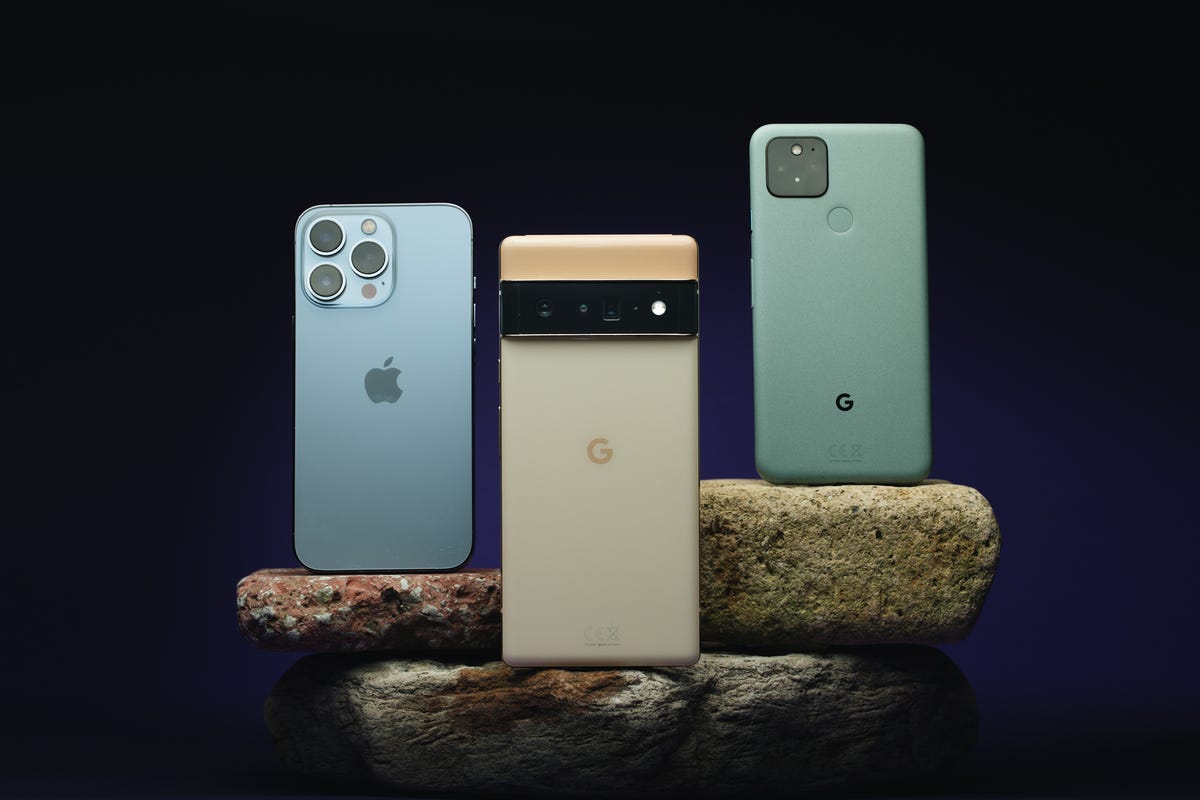
The Pixel 6 Pro, flanked by the iPhone 13 Pro (left) and Pixel 5.
Andrew Hoyle/CNET
It is IP68-rated for water resistance, meaning it can withstand being in 1 meter (about 3 feet) of water for up to 30 minutes. No, that doesn't mean you can take it swimming, but it does mean it should be able to shake off having the odd beer spilled over it by your clumsy mates.
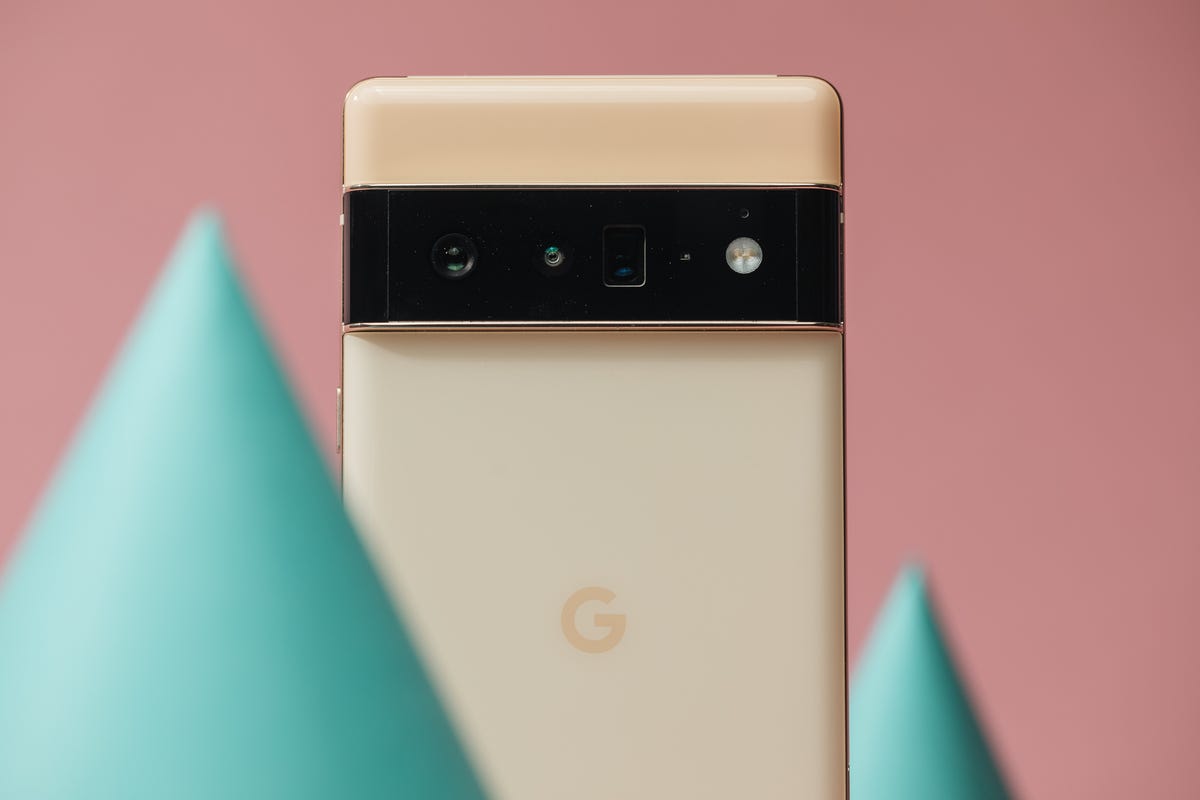
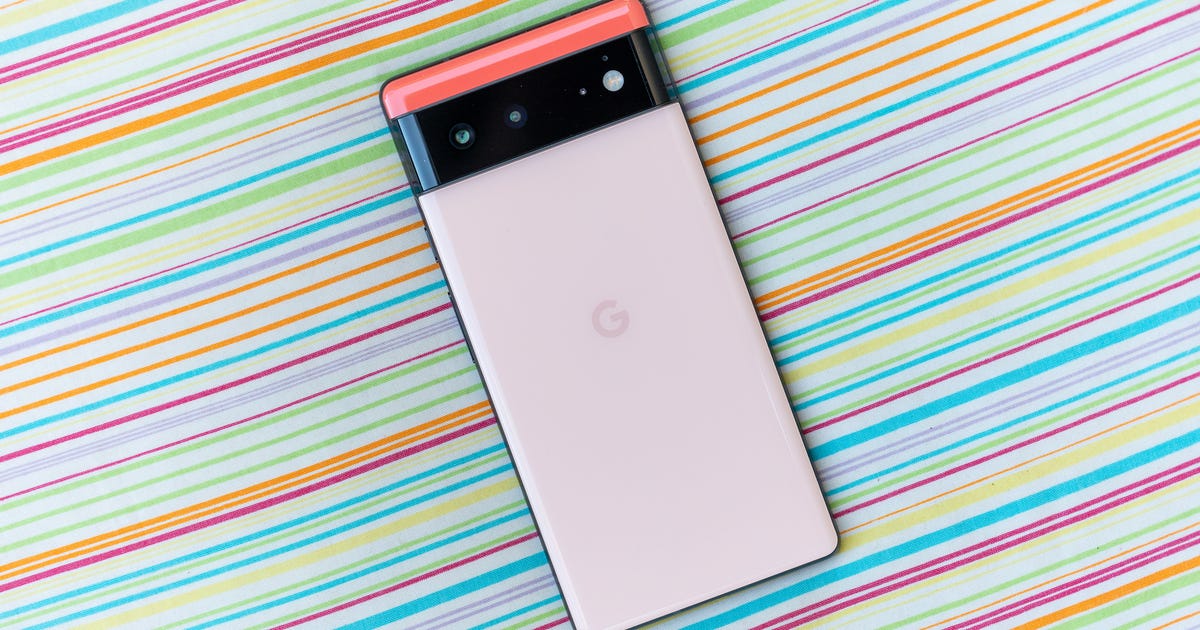
An interesting design choice is the large camera bar that stretches across the back. It protrudes from the phone by about 3mm, so it doesn't lie totally flat when you put it on a table, but nor does it rock from corner to corner like phones with camera bumps just on one side. I like the look of the phone and it certainly stands out. One tip though: Get the Sorta Sunny orangey-peachy color, if you can find it in stock. The black-and-gray option, Stormy Black, looks rather dull by comparison.
The camera strip protrudes from the phone by about 3mm. As a result, it won't lie flat on a table.
Andrew Hoyle/CNET
The rear-mounted fingerprint scanner seen on the Pixel 5 has been removed, replaced instead with an in-screen scanner, which I found worked accurately and quickly most of the time, although Patrick found the Pixel 6's scanner to be much more hit and miss in his review. There's no face unlock ability, which is a bit of a shame.
Three excellent cameras
That big bar on the back hides three cameras: a 12-megapixel ultrawide; a 48-megapixel telephoto that offers 4x optical zoom; and a main camera that uses a larger 1/1.3-inch sensor, which Google says captures 2.5x more light than the Pixel 5. The cameras on the Pixel phones have always been excellent, and this new generation is no different.
Images from the main camera lens are stunning. They're vibrant, they're packed with detail and there's an amazing balance of exposure, with bright skies kept under control and shadowy areas being easily visible.
Pixel 6 Pro, main camera.
Andrew Hoyle/CNET
The golden colors of the leaves have been captured beautifully here, with a rich blue sky visible behind.
iPhone 13 Pro, main camera.
Andrew Hoyle/CNET
And here's the same image taken on the iPhone 13 Pro. There's little to choose between them, but if I was being hypercritical, I'd say that the white balance on the Pixel 6 Pro has resulted in a warmer, more orange tone on the tree trunk, which I think looks better. You can see how the Pixel 6 Pro's camera really stacks up against the iPhone 13 Pro's in my photography shootout.
Pixel 6 Pro, main camera.
Andrew Hoyle/CNET
This scene looking towards the beautiful Edinburgh castle is a challenging shot, with dark shadows and an extremely bright sky beyond the trees. The Pixel 6 Pro has handled it well though, maintaining a lovely exposure overall.
Pixel 6 Pro, main camera.
Andrew Hoyle/CNET
And it's much the same here, with vivid blue skies, superb exposure and plenty of detail.
Pixel 6 Pro, ultrawide camera.
Andrew Hoyle/CNET
Switching to the ultrawide lens, the scene maintains the rich colors and exposure. Zoom closer in and it's clear it has less overall detail, but it's still a lovely shot.
Pixel 6 Pro, ultrawide camera.
Andrew Hoyle/CNET
Another from the Pixel 6 Pro's ultrawide lens. But check out the iPhone 13 Pro's:
iPhone 13 Pro, ultrawide lens.
Andrew Hoyle/CNET
The iPhone's offers a much wider view that lets you capture more in the scene. They're both excellent wide lenses and both do a great job in packing in those beautiful colors, but I'd like to have seen the Pixel offering a slightly wider scene.
The 4x zoom lens is amazing too, providing tons of detail thanks to its high resolution sensor. I think 4x is a great zoom level for a phone as well; it allows you to find compositions that would be beyond the reach of lesser zoom levels, but it's not quite as restrictive as the 10x zoom you'll find on the Galaxy S22 Ultra. It's a zoom level I feel I'd use a lot on my travels and have already taken a few 4x shots with the phone that I'm really pleased with as artistic images.
Pixel 6 Pro, 4x zoom.
Andrew Hoyle/CNET
This zoomed-in image is so pin-sharp I can actually read the headline on the newspaper. It's a really impressive lens that doesn't force you to make any kind of compromise on quality in order to achieve those zoom levels. By comparison, the iPhone 13 Pro's optical zoom maxes out at 3x, so the Pixel 6 Pro is able to achieve a closer-up image. Which, frankly, I'd take any day over a wider-angle view.
Pixel 6 Pro, 4x zoom.
Andrew Hoyle/CNET
It's handy as well for focusing your view on a smaller scene like this, capturing intimate little still-life scenes, rather than grand, sweeping vistas. The fine textures on the leaves here are extremely sharp.
Google has thrown some extra features in too, including a tool that automatically removes people from the background in an image, which sometimes works well, and sometimes leaves a big splotch where a person once stood. Then there's the long exposure mode, which allows you to create ethereal blurred waterscapes and the Nightscape mode, which does an excellent job of taking shots in the dark.
Pixel 6 pro, Nightscape photo.
Andrew Hoyle/CNET
I'm seriously impressed with the photography abilities of the Pixel 6 Pro and there's no question that it's among the best cameras you can get on a phone right now. Video quality is excellent as well, with superb dynamic range, excellent image stabilization and plenty of detail thanks to the 4K resolution.
Does Google's Tensor processor make a difference?
At the heart of the phone is Google's first home-baked processor, named Tensor. It's a significant move for Google to produce its own silicon and it shows a strong commitment to remain in the hardware game -- after all, you don't go to the effort of developing your own processors as a one-off experiment.
But it's essentially irrelevant once you get the Pixel in your hand, as it functions just like any other phone. It's nippy to navigate around the Android 12 interface, games like Asphalt 9: Legends and Call of Duty play perfectly, while photo editing and video streaming are handled exactly as well as you'd get from any other top-end phone right now.
Pixel 6 Pro benchmark tests
Google Pixel 6 Pro
Apple iPhone 13 Pro
Samsung Galaxy S21 Ultra
Legend:
Geekbench 5 (single core)
Geekbench 5 (multi core)
3DMark Wild Life Extreme
Note:
Longer bars equal better performance
On benchmark tests like the Geekbench 5 processor test and 3DMark's Wild Life Extreme graphics test, the Pixel 6 Pro doesn't score quite as highly as the iPhone 13 Pro, but it's up there with the Galaxy S21 Ultra (and it edged out the powerful OnePlus 9 Pro on the graphics test too). Benchmarks are by no means a direct indicator of real-life performance, but it's good to at least see that Google's new silicon is operating in the same ballpark as its rivals.
No, the Tensor chip is not setting a new standard for lightning-fast performance. But it doesn't need to; today's phones already pack way more power than any of us are likely to need on a daily basis. Google's push into chip production goes beyond simply creating a "benchmark beater" and a lot of the real benefits will come over time as the company develops more ways to take advantage of its own hardware.
The Tensor processor is particularly designed with machine learning, AI and speech-recognition applications in mind. There are already speech-recognition functions built into the keyboard (for dictating messages or emails) as well as real-time translation tools and improved visual language translations when using Google Lens via the camera.
Both the Pixel 6 and Pixel 6 Pro run the latest Android 12 software.
Andrew Hoyle/CNET
Android 12 is lovely to use
The Android 12 interface is extremely neat and easy to use. It's my favorite version of Android so far, offering an uncomplicated experience that even Android novices won't take long to get to grips with. One of the bigger features that's (for now) exclusive to the Pixel 6 and 6 Pro is the ability to create custom themes for the phone based on whatever image you have as your background.
When you choose a new wallpaper (either one of the many built-in ones, or any of your own images saved to your phone), the phone will automatically pick out the dominant color and will use that, and its complementary colors, to change the look of parts of the interface, including some of the default Google app icons on the home screen, such as the Play Store, Gmail and Photos. It's a nice idea, although it probably shouldn't be the main reason you decide to part with your cash.
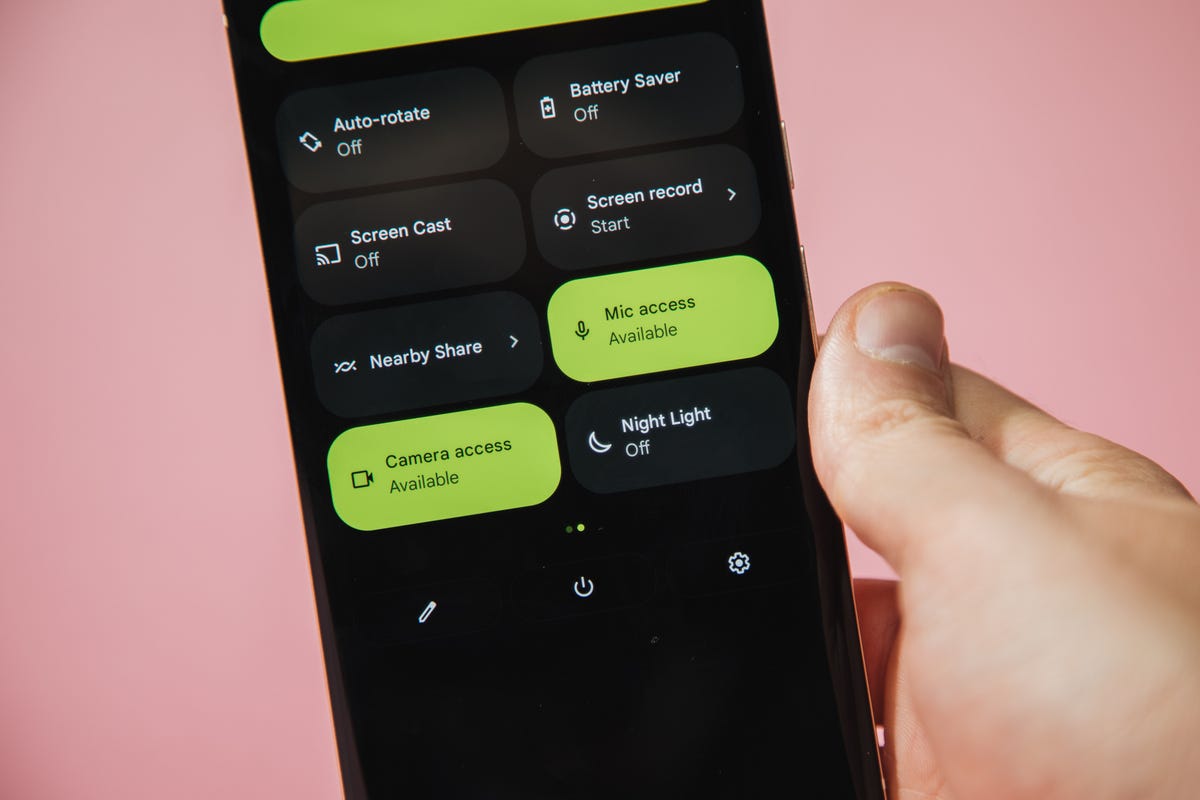
Security has been given a particular push both on the software and hardware side. The Tensor processor has a dedicated Titan coprocessor that apparently allows for much better on-device security, while Android 12 offers more granular control of your security and privacy settings. That includes a dashboard that shows what apps have used what information recently and handy buttons in the pull-down notification tray that turn off system-wide access to your camera and microphone.
Those quick-access privacy buttons might come in handy.
Andrew Hoyle/CNET
Google has also promised that the Pixel 6 and 6 Pro will receive security updates for five years, which will mean these phones will be safer to use for longer. Many older phones are still perfectly usable from a hardware standpoint, but if they don't have the latest security patches on board then they're susceptible to all kinds of hacking nastiness. From both a cost and environmental perspective, being able to use our phones safely for longer is only a good thing.
Vibrant display, solid battery life and fast charging
The Pixel 6 Pro's 6.7-inch display is pin-sharp thanks to its 3,120x1,440-pixel resolution. It's bright, too, with vibrant colors that do justice to colorful games like Candy Crush Soda Saga or video like Netflix's world-dominating show Squid Game. It has an adaptive refresh rate that can go up to 120Hz when you're playing fast-paced games, but also slows down to only 10Hz when the phone is basically sitting idle. Performance when you need it; power-saving when you don't.
The Pixel 6 Pro and perhaps its biggest rival, the iPhone 13 Pro.
Andrew Hoyle/CNET
The phone runs on a 5,003-mAh battery, which should be good for a full day of mixed use. After one hour of streaming a YouTube video at max brightness it had dropped from full to 98%. By contrast, the OnePlus 9 Pro had dropped to 90%, while the iPhone 13 Pro dropped to only 99%. After a further hour the 6 Pro had dropped to 89%, while the iPhone 13 Pro was at 93%. You certainly shouldn't struggle to get through the day with it, but as with all phones, you can help it by keeping screen brightness down, avoiding demanding tasks like gaming or video streaming until you're near a plug, and turning off GPS.
It has Qi wireless charging and it supports fast charging with a 30-watt charger (not supplied), which will take the phone to 50% full in 30 minutes. That's decent, but not really a match for OnePlus's 65-watt fast charging, which will fully charge the device in the same time. Still, it's fast enough to be able to give your phone a quick boost before you head out and about, and the Extreme Battery Saver mode pauses all but your essential apps to preserve the remaining juice.
Google Pixel 6 specs vs. Google Pixel 6 Pro, Google Pixel 5, Apple iPhone 13
HDR video recording with Dolby Vision up to 4K at 60fps
Processor
Google Tensor
Google Tensor
Qualcomm Snapdragon 765G
Apple A15 Bionic
Storage
128GB, 256GB
128GB, 256GB, 512GB
128GB
128GB, 256GB, 512GB
RAM
8GB
12GB
8GB
Undisclosed
Expandable storage
No
No
No
No
Battery
4,614 mAh
5,003 mAh
4,000 mAh
Undisclosed; Apple lists 19 hours of video playback
Fingerprint sensor
Under display
Under display
Rear
No (Face ID)
Connector
USB-C
USB-C
USB-C
Lightning
Headphone jack
No
No
No
No
Special features
5G sub 6 (some carrier models also have 5G mmWave) support, Wi-Fi 6E, 30W fast-charging, wireless charging, Magic Eraser, Motion mode, Real Tone, Face Unblur, Cinematic Pan, 5 years OS security updates, IP68 rating for dust and water resistance, Gorilla Glass Victus (front), Gorilla Glass 6 (back), dual-SIM capabilities (nano-SIM and e-SIM)
5G sub 6 and mmWave support, Wi-Fi 6E, ultra-wideband, 30W fast-charging, wireless charging, Magic Eraser, Motion mode, Real Tone, Face Unblur, Cinematic Pan, 5 years OS security updates, IP68 rating for dust- and water-resistance, Gorilla Glass Victus (front and back), dual-SIM capabilities (nano-SIM and e-SIM)
5G enabled; water-resistant (IP68); 90Hz-refresh-rate display; dual-SIM capabilities (nano-SIM and e-SIM); reverse wireless charging; fast charging
Nothing 1 mobile phone nothing phone hands on nothing phone 1 shop what is the nothing phone 1 nothing phone 1 official website nothing phone 1 official website nothing phone 1 release date
Nothing Phone 1 Hands-On: There's a Lot to Like, Including the Price
Nothing Phone 1 Hands-On: There's a Lot to Like, Including the Price
The Nothing Phone 1 launched with a lot of hype this week, but what exactly is it? Should you buy one? And, does it rival Apple's iPhone? I've been trying out the new phone and have found plenty to like, from its flashing LED "glyph" to its affordable price. My full thoughts on the phone are now in our Nothing Phone 1 review, but here I'll put together an all-around explainer about what Nothing and this phone actually are. While a lack of US availability at launch is disappointing, this phone is an interesting midrange model for those of you wanting a unique alternative to Apple, Samsung or Google phones.
Here, then, is what you need to know about this first phone from the tech startup Nothing, including its price, when you can buy it and, crucially, whether it's actually any good. You can also check out how the Nothing Phone 1 compares to the Pixel 6 and iPhone 13.
What is Nothing?
Nothing is a tech brand started in 2020 by entrepreneur Carl Pei. He was one of the founders of OnePlus, a company that offers phones and other devices and has been known for making solid products with good specs at prices that typically undercut its rivals Apple and Samsung.
It was exactly that philosophy that transformed OnePlus from a tiny, niche company to a top tech brand with products that offer serious competition to the best ones out there.
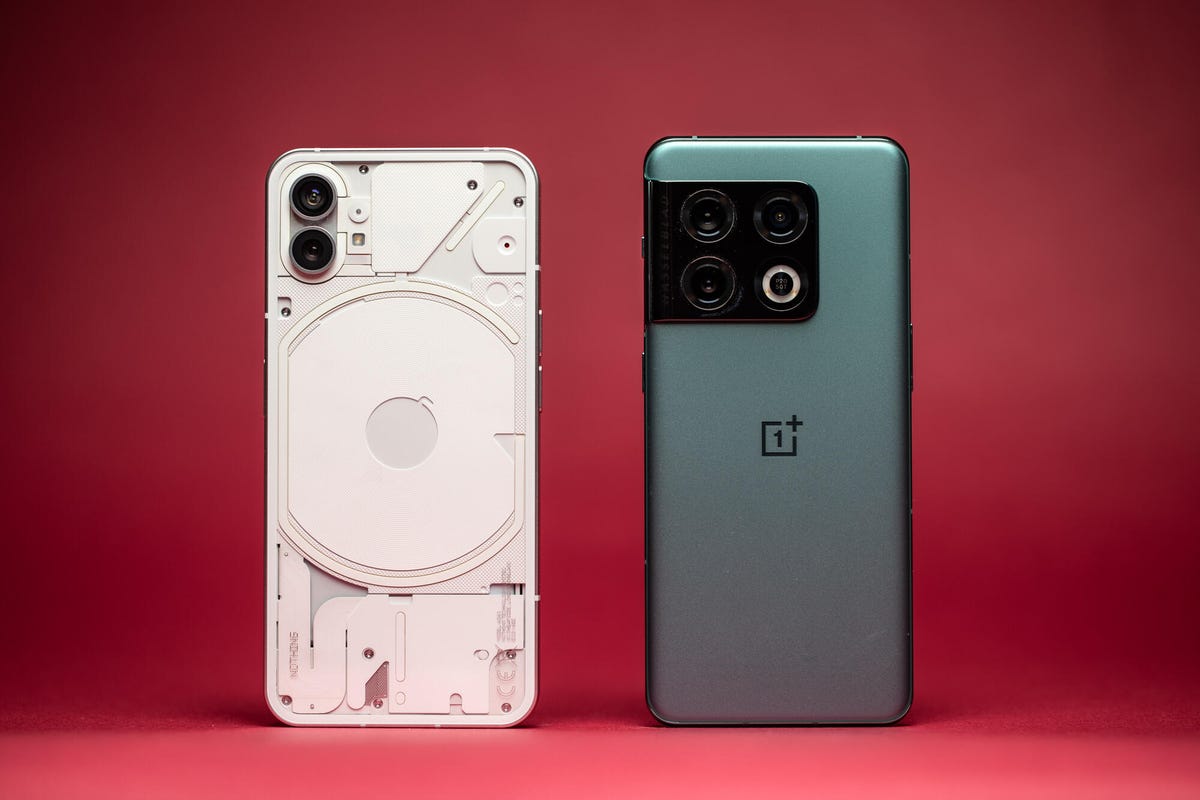
The Nothing Phone 1 (left) and the OnePlus 10 Pro.
Andrew Lanxon/CNET
Pei left OnePlus to start his new company, Nothing. While I can't say I'm much of a fan of the name, Pei's philosophy of trying to do things a little differently than rivals should make it an interesting brand to keep an eye on.
What's exciting about the Nothing Phone?
But who cares who's behind the company if the product itself doesn't have anything to shout about? Thankfully, the Nothing Phone 1 does have some neat features to look forward to.
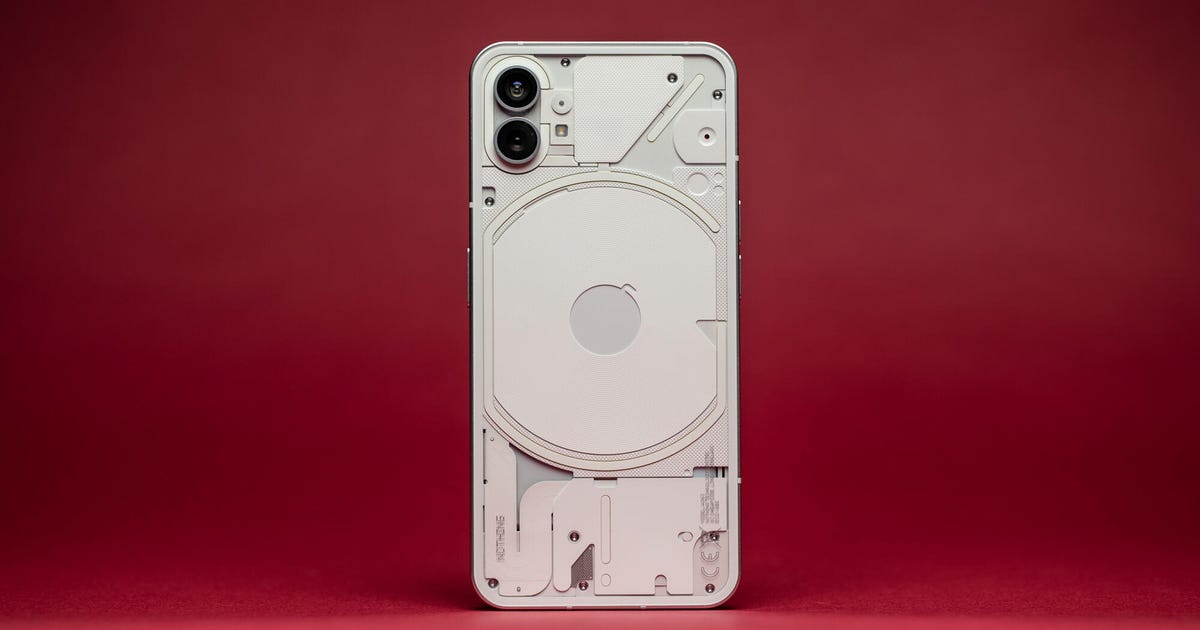
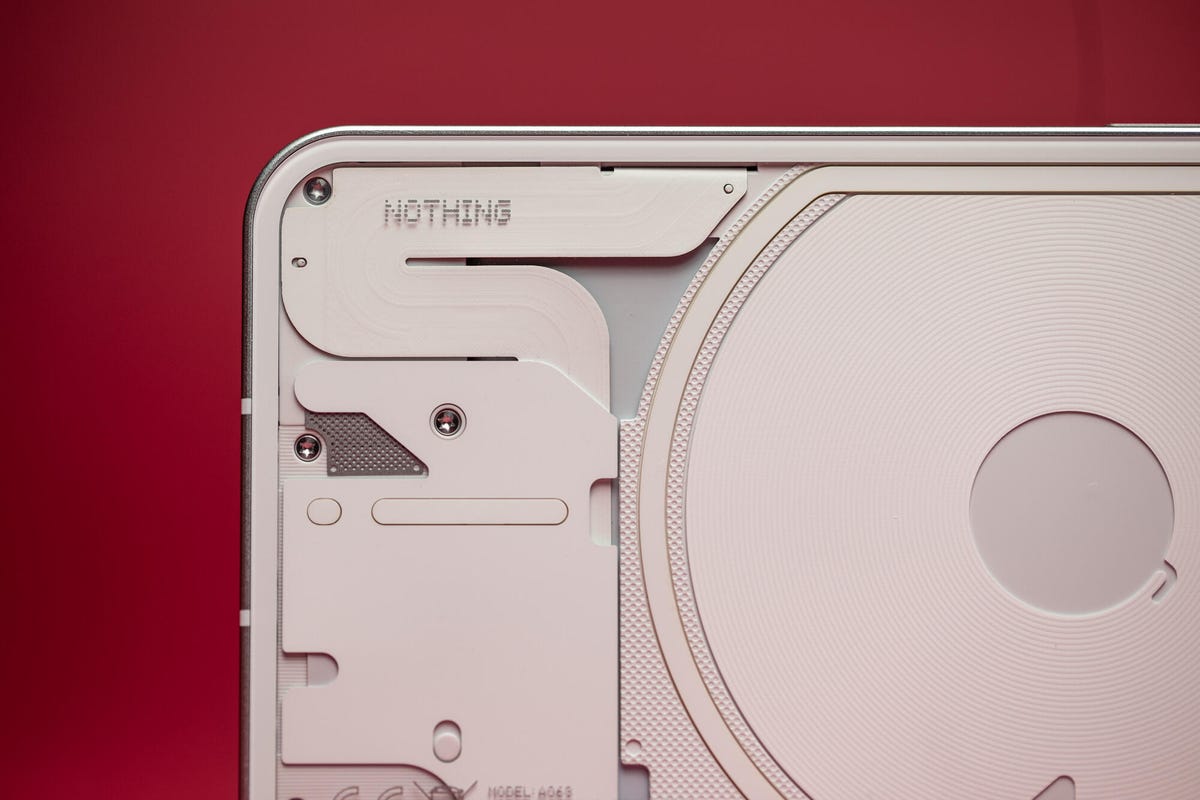
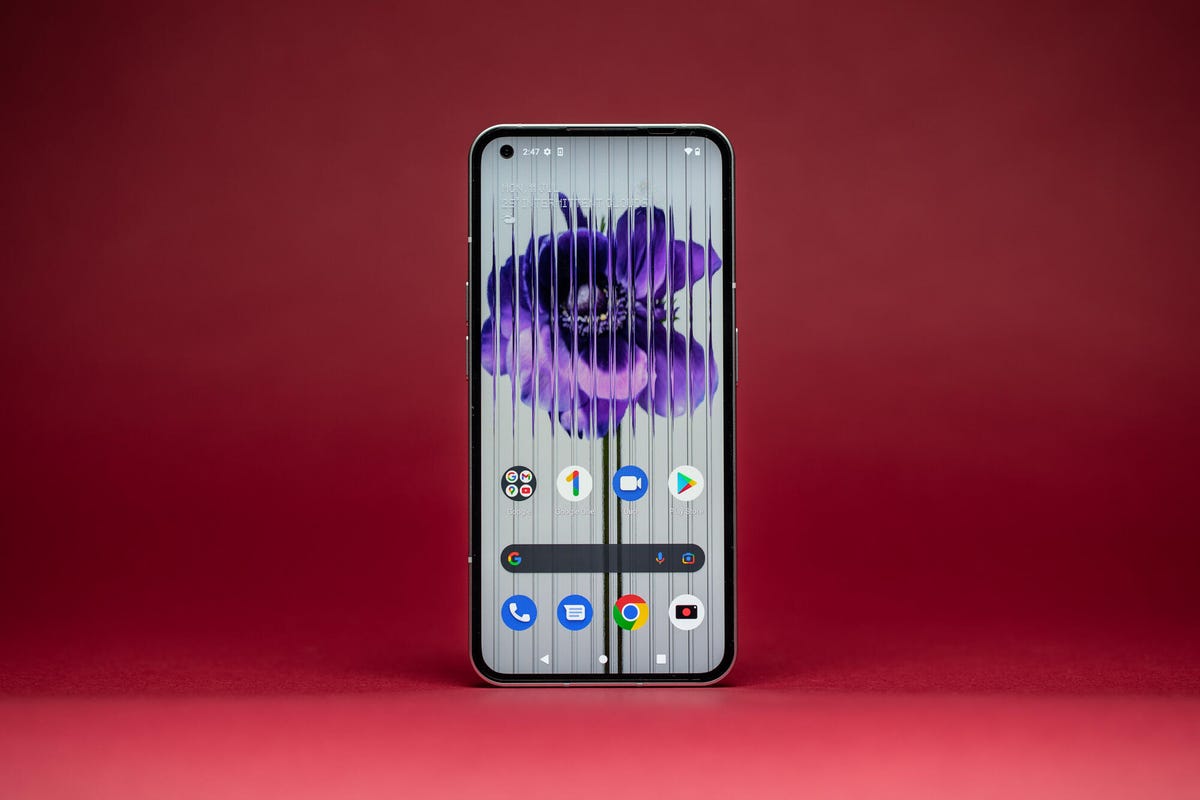
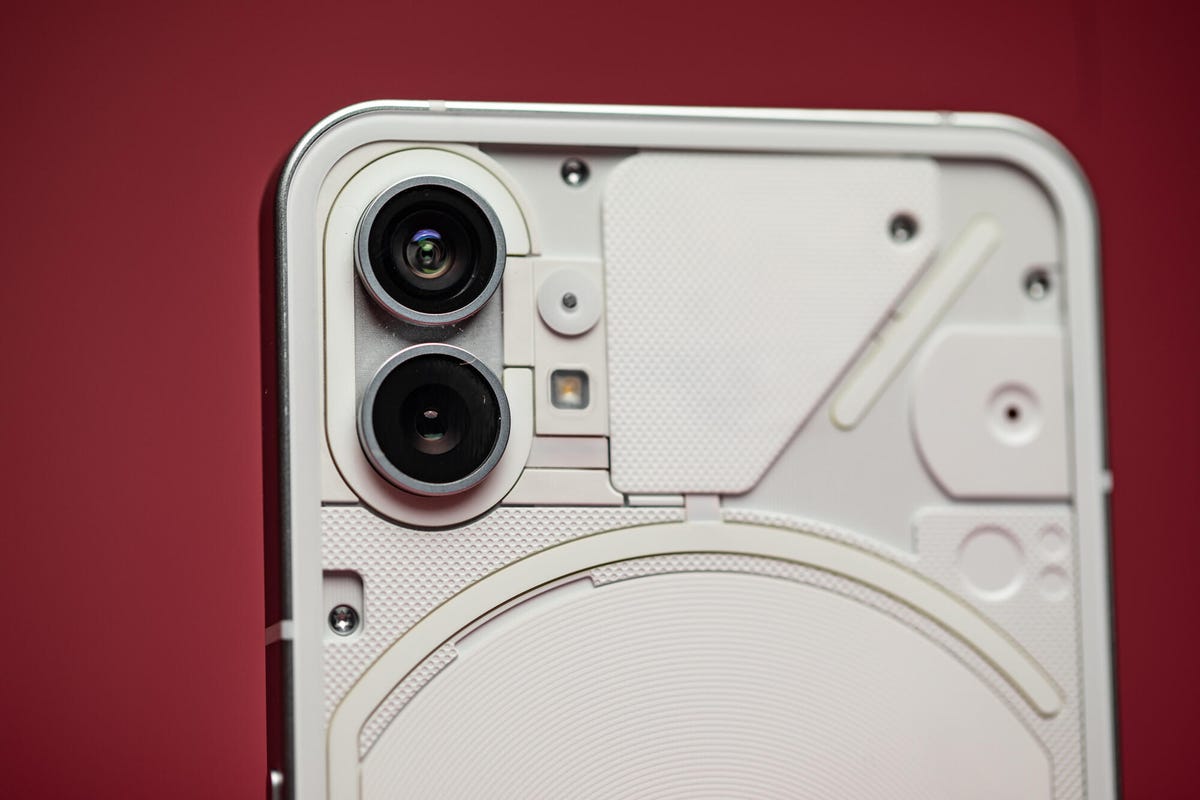
Its design is where it really stands out. The back has a clear cover that exposes the internals and makes it feel like you're looking into the heart of the phone. You can see where different pieces connect, you can see exposed screw heads and the only branding is the subtle Nothing logo and the little red dot, which is the signature of the brand.
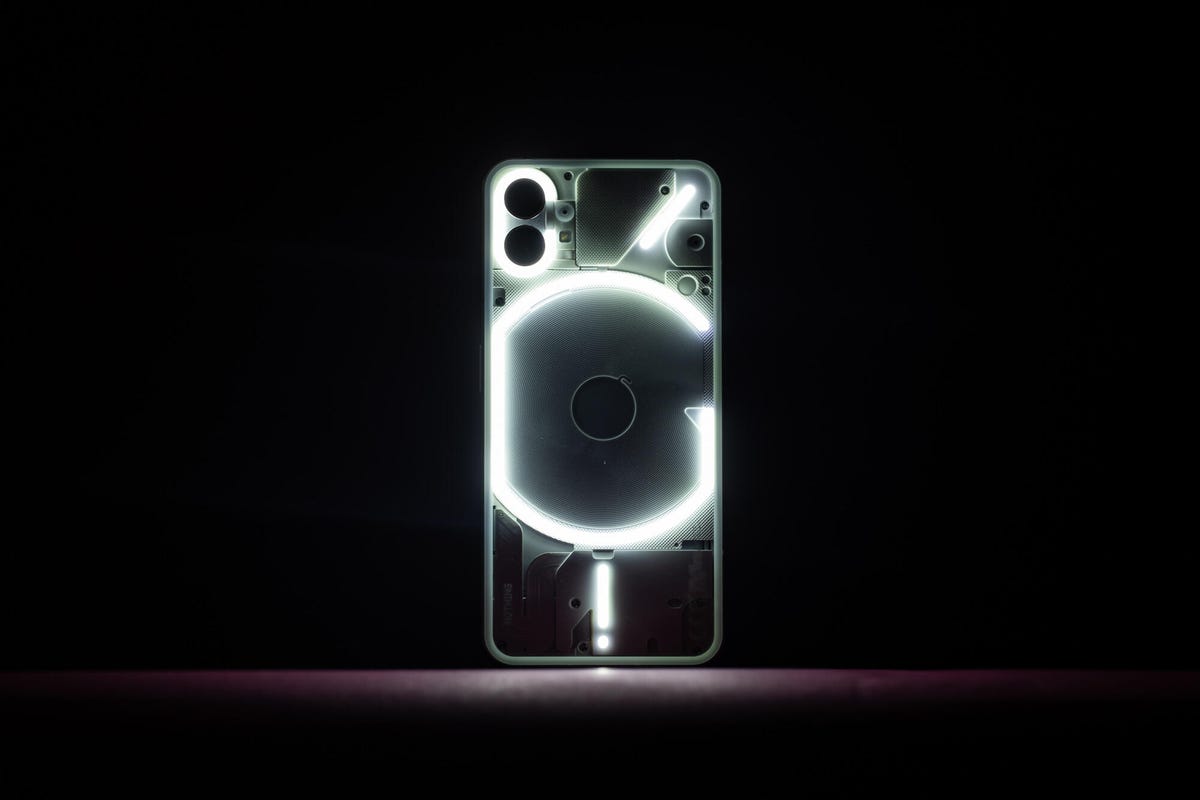
But it gets better. Some of those pieces seen beneath the cover are actually LEDs that light up in what Nothing calls a "glyph" when you get incoming notifications. This is arguably something of a novelty, but it's definitely quite a fun quirk of this phone.
The light-up "glyph" makes the phone stand out.
Andrew Lanxon/CNET
On the back you'll also find a dual camera setup with a standard and ultra-wide view. The phone is wrapped in a metal band that looks and feels nice, while the 6.55-inch OLED display is vibrant and sharp. The Qualcomm Snapdragon 778G+ processor should be more than capable of handling everyday needs while also giving you access to that superfast 5G network.
It's an Android phone at its heart, running the latest Android 12 over which Nothing has slapped a neat and clutter-free interface that doesn't preload any nonsense that could slow things down. Then there are features like in-screen fingerprint scanning, IP58 water resistance, a 120Hz screen refresh rate and fast charging -- all of which add up to this phone feeling surprisingly feature-packed for its price.
How much does the Nothing Phone 1 cost?
One of the most exciting things about this phone is its affordable price. It costs £399 in the UK. This puts it firmly in the lower-midrange price bracket, which to be honest came as a surprise when I first heard it. The specs seem really solid. And with such a focus on design, I expected a price of maybe a hundred more pounds. So you are getting a decent-performing phone for a good price. On paper, at least.
The see-through back looks cool, and there's only some very subtle Nothing branding to be seen.
Andrew Lanxon/CNET
US pricing isn't confirmed, which I'll come to, but that £399 price converts directly to $475 (or AU$700), which puts it around the same price as the 2022 iPhone SE ($429) or the upcoming, US-only Google Pixel 6A ($449).
When can I buy the Nothing Phone 1?
The phone launched Tuesday in the UK and Europe first. There isn't currently a firm plan on when it might get a proper US launch. It is likely to happen, though, perhaps once Nothing finds a carrier to partner with to help make its 5G bands compatible.
We will bring you US availability updates as soon as they happen.
The phone runs Android 12.
Andrew Lanxon/CNET
Is the phone the first Nothing product?
The Phone 1 is probably the most high-profile and most exciting product Nothing has launched, but its first product was a set of earbuds it launched last year called the Nothing Ear 1 buds. You can certainly tell they're from the same team. There's a definite aesthetic shared between the products, with the same transparent elements that show the inner workings.
Like the phone, the buds were launched with a more reasonable price but still offered pretty decent performance overall that made them well worth considering if you didn't fancy splashing out for Apple's earbuds. If you have the Nothing Buds and love the unusual look then you'll almost certainly appreciate the phone.
It has a dual camera setup with a standard and ultra-wide view.
Andrew Lanxon/CNET
Should I buy the Nothing Phone 1?
There's always going to be a lot of fanfare and PR spin and marketing nonsense around a new company. And certainly some of Nothing's rhetoric around "more soul," "brave simplicity" and a "new way to communicate" is arguably a little pretentious. But putting all of the company nonsense aside, the actual product itself seems pretty good.
It's got a solid set of specs and a stripped-back interface. While its design might not be to everyone's tastes, it certainly stands out from the crowd. Personally, I think it's quite cool.
But it's that affordable price that I think makes the phone so appealing. The Phone 1 isn't trying to compete with the iPhone 13 Pro or the Galaxy S22 Ultra. Instead, it aims to give a decent overall experience for a price that's much more approachable to those of us tightening our purse strings.
We're testing the phone right now for the full review, putting its processor, camera and other features through their paces to see just how well it performs against the competition and whether it's really worth your money.
Unlocked Pixel 6 Sees $100 Discount Ahead of Official Prime Day Deals
Unlocked Pixel 6 Sees $100 Discount Ahead of Official Prime Day Deals
This story is part of Amazon Prime Day, CNET's guide to everything you need to know and how to find the best deals.
The Google Pixel 6 is a budget-friendly smartphone option that doesn't skimp on function just because it comes at a decent price. It has a lot of great features, including a powerful camera, a large display and a long-lasting battery. Plus, it runs the latest version of Android -- and will for at least five years, Google promises -- making it a great choice for anyone looking to upgrade their current device.
With a starting price of $499, Amazon has some major deals on Google's Pixel 6 ahead of Prime Day, which will kick off July 12. If you want to get your hands on one of the best Android phones money can buy, snag a Pixel 6 while they are on sale for $100 less than the list price.
Two sizes and colors are available as part of this deal, with the 128GB version going for $499 and the 256GB model for $599. In terms of design, power, features and performance, this phone is a vast improvement over the Pixel 5.
"This is the Pixel phone I always wanted from Google," CNET's Patrick Holland wrote in his Pixel 6 review in November. "The Pixel 6 exemplifies the best of what Google services and Android 12 have to offer."
Its 6.4-inch display is made of tough Corning Gorilla Glass Victus, which will keep your phone well protected. It's also IP68-rated to protect against water and dust. Plus there's new and improved camera hardware, including a 50-megapixel wide rear camera that captures 150% more light than its predecessor.
Google's own processor, the Tensor chip, gives great performance and a long battery life that adapts to you and saves power for the apps you use the most while you're on the go. And when you use a Google 30-watt USB-C charger plugged into a wall socket, you can take advantage of fast charging.
Another cool feature that Tensor enables is Live Translate, which helps you translate video captions, private chats and messages and more in up to 55 languages right on your phone without the need for any apps or even internet access.
And each phone in this sale is unlocked, meaning you can choose the data plan and carrier that work for you.
Galaxy note 20 here s who should buy a hybrid galaxy note 20 here s who should buy the engagement galaxy note 20 here s who should buy umbrella galaxy note 20 here s who s hiring as millions of americans galaxy note 20 here s my number call me maybe galaxy note 20 here s mud in your eye origin galaxy note 20 release date galaxy note 20 specs galaxy note 20 price
Galaxy Note 20: Here's who should buy it and who should upgrade to the Ultra
Galaxy Note 20: Here's who should buy it and who should upgrade to the Ultra
Samsung has a knack for turning out powerful phones, especially in its Galaxy Note line. This year, it has two, the standard Galaxy Note 20 5G, which launched at $1,000 (£849, AU$1,499, both 4G) and the Note 20 Ultra, which launched at $1,300 (£1,179, AU$1,849, again both 4G). Both have sharp displays, excellent cameras, all-day battery life and impressive internal performance, along with an S Pen stylus that makes the Note unique. But you can only buy one, so which will it be?
This Galaxy Note 20 review focuses on the differences between 2020's Note phones in the hopes it'll help answer your questions while you make a decision -- or just drool over Samsung's large-screen devices. On the whole, I can recommend both Notes, just not at their retail prices.
I suggest keeping an eye out for deals, bundled offers, discounts and trade-in values that bring the prices down by $300 or more. Both phones will have fluctuating prices throughout the holiday season -- check out CNET's guide to the best Black Friday phone deals. Samsung prices tend to fall as the months go on, so your chance of snagging a deal are high. Plus, a surprise recommendation at the end if you're not sold on using the S Pen stylus daily.
Design differences matter: Screen, plastic vs. glass
The Galaxy Note 20 and Note 20 Ultra clearly look like different devices, but not just because of the Note 20's slightly smaller 6.7-inch screen to the Note 20 Ultra's 6.9-inch display.
It's apparent that the Ultra has a glass backing (Gorilla Glass Victus, in fact,) while the Note 20 uses polycarbonate (that's plastic). If you use a case, it might not make a difference to you, but after all these years of being conditioned to equate a premium, $1,000 device with glass construction, plastic makes it feel cheaper than its price tag, even though the specs are strong.
I also noticed a sharp edge where the Note 20's plastic backing joins the metal frame, meeting in a gap big enough to run my fingernail all the way around. If you're going to use a case, it might not bother you, but Samsung can and should do better.
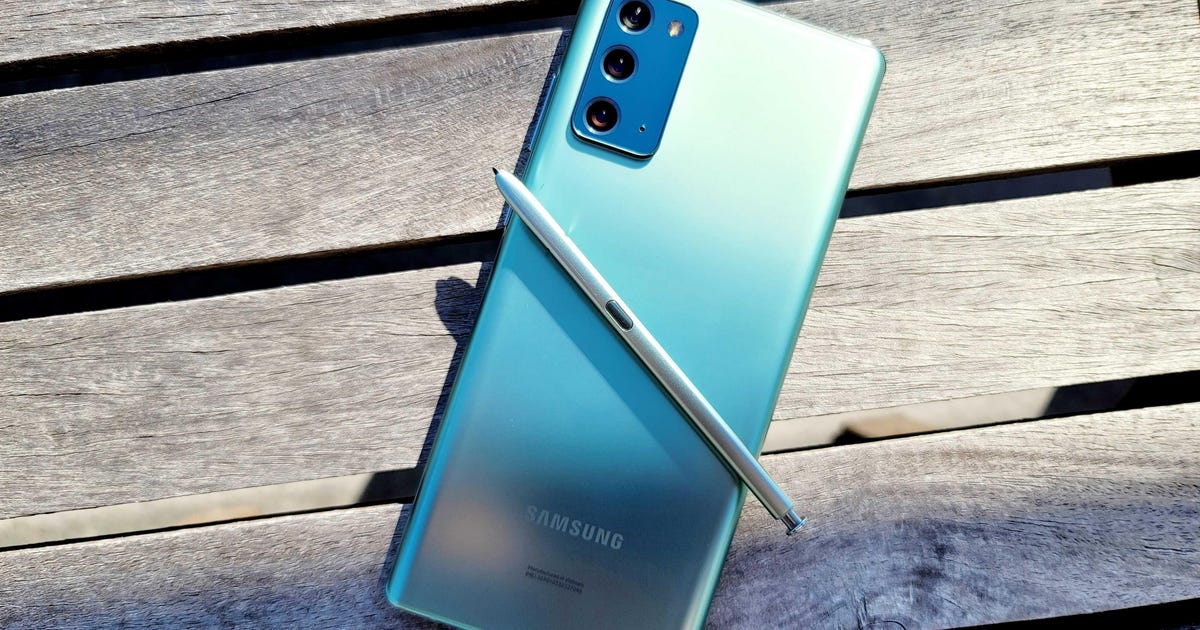
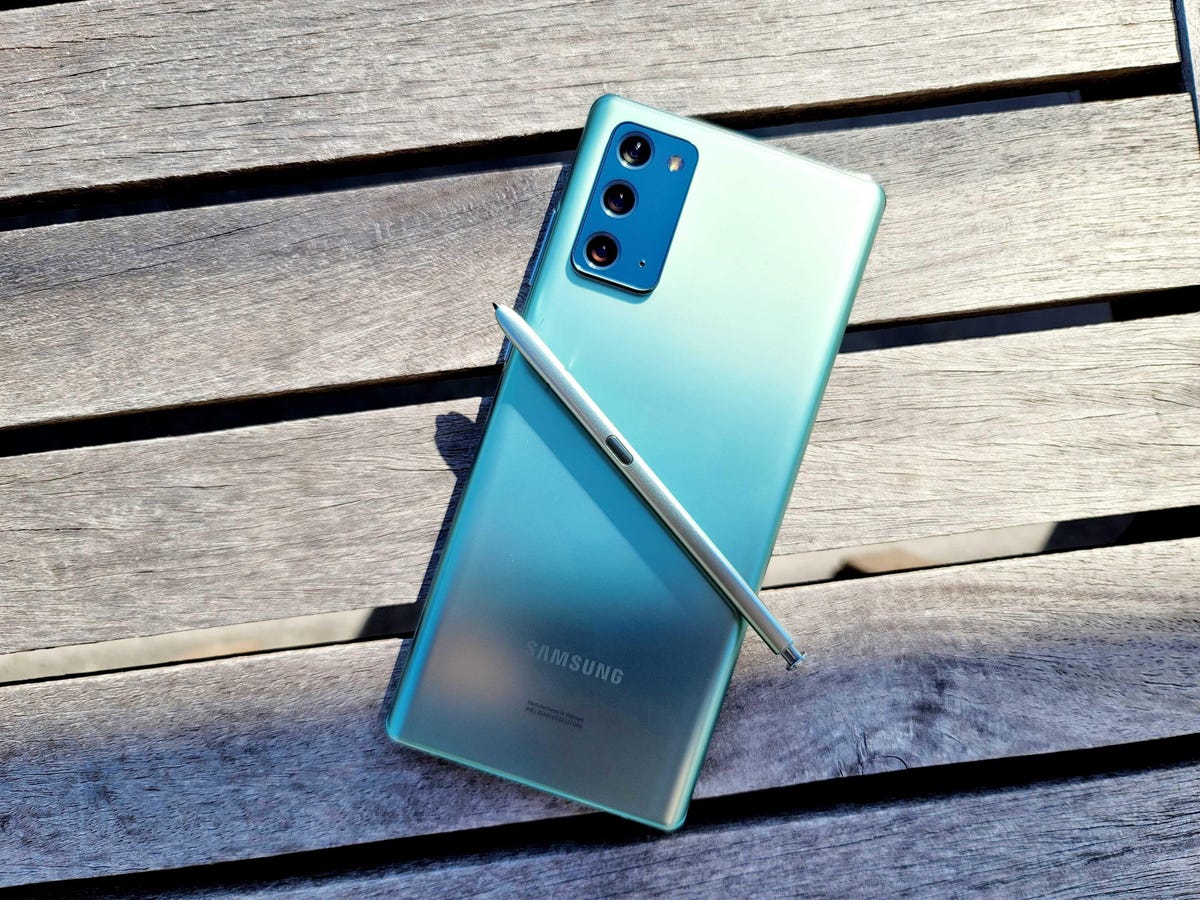
Samsung's Galaxy Note 20 in mystic green.
Jessica Dolcourt/CNET
There's no curved screen on the Note 20 the way there is on the Ultra. That doesn't bother me, but the edge-to-edge display on both phones means there are still plenty of accidental screen presses when you're simply holding the phone. For example, if you're passively watching a video and shift your finger to find a more comfortable grip, you may wind up inadvertently triggering a button.
The final design difference worth noting is the 120Hz screen refresh rate on Ultra, compared to the standard 60Hz rate on the Note 20. It won't make a difference if you're switching from a 60Hz phone, but it can feel comparatively "slow" if you're switching from a phone with a 90Hz or 120Hz display.
The Galaxy Note 20, left, has a plastic back, compared to the Note 20 Ultra, right, which has a glass back.
John Kim/CNET
The Note 20 Ultra is the clear camera winner
The Ultra's has a massive and protruding camera array on its back to accommodate larger sensors and perhaps help it stand out. Meanwhile, the Note 20's camera bump makes the phone less top-heavy and prone to rocking when you write on it while it's on a flat surface.
But the Note 20 Ultra took better photos overall. You're going to get great great shots no matter which phone you use, when you're taking photos in brightly lit conditions: saturated color, crisp edges, the works. But if you're at all interested in zoom photography, the Ultra's 5x optical zoom takes the crown. Not only does it get you very good telephoto images up to 5x, it can also go up to 50x.
This cute harbor seal was photographed at 30x on the standard Note 20.
Jessica Dolcourt/CNET
Same seal, shot on Galaxy Note 20 Ultra at 50x zoom.
Jessica Dolcourt/CNET
The Note 20's 3x optical to 30x AI-assisted zoom is still good as well, and better than the Galaxy Z Fold 2 (which has 2x optical zoom), but image quality at 30x was better on the Ultra than on the regular Note 20. Most of the time the Note 20 will fulfill your photographic needs. But when I took them both to the moody Northern California coast, many of my nature shots were simply better on the Ultra and I stopped reaching for the note 20 altogether.
The Ultra has a 108-megapixel camera you can use to crop into shots for more detail, a feature I've found to have uneven results.
Snapdragon 865+ processor (other markets use a Samsung Exynos chip)
Extras like fast wireless charging
Other notable differences
Screen size, battery (4,300 vs. 4,500)
MicroSD card
512GB option with Ultra
8GB RAM versus 12GB RAM on Ultra
Should you buy the Note 20, Note 20 Ultra, or a different phone?
The Note 20 Ultra is too big, too heavy and too expensive. But I'd still personally buy it over the Note 20 because I do find myself using the extra camera features. However, I don't actually think it's worth $300 more than the Note 20 just to have a 120Hz screen, 5x optical zoom instead of 3x, a glass backing and a microSD card storage option -- plus all the other extras.
Most people will be happier with the cheaper Note 20 over the Ultra, but again, I think Samsung has overcharged for both phones at their full retail price, and I find the Note 20's $1,000 price tag for what is essentially a plastic phone cheeky at best and insulting at worst.
For either phone, look for a deal. I'd be happier to pay $1,000 for the Ultra and $700 for the standard Note 20, if we're keeping Samsung's $300 price delta intact.
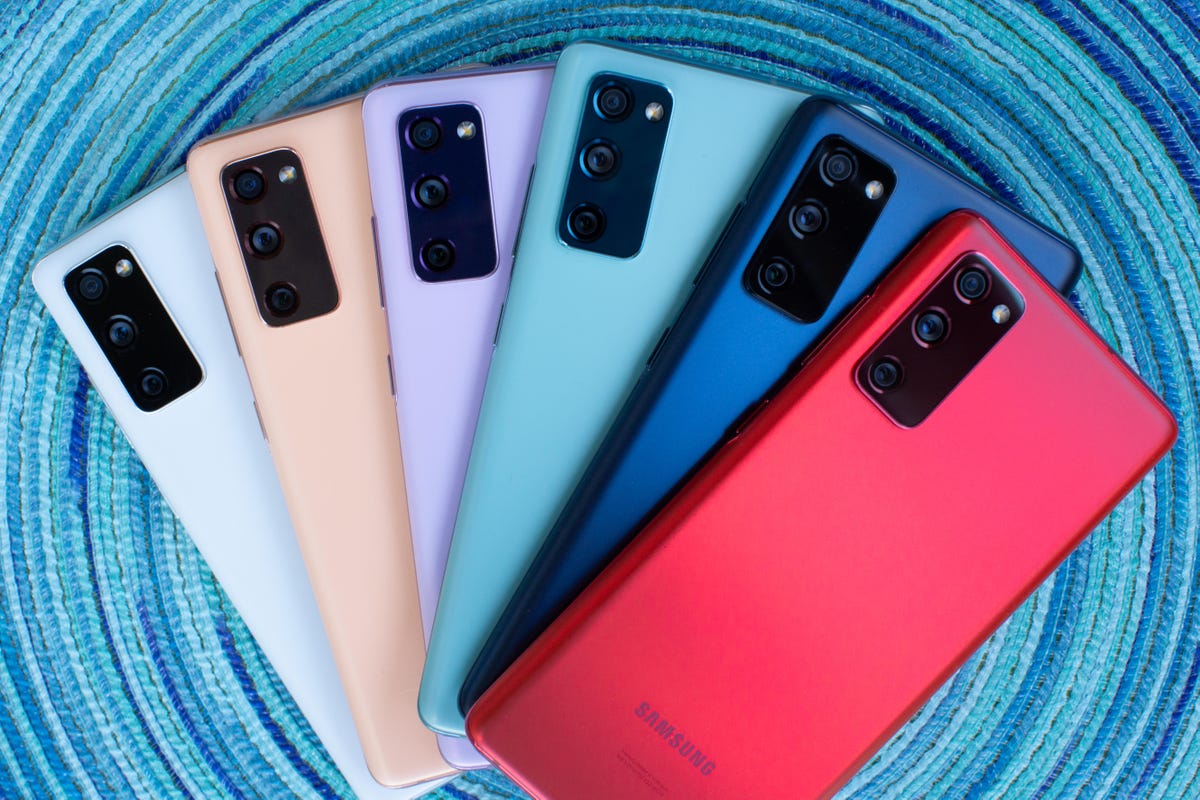
The Galaxy S20 FE comes in a range of colors.
Angela Lang/CNET
Here's another alternative within the Samsung cosmos. The newer Galaxy S20 FE (Fan Edition) is a middle way. It merges some of the Ultra's best features with the Note 20's cost-cutting trade-offs, bringing you a 6.5-inch display with a fast 120Hz refresh rate, a big 4,500-mAh battery, 3x optical zoom and a rear plastic backing. There's expandable storage, too, and of course, support for 5G data speeds.
While the cameras won't be quite as good, and there's no S Pen stylus, the Galaxy S20 FE is the best buy in terms of value, if not a status symbol -- though it does come in fun colors.
Best yet, it starts at $700 full retail and was already on sale for $600 in some stores by the time it hit the market. With trade-in values and seasonal deals, I expect that price to fall.