Here is one of the pictures featuring the See How They Run. Numerous images associated with the See How They Run can be utilized as your point of reference. Below, you'll find some additional pictures related to the See How They Run.
The personal computer industry backed a promising candidate in the ultrabook concept, convincing even a skeptic like myself that a new class of superslim, superlight laptops was the key to exciting consumers. Ultrabooks were well on their way to becoming the PC form factor of the future.
And now, it's already over.
In record time -- something less than six months -- the ultrabook term has become so overused and amorphous that it's well on its way to being useless.
Liberal terminology The first major examples of this new ultrabook rift are two laptops we recently reviewed. The HP Envy 14 Spectreand the Samsung Series 5 Ultra are both 14-inch laptops pitched as ultrabooks. The idea of bringing the ultrabook concept to larger laptops is a reasonable one -- the initial wave of ultrabooks were all 13-inch systems -- but they need to be nearly as thin and lightweight as the 13-inch models.
Instead, both the HP Spectre and Samsung Series 5 Ultra weigh a hair under 4 pounds, about a full pound more than a 13-inch MacBook Air. Both are also about one-tenth of an inch thicker. That may not sound like much, but when less than an inch is your baseline, it makes a noticeable difference in the feel of the laptop in your hand.
The biggest deviation from the ultrabook model to date is the 14-inch Samsung's use of a standard 500GB platter hard drive. The ultrabook platform is supposed to be built around faster, lighter solid-state drives (SSDs), and Samsung includes a tiny 16GB SSD as a secondary drive, which allows it to meet the letter, if not the spirit, of the ultrabook specifications. This system also includes an optical drive, which is another difference from previous ultrabooks.
It's relatively thin and light, but should it be an ultrabook? CNET
What you end up with, especially in the case of the Series 5 Ultra, is a perfectly fine midsize, mainstream laptop that can stand toe to toe with anything similar in the $850-$950 range. If we had seen it eight months or a year ago, our initial impression would be, "Wow, that's a pretty thin 14-inch laptop."
But today, there's absolutely nothing about it that says "ultrabook," which is bad news for this promising new category.
The origins of ultrabook So, what is an ultrabook supposed to be, anyway?
Seeing the success of Apple's MacBook Air, Intel and PC manufacturers wanted to find a way to replicate it for Windows-based consumers in systems that could be sold at a reasonable price. The idea was pitched as an entirely new laptop category, although the name "Ultrabook" was a trademarked Intel marketing term, and the systems that were going to use it had to meet a series of Intel-set system requirements.
In fact, Intel even set aside $300 million to help PC makers develop these new systems, saying in August 2011 that it would "invest in companies building hardware and software technologies focused on enhancing how people interact with Ultrabooks such as through sensors and touch, achieving all-day usage through longer battery life, enabling innovative physical designs, and improved storage capacity."
The $799 Toshiba Z835. CNET
From that original big idea, and the subsequent challenge Intel presented to PC makers, came the first generation of laptops to use the ultrabook name. These systems, from companies such as Acer, Lenovo, Toshiba, and Asus, came off very well in our initial reviews and we were surprisingly impressed with the platform, especially as prices declined, offering buyers systems with 128GB SSD drives for as little as $799.
Ultrabooks 2012: From noteworthy to no big deal But a few months ago, at CES 2012, I warned that the road ahead looked foggy, saying: "The ultrabook is in danger of being oversold by both Intel and industry watchers overeager to get behind the Next Big Thing."
And that seems to be exactly what is happening here. The ultrabook idea was a hit. It even seemed to have high name recognition with CNET readers, who would e-mail us with specific questions about which ultrabook they should buy. Now, everyone's rushing to join the bandwagon and the bigger 14- and even 15-inch ultrabooks hitting stores feel like they dilute the concept far too much.
For an example of this kind of branding done right, think back to the early days of wireless networks, when Intel's Centrino name meant that a laptop was able to connect to Wi-Fi and do most of the other networking things you needed it to, without you having to delve too deeply into the spec sheet.
In this case, instead of looking for an Intel ultrabook sticker on a laptop and knowing that it's going to be very thin, very light, rely on SSD storage, boot quickly, and run for a long time on a battery charge, now consumers will have to go back to checking the size and weight specs carefully.
How is that helpful for anybody?
Expect to see more laptops that look like this. CNET
The ultrabook is dead; long live the new laptop order But the ultrabook, as originally presented, is still an idea whose time has come. Apple's MacBook Air proved that consumers could live without optical drives and large-capacity hard drives, and valued long battery life and portability over ports and connections (in that sense, systems such as the Dell Adamo were ahead of their time). Also, ultrabook branding is certainly not going away anytime soon, and we'll all see dozens of new ultrathin laptops both with the ultrabook label and without during the rest of 2012.
The real long-term victory is that the ultrabook is rewriting what it means to be a mainstream laptop. By this time next year, I find it hard to believe that any midprice, midsize laptop won't be well under 1 inch, and closer to 3 pounds than 4 or 5. Optical drives will continue to fade away, as will dedicated Ethernet jacks (although I'm still convinced you'll eventually need one in a pinch). If you're a PC maker and most of your future laptops aren't at least trending toward ultrabooks and the MacBook Air, you simply won't be in the game.
So, yeah: I'm no longer sure what "ultrabook" means anymore. But if most future laptops are going to be thinner, lighter, and faster -- whether or not they get an Intel-approved sticker -- maybe that's not such a bad thing.
Parenthood can be exciting and overwhelming, especially when it's your first child. It's a time filled with questions and frantic Google searches about what's best for your baby. Don't worry -- that's completely normal.
Making sure your baby is eating is one of the most important tasks you have. So you may be wondering how many bottles you need to buy and keep on hand. The exact number depends on several factors, including your baby's age and whether you are breastfeeding. Here's what to consider when shopping for bottles and what types of bottles are available.
Taiyou Nomachi/Getty images
How many bottles do I need for a single day?
Every baby is different. How many bottles you need each day will depend on factors like your baby's age and whether you are breast-feeding, using formula or a combination of the two. There is no specific recommended number of bottles you need to buy to achieve peak feeding. But you should consider how often your baby eats and especially how often you want to clean the bottles.
You can expect to feed your newborn baby every two to three hours. They may need to eat more frequently if you are breastfeeding because breast milk is digested faster than formula.
We've rounded up the standard recommendations for how many baby bottles you need based on your baby's age and feeding habits.
Read more: Baby Registry Checklist: 10 Baby Products I Wish I'd Asked For
One to four baby bottles
If you are home and breastfeeding your baby, you won't need as many bottles. You'll likely only need to have one to four bottles ready to use per day. Of course, you'll want to have a few bottles on hand if you need to step out to run an errand. You can also consider having a few bottles around if you prefer to bottle feed your baby in public or if your partner wants to take part in feedings.
Bottles become less important as your baby gets older. You'll need fewer bottles if your baby is past the six-month mark and beginning to supplement with solid foods. In this case, experts recommend feeding them formula or breastmilk from a cup instead of a bottle.
Three to six baby bottles
It's common for babies to feed five to six times per day in the two-month to five-month age range. If you are doing a combination of breastfeeding and bottle feeding, your will likely need fewer than six bottles a day. Consider how often you need to clean the bottles. If you don't want to worry about cleaning the bottles every time your baby needs to eat, you can buy a few more.
Six or more baby bottles
Within the first month, newborns need six to eight feedings per day of around two to four ounces of milk. As your baby grows into their second month, how often you are feeding them may decrease because they are eating more at one time.
If you are also breastfeeding your baby, they will likely need fewer than six to eight bottles per day during that first month. However, if you're a working mom or will be away from your baby for periods of time, it's best to have more bottles on hand. You want to have enough to cover the entire time you're away.
Read more: Still Sterilizing Your Baby Bottles? You Might be Wasting Your Time
Jamie Grill/Getty
How to find your ideal baby bottle
Now you have an idea of how many bottles you need, so let's talk about which bottles are best for your situation. There are a few factors to consider when choosing bottles for your little one. It comes down to the types of baby bottles and the materials used to manufacture them.
Types of bottles
There are several bottle types to consider. Each comes with pros, cons and specializations. Some parents choose to keep a variety on hand to fit different needs.
Standard bottles
Standard baby bottles are basically what comes to mind when you picture a baby bottle. They are the most common bottles you see at stores and are typically what parents use for everyday needs. With a standard baby bottle, you don't get any bells and whistles. They are dependable and offer the most standard fits for teats and accessories. Standard baby bottles are generally the most affordable option.
Anti-colic bottles
Sometimes, babies swallow air when using standard bottles, leading to painful gas and indigestion. This can cause your baby to have prolonged fits of crying, also known as colic. Colic is most common during the first six weeks and will usually go away on its own. Anti-colic bottles are designed to help prevent your baby from swallowing air while they eat. This type of bottle is typically more expensive than standard bottles and is more difficult to clean. However, if you've noticed your baby tends to swallow air, it's worth it.
Self-sterilizing bottles
Self-sterilizing bottles are designed to be quickly and easily sterilized in the microwave. You'll fill a small portion of the bottle's base with water and place the bottle's parts on top. Then, you place it in the microwave for a few minutes to steam sterilize.
Disposable bottles
These single-use bottles come ready to use and are relatively inexpensive. But using them frequently can quickly become more expensive than feeding your baby with reusable bottles. They also aren't eco-friendly.
Catherine Delahaye/Getty
Baby bottle materials
There are a few different materials commonly used in the production of baby bottles. Plastic, glass, silicone, and stainless steel are most common within the US. Each material comes with its benefits, downsides and price points. While some materials may be better for some circumstances, the final selection may be a matter of preference.
Plastic bottles
Plastic bottles have traditionally been the most common, though there are some issues to consider. In the past, plastic baby bottles had the industrial chemical Bisphenol A (BPA) in them. In 2012, the US Food and Drug Administration banned the plasticizer BPA from baby bottles due to health concerns. However, some chemicals that are still allowed in plastic bottles may make you uncomfortable about using them. Despite potential health concerns, plastic does offer an inexpensive and durable option. If you decide to go with plastic bottles, avoid ones with BPA, BPS, Phthalates and PVC.
Glass bottles
Glass bottles don't have the risk of chemicals that plastic bottles do. They are also easy to sanitize and can withstand high temperatures. The downside of glass bottles is that they are more expensive and can break. They may also be too heavy for your baby, who may try to grab the bottle while eating.
Silicone bottles
Food-grade silicone bottles are a favorite among parents since they are shatter-proof like plastic but don't run the same risk of harmful chemicals. If you've decided that you want silicone bottles for your baby, ensure the product is made with food- or medical-grade silicone. Note that silicone bottles are generally more expensive than plastic and glass bottles.
Stainless steel bottles
Stainless steel bottles are often more expensive, but they come with upsides others don't have. For instance, stainless steel bottles withstand high temperatures, are lightweight and easy to hold and won't shatter. The main downside of stainless steel bottles is the cost and there is the risk of them containing lead. To ensure that your baby bottle is lead-free, purchase #304 or 18/8 food-grade stainless steel.
Read more: Should You Sterilize Your Baby Bottles? Here's When and How to Do So
Other considerations
There are other decisions that go into buying baby bottles. There are various accessories and components: nipples, venting systems, breast pump attachments and so on. You need to make sure they all can work together. Unfortunately, products aren't universally compatible, so do your research before you shop.
Different bottles also have various widths of the neck, which can impact how easy it is to clean and will determine which nipples will fit. Beyond that, it's best to ensure you choose bottle types and materials that are you are comfortable with.
The information contained in this article is for educational and informational purposes only and is not intended as health or medical advice. Always consult a physician or other qualified health provider regarding any questions you may have about a medical condition or health objectives.
Samsung problems and solutions samsung something went wrong why is samsung so bad samsung phone problems and solutions samsung company problems and solutions samsung major successes and failures samsung store samsung stock
Samsung's mistake -- and CNET's reaction -- inspired me to work here
Samsung's mistake -- and CNET's reaction -- inspired me to work here
This story is part of CNET at 25, celebrating a quarter century of industry tech and our role in telling you its story.
I knew I wanted to work at CNET the moment Samsung introduced its Galaxy S4 in March 2013. The S4 itself wasn't the reason -- it was a great phone, but that point was lost in the awkward way Samsung chose to unveil it. What caught my attention was that CNET didn't waste any time explaining what the problem was.
Samsung debuted its next big iPhone competitor with a Broadway-style launch event at Radio City Musical Hall in New York that was thick with ridiculous levels of 1950s-era theatricality. It was two years before I started here, and I was watching the event as part of CNET's livestream coverage.
Actors in cheesy skits described the phone's many features, with a narrator introducing the series of stereotypical and cringeworthy characters. There was a parent apologizing to a child for not taking a photo with a Galaxy S4, and a young male tourist boasting about all his travel photos. But a final sequence, showcasing several women praising how the phone's health features might let them eat cheesecake or might take the place of the doctor they wish they'd married, took Samsung's event straight into unacceptably sexist territory. And other embarrassing lines, like "Our family videos look like a movie about a single mother" (seen at the 1:50:34 mark in the video below) and "While the women are cooling off" (at the 2:17:19 mark), only made things worse.
Former CNET Executive Editor Molly Wood wasn't having it.
"I am pissed. I am actually offended," she said to livestream co-hosts Donald Bell, Brian Tong and Lynn La. "The part where you start talking about women's wet nails and the lotion on their hands and how they can't eat cheesecake and how they should have married the doctor ... I mean what was that? I'm sure the phone is great, but I do not care. Samsung, you are not helping."
Though I'd been watching CNET's livestreams and reading the site for years, Samsung's event lives with me seven years later because I remember how I felt watching it. I loved how Wood and her colleagues handled the situation. They didn't just run through the phone's specs -- they told me as a human why I should buy (or not buy) the GS4, and they didn't hold back in criticizing the company presenting it.
Senior Editor Jessica Dolcourt drove that well-balanced message home a few minutes later. In a hands-on video with the Galaxy S4 from the event, she intelligently went through its new features, and compared it with a rival phone, all in less than two minutes.
Simple. Succinct. Honest. Sign me up to be on that team.
Molly Wood (right) producing the final episode of the Buzz Out Loud podcast with Veronica Belmont (left) in 2012.
CNET
When I spoke to Wood last week about her memories of that press conference, she affirmed that the culture at CNET is what allowed her to practice nearly every form of journalism.
Brett Pearce/CNET
"There is this experimental bravery that was built into CNET in the first place that led us to even experiment with things like livestreaming coverage of events," she said.
She noted that a major focus of her time here was fighting battles about digital rights management and privacy. Both debates continue as companies like Apple have continued to build products that lock in consumers.
"There was a time where [CNET podcast] Buzz Out Loud was cited in amicus briefs by the Electronic Frontier Foundation arguing for strong net neutrality regulations," Wood said. She called Apple's recent acquisition of weather app Dark Sky and its removal from Android a "horrible ecosystem flex."
Despite the continued dominance of companies like Apple, Wood said she's been glad tech has become more than just a niche. "What has been cool for me and my evolution as a journalist was that I don't want to just cover [tech] from a business perspective or talk about gadgets," she said. "I want to talk about power and policy and money and business models and labor. I think as tech gets absorbed into the bigger journalism world, it's good to have those conversations."
After leaving CNET in October 2013, Wood spent some time at The New York Times before joining American Public Media's Marketplace in 2015, where she produces shows such as Marketplace Tech and Make Me Smart.
Samsung declined to comment for this story.
From TechTV to CNET
But my journey to CNET started with the TechTV cable network, which I was a big fan of throughout high school. TechTV was where I first learned about CES, watched E3 coverage and discovered new gadgets. Shows like Call for Help and X-Play explained how technology works and reviewed video games in an engaging, helpful way that didn't talk down to viewers. When I felt a bit more comfortable, I worked up to The Screen Savers (TechTV's more enthusiast-level show) and appreciated Fresh Gear for its focus on explaining new gadgets of the early 2000s.
When TechTV's merger with the G4 video game network in 2004 altered much of its identity, I followed several TechTV staffers as they moved over to CNET. These were people like James Kim, who died in 2006 at age 35 in the Oregon wilderness while trying to help his lost family, and Nicole Lee, who's now at Engadget.
Reading some of their articles eventually got me addicted to CNET's reviews and its live coverage of Apple's product reveals. Before long, I felt like I personally knew several of my now-colleagues years before actually meeting them. When I needed a cheap laptop in 2011, I referenced Scott Stein's recommendation multiple times to make sure the computer could handle the work tasks and light gaming that I needed it to do (Scott is now one of my favorite people to creatively brainstorm with). I watched hours of CNET Update with Bridget Carey, and now we partner up on toy coverage. Kent German would take me to Mobile World Congress through his photos; years later he's edited several stories I've written for CNET Magazine as wel l as this one you're reading.
I also developed an absolutely voracious addiction to Adventures in Tech by former editor Luke Westaway and the other highly produced videos from the CNET UK team for their accessible information. I freaked the EFF out during my first visit to the London office in 2016 when he and Andrew Hoyle invited me to be on their CNET UK podcast.
Applying and arriving
Deciding where I wanted to work was easy, but getting the experience to get there would take more time. From 2010 through 2014, I worked for Patch, the then-AOL owned local news property, covering news in my hometowns of Patchogue and Medford on New York's Long Island. As I reported on everything from devastating shootings to the literal moving of a library, I found pretty much any excuse I could to create CNET-like content. I wrote and filmed a hands-on first impression of the parking meters that were just installed in Patchogue. If a 3D printer showed up in town, I wrote about it. Later when I moved to the New York Daily News, I'd volunteer to help cover 2015's Apple Watch event and net neutrality.
At the same time I often flipped through the CBS Interactive job boards to see what was available at CNET and its sister sites like GameSpot. Then in May 2015 I found what appeared to be a perfect fit: an associate editor role managing CNET's home page and social media, copyediting content and covering breaking stories. It was an irresistible opportunity with a weekends-based schedule that would be familiar. I was already working weekends at the Daily News and it was a lifestyle I preferred at the time since it let me explore New York on the weekdays without dealing with crowds. (I'll admit now, though, that I happily have a normal Monday to Friday schedule.)
I also had the qualifications the job posting asked for: I'd managed multiple home pages, posted on social media, edited stories and wrote breaking news in every job I'd had since 2010. And if there's one thing I know about opportunities: If you don't jump on them quickly, they'll blow away. I knew I had to apply for the role immediately when I saw it, even though at the moment I was on vacation at Universal Studios Orlando and waiting to ride Poseidon's Fury.
With plenty of time to kill, I used my phone and the park's Wi-Fi to edit and submit my resume and compose a cover letter. Thankfully, Poseidon's Fury queue area is mostly indoors, making it easier to see my iPhone 5S' screen. Since the park's Wi-Fi was a bit spotty, I wasn't 100% sure my application was submitted. I checked later from my computer and it appeared to be in, thus beginning a waiting game.
A few weeks went by. Then one morning while getting ready for work I found an email from a recruiter who asked to set up a phone interview. I took a double-take: Surely CNET gets hundreds of resumes for open roles. Is this real? Let's refresh my web browser. Yes, it was real. I had to reply immediately.
A monthlong series of phone interviews followed, including one in-person interview at CNET's New York PC lab. I geeked out over seeing how the laptop battery tests were run, and I met Jeff Bakalar after telling Executive Editor John Falcone that I listen to all of CNET's podcasts, like The 404.
On July 31, 2015, I was officially offered the job, and a month later I walked into CNET's New York office as an employee. I couldn't believe I had the role, even after a few months of working here (Imposter Syndrome sucks). But a great thing about working at CNET is that new opportunities come fast, and in our culture of sharing expertise and thoughts it's really easy to turn your personal passion into something that becomes a full-blown project.
After simply raising my hand to offer to help, I've now attended multiple Comic-Cons, CESes, Toy Fairs and Star Wars Celebrations. I've written movie reviews, explainers and even a guide to every Power Rangers series so far. And behind the scenes I'm managing our home page, editing every day, guiding headlines and working with GameSpot.
The wildest feeling is that while CNET is now the longest job I've ever held, I still feel like I only just got here. There are so many different challenges and new directions to pursue that even when you know Apple will unveil an iPhone in September every year, suddenly we'll launch a show about hacking the apocalypse or a multipart dive into what it takes to recover from the Fukushima nuclear disaster.
Above all, all the work we do comes from a place of honesty. We just want to deliver readers helpful facts and advice, and hopefully that information can be your guide. Seven years later, how Molly Wood handled the Samsung press conference is a standard for how we can help our readers cut through the marketing spin we often get from companies: Be simple, be succinct, and be honest.
How to buy a drone for kids how to buy a car how to buy a business how to buy a domain name how to change yahoo to google how to get free robux how to pronounce
How to buy a drone
How to buy a drone
For me, it all started with the Hubsan X4 H107C, a palm-size quadcopter with a low-res camera that can be picked up for less than $40 (or about AU$100 or £45). It has a paltry 5 to 7 minutes of flight time and I crashed it loads, but I was hooked and wanted to fly as much as possible.
This is why quadcopters, multirotors, unmanned aerial systems (UAS), unmanned aerial vehicles (UAV), drones or whatever you want to call them, have become so popular: Unlike radio-controlled planes and helicopters, the entry cost can be very low, the learning curve shallow and, depending on the size, they can be flown in your backyard or living room.
In the course of buying and maintaining my own and testing and reviewing drones for CNET, however, there are some things I've learned that you should consider before entering the hobby -- even if your plan is to just start with a toy drone like I did. But, before I get into all that, here are my go-to recommendations for consumer drones at the moment.
Best toy drones
Joshua Goldman/CNET
Along with the Hubsan X4, I'm a fan of the Syma X5C because it's inexpensive at around $40 (or about AU$50 or £35). You can easily find parts and extra batteries for it, and its size -- while still small and light -- makes it easier to keep track of outdoors than smaller models. It even has a camera on it, albeit a pretty crummy one.
For flying indoors, I recommend Parrot's Minidrones like the Mambo, if you just want something stable you can fly with your phone for a few minutes. They're available in several different styles and start at about $100 (or about AU$150 or £100), though older models can be found for considerably less. They're great for younger pilots, too, because they have sensors to help them hover in place unassisted -- very handy when navigating around the house.
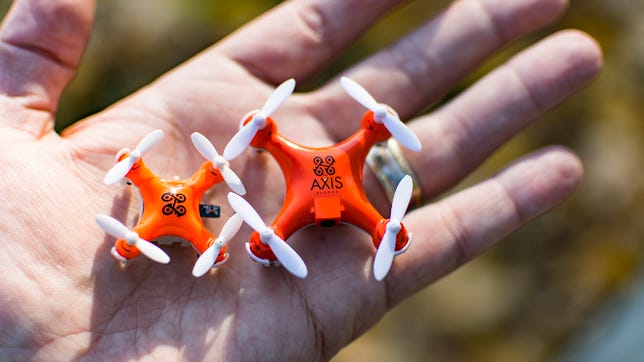
There is also a new breed of mini and nano quads that are a lot easier to fly, thanks to the addition of air pressure sensors. Look for models such as the Aerix Vidius HD that offer an altitude assistance or hold feature, which keeps you from having to constantly adjust the throttle so you can concentrate on directional controls.
Best camera drones
Joshua Goldman/CNET
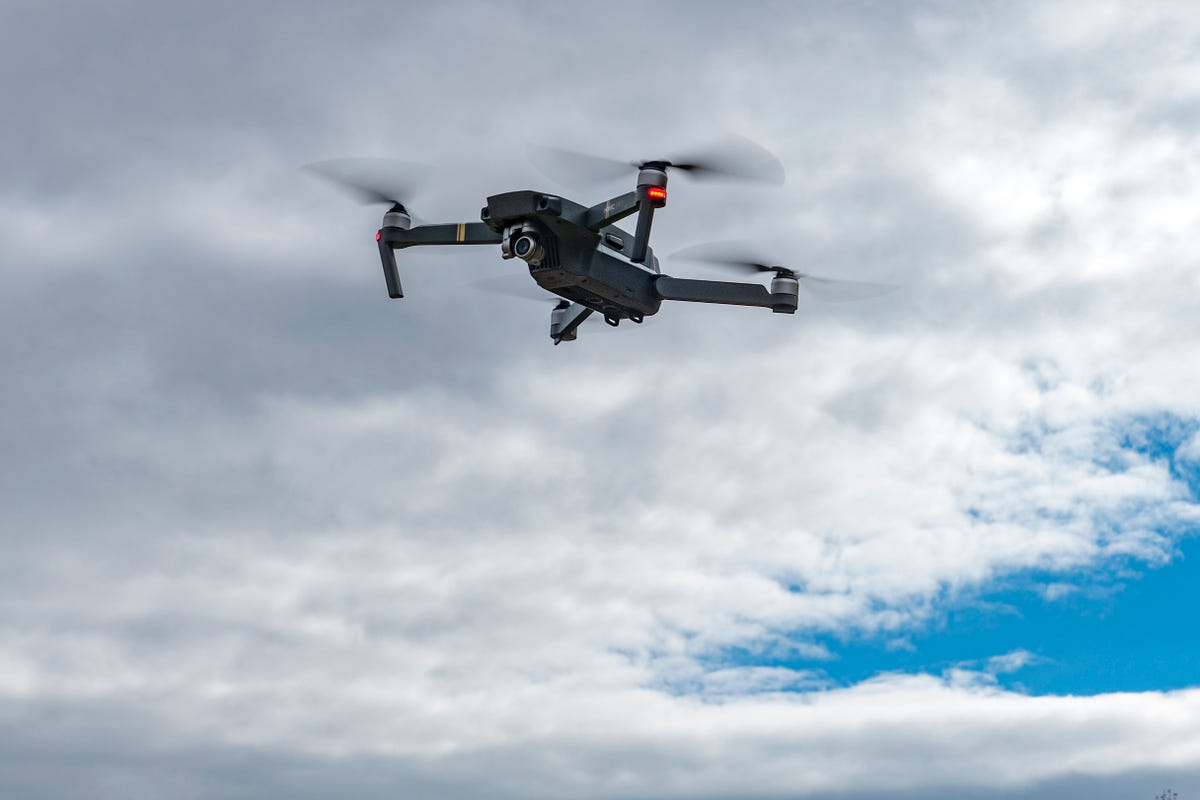
DJI is the leader in flying cameras, whether you're looking for something to get started in aerial photos and video or want an out-of-the-box solution for TV and film. Of course, the more money you spend, the better the features get. If you're looking for great performance and features with a design so small you can fit it in your backpack with room to spare, go with the DJI Mavic Air.
If you don't like the sound of dropping a lot of money on a camera that's permanently attached to a drone, check out GoPro's Karma drone. The camera-maker is exiting the drone market, but it's going to sell through its Karma inventory and continue to support its one and only quadcopter. The Karma uses one of the company's tiny action cams, so when you're not flying you can use the camera for whatever else you want to capture on land or in the water. But, more importantly, the motorized gimbal that stabilizes the camera in the air can be removed and attached to an included handgrip, giving you the option to shoot stabilized video and photos on the ground.
Best selfie drones
Yuneec Breeze 4K
Joshua Goldman/CNET
Small like a toy drone, but with the smarts of higher-end camera drones, selfie drones are basically the point-and-shoot cameras of the sky. Selfie drones are small enough they're unobtrusive in public places: You fly them with your phone instead of a big controller, and simple onscreen controls and automated shooting modes let you capture dramatic shots with little more than some taps and swipes.
DJI's Spark is the most versatile in the category and is loaded with advanced tech to make flying simple and safe. However, if you want to save some money, consider either the Yuneec Breeze 4K and Hover Camera Passport. The Breeze, pictured above, has special shot modes that will make you look like a pro pilot. With just a few taps in its mobile app, you can program it to perform special camera moves like 360-degree orbits or direct it to fly up high and reveal the scene around you. And if you don't want to control it with your phone, Yuneec has a small video-game-style controller and a first-person-view headset available.
The Passport's unique folding design makes it not only superportable, but safe, too, with propellers that are completely protected by its frame. After launching just tap twice on your phone screen to make the drone follow your face. Once you get your shot, the drone folds down to the size of a hardcover book.
Best racing drones
Fat Shark 101
Sarah Tew/CNET
Unless you're really a tinkerer and know your way around a soldering iron, I recommend first-time buyers stick to ready-to-fly (RTF) models. The thing is, when it comes to racing drones, most people in the hobby build their own. That's not to say RTF racing quads don't exist, but they aren't as abundant as drones for photography or just having a few minutes of fun.
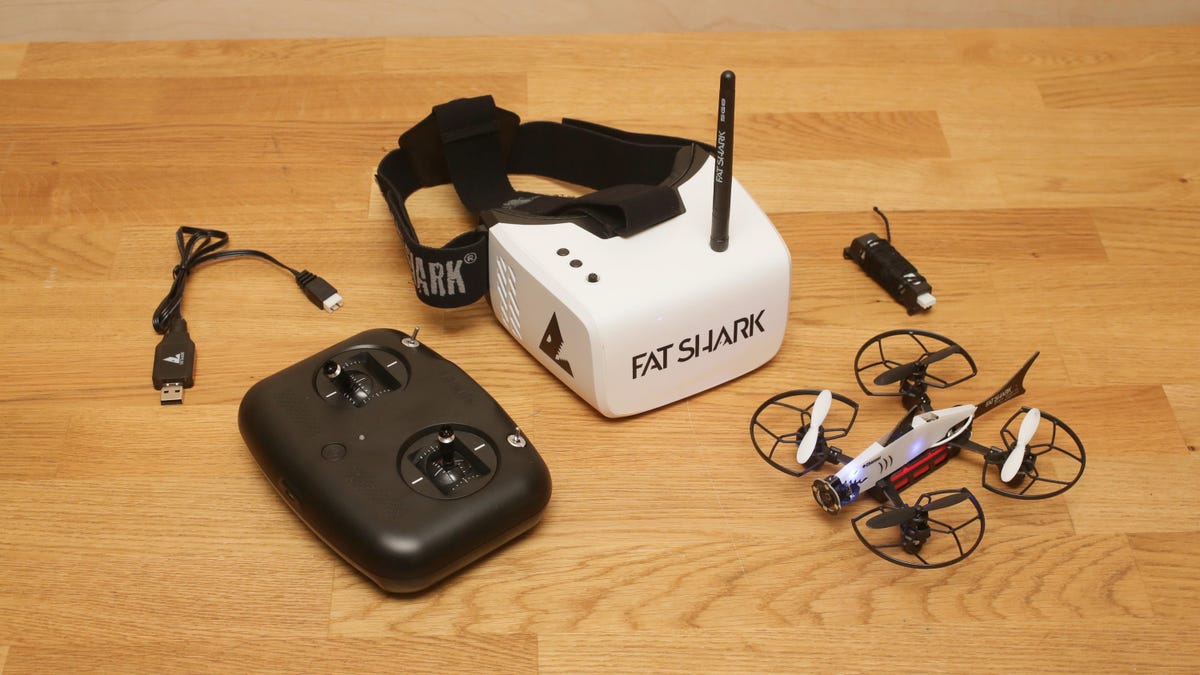
If you think you might be interested in racing and want a cheaper entry point, check out the Fat Shark 101. The kit comes with everything you need to get started -- a quad, a simplified controller and an FPV (first person view) headset -- and doesn't require a ham radio license from the FCC. They even throw in a couple of gates to practice flying through and access to a flight sim. The best part is, you can upgrade, so the goggles will work with other drones, as will the controller.
If you want to jump right in and get a larger racer, consider the UVify Draco. It's ready to fly and you can buy it direct from UVify with a controller and FPV goggles if you don't want to worry about picking those out on your own separately. The drone is built tough, but the design is modular, so if you snap a motor arm, you can just pop a new one on and get back in the air. (The company also has a new micro racing quad called the Oori that it says is the fastest RTF drone for its size.)
You can also check out sites like Team Blacksheep and GetFPV.com that sell complete kits to assemble yourself as well as RTF options. The latter will also has a great section for beginners with part explainers. Sites like Banggood, HeliDirect and Horizon Hobby are also excellent for finding parts and batteries, too.
The seven things to consider before you buy
Cheaper drones aren't necessarily for beginners
Tiny inexpensive quads like these can be a pain for first-timers.
Joshua Goldman/CNET
Like many things in life, you get what you pay for with drones: The more money you spend, the more features you get that make flying easier. For example, while the Hubsan X4 quad I mentioned at the top isn't a bad place to start, it lacks sensors found on higher-end drones to help it hover in place on its own or return to you if you get in a jam.
If you're just starting out, GPS is invaluable and worth paying more for if you're looking for stable flying out of the box, especially for photos and video. GPS is something you won't typically find on toy-grade drones, and although they're good to practice with, new pilots might find toy drones to be incredibly frustrating.
Flight times are still relatively short
Battery life is still the suck when it comes to drones. Several camera drones claim a battery life at or around 30 minutes. When a manufacturer gives you a flight time, that is typically reached under ideal testing conditions in a controlled environment. The faster you fly, the more weight you add, the stronger the winds you're flying in, the quicker the drone will sap its battery. Plus, there's the time it takes to get up in the air and land that's not accounted for in that time.
My general rule of thumb is to take whatever the manufacturer claims and subtract 5 to 10 minutes for midsize drones. Toy drones typically get between 5 and 7 minutes of good flying, though some can hit the 10- to 12-minute range.
The price of the drone is only the beginning
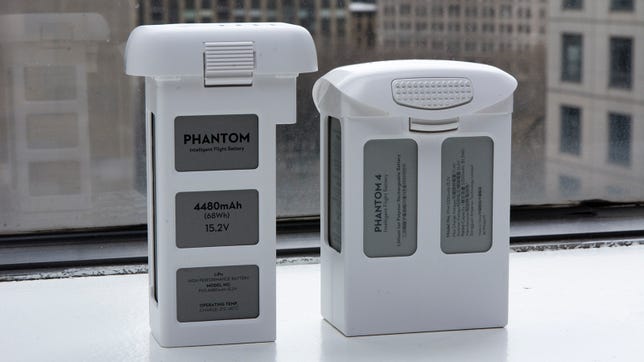
Depending on the aircraft, batteries can run you from about $5 apiece for toys to more than $100 each for camera drones.
Joshua Goldman/CNET
So you just dropped $1,000 on a new drone. Guess what? You're not done spending. At the very least, you'll want to buy a couple extra batteries, some spare propellers, maybe some prop guards and perhaps a quick charger, so you're not waiting hours to fly again. You're more than likely going to crash, which could lead to repair costs -- either for replacement parts or shipping it back to the manufacturer for them to repair. (This is exactly why DJI offers crash insurance for new drones.)
When you're shopping for your drone, see how easy it is to find replacement parts, batteries and other accessories and take note of the prices. Also, be cautious when buying third-party parts, especially batteries and chargers, which might not be the same quality as those made by the drone manufacturer.
Everyone will assume you're invading their privacy
When you're out flying in a public space, or even in your own backyard, anyone who sees you doing it will think you're spying on them or someone else. You could be standing in the middle of a 20-acre field with no one in sight and your drone no more than 50 feet directly overhead and you might end up answering questions about being a peeping Tom. I say this because it's happened to me. Repeatedly.
And along those same lines....
Everyone but you thinks they're dangerous
It doesn't matter if you're the safest pilot around or that you could do more damage hitting someone with a baseball than with some of the drones I've flown, but that won't stop onlookers from feeling a threat to their safety. And, frankly, that's completely fair.
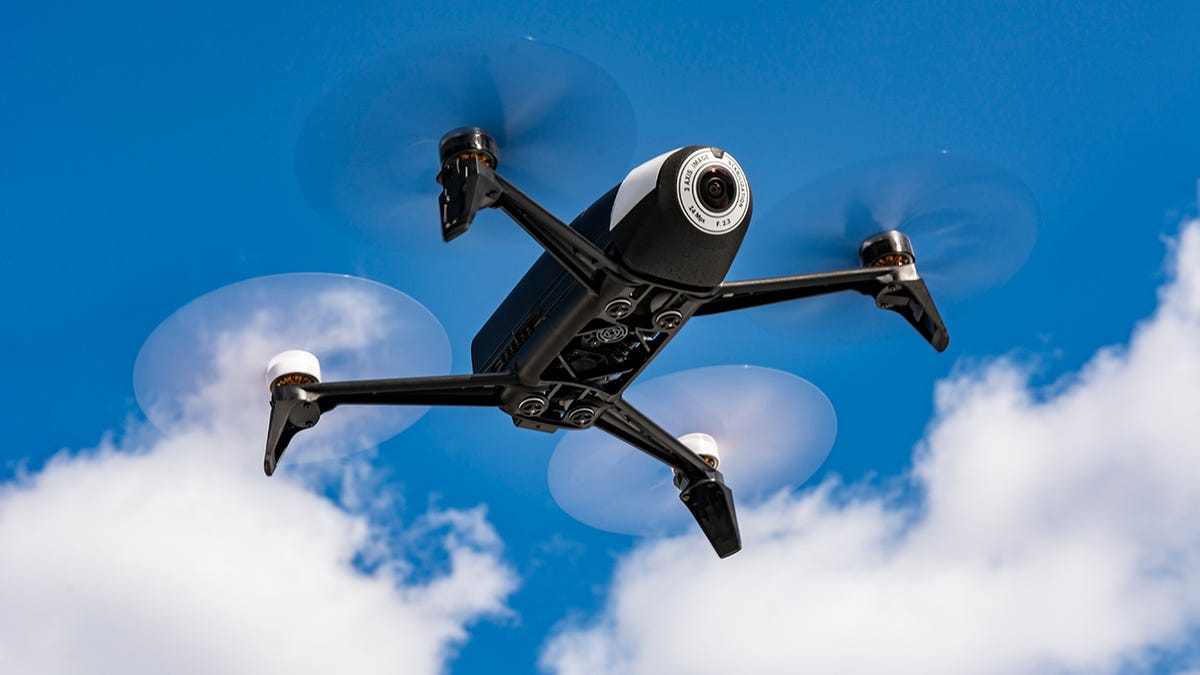
Parrot's Bebop 2 is one of the safer drones available, with props that stop instantly if they hit anything.
Joshua Goldman/CNET
Nothing about plastic blades spinning at high speeds screams "safety." Then you add in the potential for unpredictable movements or system failures, whether from 400 feet or at eye level, and you've got something pretty scary for those living by what the media feeds them.
To help calm some fears, US-based pilots may want to get an Academy of Model Aeronautics membership. Along with a whole host of benefits including access to AMA-member flying sites, a membership gives you $2,500,000 comprehensive general liability insurance as well as $25,000 accident/medical coverage, $10,000 maximum accidental death coverage and $1,000 fire, theft and vandalism coverage for members. You can also get on-the-spot insurance from Verifly. Download the company's iOS or Android app and it will quote you an hourly price for up to $2.5 million in liability coverage.
Finding places to fly can be difficult
I live in New Jersey and work in New York, and it's becoming increasingly difficult to find places to safely -- and legally -- fly. US national parks are off-limits, and in New Jersey so are all state parks. The county and municipal parks around me all have different regulations regarding RC aircraft. And then there are the no-fly zones, which makes much of New York out of bounds as well as just dangerous, because of buildings, people and cars.
Before you buy a drone -- even a toy one if you plan to fly outside -- you'll want to visit AirMap or Mapbox to check no-fly zones for places you intend to fly. In the US, you can also download the FAA's B4UFly app to check your planned location. These don't cover state or local ordinances, though, so you'll still need to check them to see if you're OK to fly.
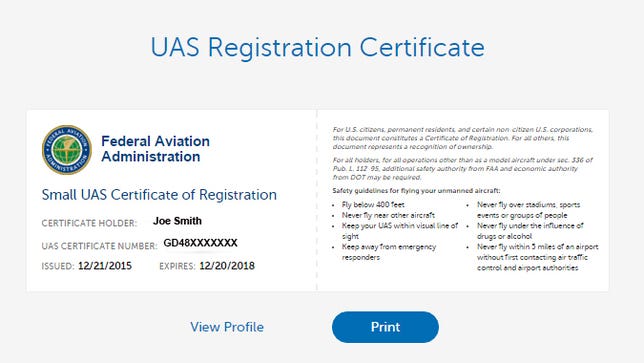
Basically, any RC aircraft except toys need an FAA registration
Screenshot by Sean Hollister/CNET
The US Federal Aviation Administration (FAA) is requiring anyone who wants to fly an unmanned aerial system (UAS) that weighs between 0.55-pound (250 grams) and 55 pounds (approximately 25 kilograms) for recreation or hobby to register with the agency. Civil penalties for not registering may include fines up to $27,500. Criminal penalties may include fines up to $250,000 and/or imprisonment for up to three years.
Most sub-$100 UASs fall under this weight. For example, all of these toy drones weigh in under that half-pound mark. A kitchen or postal scale can be used to weigh your drone or you can check with the manufacturer. Also, this applies to both store-bought and homemade aircraft.
The registration cost is $5 and it can all be done online in a matter of minutes. You don't have to register each aircraft you own, just yourself, and you'll be given a number to attach to what you're flying. That's it. Essentially, it's the FAA's way of getting you to agree that you've read its safety guidelines including staying more than 5 miles away from airports and below 400 feet.
There's no equivalent registration requirement in the UK or Australia as long as you're not using your drone for commercial purposes, although that may soon change.
Know your RTF from your FPV
Like any hobby or technology, there's a whole lot of lingo and abbreviations that come with the territory. Here are some of the ones you'll come across the most.
Ready-to-fly (RTF): A drone that requires little to no assembly and is ready to fly out of the box.
Almost-ready-to-fly (ARTF or ARF): These drones may require some minor assembly and additional equipment such as a receiver (Rx) and radio transmitter (Tx) aka a radio controller.
Bind-n-fly (BNF): BNF models are essentially RTF drones with a receiver, but not a radio controller (you must buy one separately). But you can then use that controller to pilot other BNF aircraft, saving you some money if you decide to grow your RC aircraft collection.
First-person view (FPV): The video feed direct from a camera on the drone. It can be used for framing your photos or videos as well as piloting. With drone racing, pilots usually wear FPV goggles for an immersive experience.
Return-to-home (RTH): A safety feature that allows the drone to autonomously fly back to the pilot's location or starting point.
Gimbal: A mechanical camera stabilization system that lets you get smooth video and sharp photos even with fast movements or in high winds.
Headless mode: Intended for beginner pilots, using this mode means the drone will always travel forward, backward, left or right when moving your remote's stick in those directions, regardless of which way the front of the drone is pointed.
Follow me: A feature that allows a drone to automatically follow a subject, typically using a GPS signal from a mobile device, remote control or a beacon attached to the subject being tracked.
Brushless motor: Though more expensive than their brushed counterparts, brushless motors are more efficient, last longer and are quieter.
There are lots of good places to mount your TV, but there are also a few places where mounting a TV is not the best idea. The bathroom is one of those places. In fact, it's just about the worst environment for any type of electronics, let alone a TV. But if you're so hooked on a show you're streaming that you don't want to hit pause even for a bathroom break, you may think mounting a TV above the bath or toilet is a good solution. It's not. Really. Just don't.
But if you absolutely must, mounting a TV in the bathroom is technically doable, as long as you know what you're getting into. Here's what you need to know before you start watching National Treasure during your morning constitutional.
Bathroom TV (doo)do's and don'ts
This bathroom is nicer than my entire house.
Getty Images/Experience Interiors
A bathroom is a bad place for a TV. Two of the worst things for electronic gadgets are moisture and heat. The latter is also one of the reasons why we don't recommend placing a TV above a fireplace. Even if you have a large, well-ventilated bathroom, it's likely much more humid than a typical living room.
For example, here's what Samsung has to say about bathroom TVs:
In general, you should not put your Samsung TV in extremely hot, cold, humid or dusty places. Consequently, we recommend that you do not install your Samsung TV in a bathroom or any other room with high humidity.
Here's the relevant section in LG owner's manual for its 2022 LED LCDs:
Do not place the TV and/or remote control in the following environments: - An area with high humidity such as a bathroom. - Near kitchen counters or humidifiers where they can easily be exposed to steam or oil. - Do not expose to dripping or splashing and do not place objects filled with liquids, such as vases, cups, etc. on or over the apparatus (e.g., on shelves above the unit).
Otherwise, this may result in fire, electric shock, combustion/ explosion, malfunction or product deformation.
Sony's TV warranty, for its part, doesn't cover "contact with liquid, heat, humidity or perspiration," all of which are pretty much par for the bathroom course.
Will humidity destroy the TV instantly? Probably not, and that's part of the problem. You'll likely hear or read plenty of anecdotal stories about how someone put a regular TV in their bathroom and it was "fine." However, these people probably won't follow up with how the TV later died "for no reason."
To compound the problem most people will want to put the TV where it's easily viewable from the tub or shower, namely up out of the way. Unfortunately heat and steam rise, especially when drawn ceiling-ward by a bathroom fan.
I could tub here.
Getty Images/Phototropic
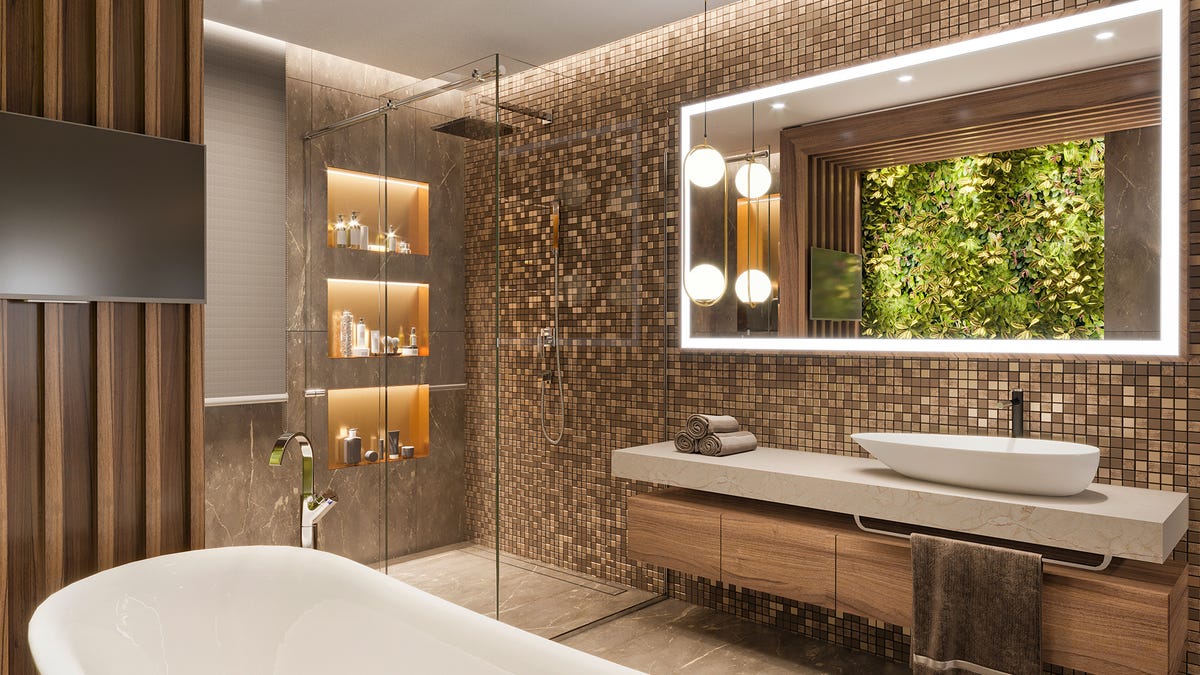
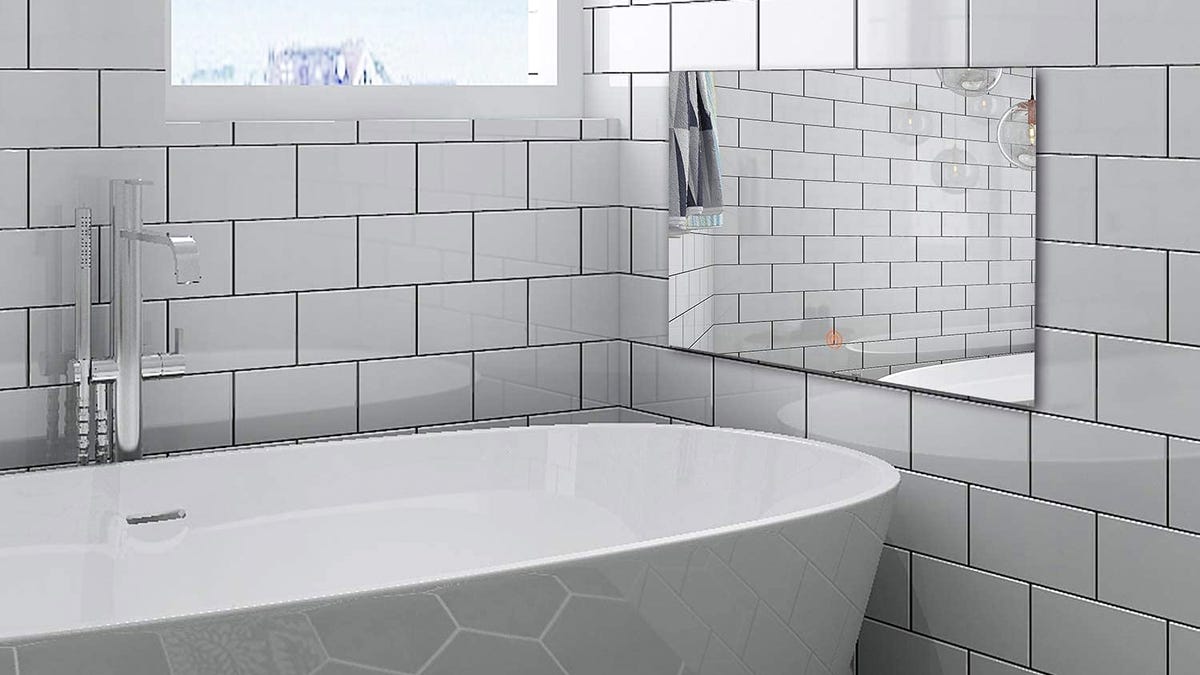
There are waterproof TVs designed for high-humidity areas but, as you'd guess, they're more expensive than regular models. They also don't feature names you'd recognize: Elecsung, Soulaca, Haocrown and others. Many have streaming apps built in. Some even double as a mirror when turned off. We haven't tested any of these models, but they cost at least three or four times as much as standard TVs of similar size.
Also, be wary of any lists on sites like Best Buy or Amazon that seem to suggest "bathroom TVs." These are filled with normal, small TVs that shouldn't be in a bathroom.
Things to consider for a bathroom TV
Add a fridge and I think I could live here.
Getty Images/John Keeble
Like other waterproof gear, for example headphones and Bluetooth speakers, waterproof TVs should have an IP rating. For example, "IP66-Certified Waterproof" means it's sealed against dust and jets of water aimed directly at the device.
Voice control would be a plus, for sure, but don't expect waterproof TVs to have the same features as a typical TV. For that matter, their smart TV interfaces are likely worse than you're used to, and might not have all the streaming services you'd want. Check user reviews carefully, if you can find any.
What's not important? Resolution. Don't worry if the TV is 1080p or 720p. With small TVs you're not likely to see much of a difference, if any.
Better hope it's splash-proof.
Getty Images/John Keeble
It's also worth checking to see if your Wi-Fi is up to the task. The signal might be strong enough to surf the web while you're enshrined on your throne, but streaming video is another story. You probably don't need to get any new gear, just give your current Wi-Fi a tuneup.
Check local building codes for any specific regulations for installing or mounting an electrical device in your bathroom. You can also mount a TV in the wall, but that's well beyond the scope of this guide and likely not something for the average DIYer.
Alternate options (tablets, smart displays and more)
Totally natural towel placement.
Getty Images/Phototropic
Maybe you don't need a "TV." Smart home displays like the Amazon Echo Show and Google Nest Hub can fit just about anywhere. They'll run Netflix and some other streaming services. You won't get full TV functionality, nor are they waterproof, but they're cheap and far easier to fit in your bathroom. Just keep them away from the tub.
Another possibility is a simple waterproof Bluetooth speaker. I've had one of these in my shower for years. Certainly not a TV, but you can listen to music, news or podcasts. They have the added benefit of being inexpensive and, of course, portable.
Mirror mirror on the wall, play for me The Gilded Age.
Haocrown
A common option is a tablet, usually with the addition of some kind of stand or bath tray. Certainly risky for an often-expensive device, but it's easier than mounting a TV in someplace that's essentially a temporary sauna.
It's also worth noting that most mid- and high-end phones are waterproof. Most tablets are not. So if you can handle a smaller screen, it's definitely a safer bath-time option.
'Bathroom TV, you're the one'
More than ever, we all need a place to relax. I have a close friend with an extremely stressful job who winds down after a long day by watching shows on a tablet while soaking in the tub. I absolutely get it.
Permanently mounting a TV in your bathroom, however, should be approached with caution. These are not good environments for electronics to live in, as evidenced by the warnings and warranties of manufacturers.
With a TV that's designed for it, or something inexpensive you don't mind replacing regularly, they're certainly better than holding your phone with one hand and your toothbrush in the other.
As well as covering TV and other display tech, Geoff does photo tours of cool museums and locations around the world, including nuclear submarines, massive aircraft carriers, medieval castles, epic 10,000 mile road trips, and more. Check out Tech Treks for all his tours and adventures.
He wrote a bestselling sci-fi novel about city-size submarines, along with a sequel. You can follow his adventures on Instagram and his YouTube channel.
The Great Resignation Hasn't Hit School Teachers Yet. Here's Why It Still Might
The Great Resignation Hasn't Hit School Teachers Yet. Here's Why It Still Might
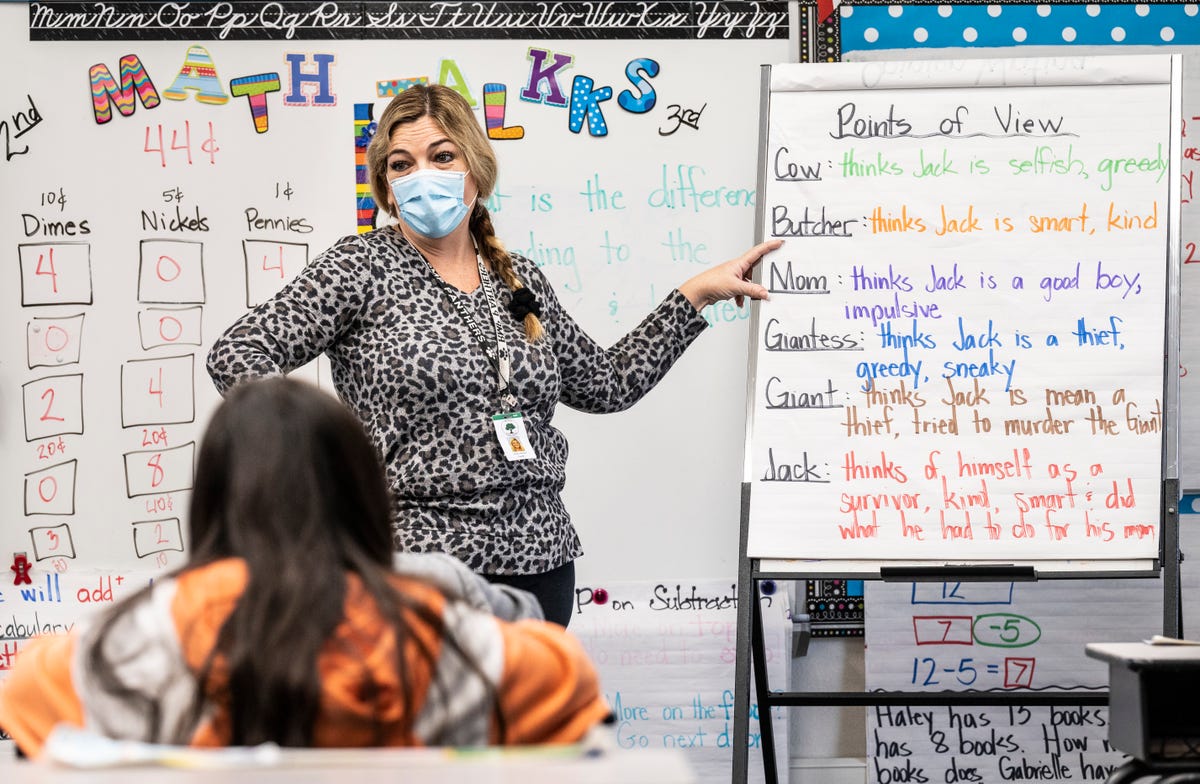
It took just a simple question for Andria Nelson to grasp how different the world of education was from everything else. Nelson had quit her teaching job just months into the 2020-21 school year and taken a job as a communications specialist for a transportation company. Her innocent request -- seeking someone to cover for her so she could go to the bathroom -- raised some amused eyebrows around the office.
"People in that office laughed at me because I asked permission for everything," said Nelson over Zoom. "I couldn't believe what it was like working in an office from being a teacher."
Nelson's story is a familiar one. She fell in love with teaching as a special education associate back in 2012, leading her to pursue a teacher's certification. By the fall of 2020, she'd spent more than seven years teaching language arts to middle school students. Along the way, she'd also coached girls soccer, cross-country and track. She was teaching accelerated English and global studies with a teacher partner and had seemingly found her calling.
Then things began to change. For every education professional, the way working as a teacher goes from dream job to recurring nightmare looks different. For Nelson, it was the anxiety of coming back to in-person teaching during the pandemic while having an autoimmune disease, being harassed by another teacher and not getting help from the school administration.
In November 2020, Nelson quit. "My mental health is not OK," she told her principal, "and now I'm starting to lose my physical health."
Nelson's departure illustrates the compounding complications of the COVID-19 era, which are taking a massive toll on teachers nationwide. But the coronavirus is just the latest crack in a system badly in need of an overhaul. Teachers were already burning out amid ever-increasing demands to do more, with little support and with stagnating salary increases. Every year, fewer people are choosing to join a profession that's hardly evolved in 50 years, and vacancies are on the rise.
Now the Great Resignation has many fearing a mass exodus out of the teaching ranks. Experts argue, however, that there isn't yet empirical evidence that teachers are quitting in record numbers. Still, even the most skeptical admit that the possibility of seeing an unprecedented wave of teacher resignations before this school year ends or the next one starts has never felt more real. And the potential consequences for students, schools, families and the country as a whole couldn't be more serious.
"Teacher resignations pose an incredible challenge to public schools," said Anne Claire Tejtel Nornhold, a former middle school teacher who's now in charge of implementing a new classroom structure at Baltimore City Schools, known as Opportunity Culture, in an effort to increase teacher retention.
When a teacher quits, she noted, students end up being taught by less experienced teachers, which may result in kids learning less. Parents frustrated by the erosion of the learning environment, she added, may consider private school or homeschooling instead.
"We do know from rigorous empirical evidence that disruptions from teacher turnover have a negative effect on student test scores," added Dan Goldhaber, director of the National Center for Analysis of Longitudinal Data in Education Research, aka CALDER, at the University of Washington. "And that test scores are predictive of a variety of later life outcomes, like the probability of employment and labor market earnings."
At stake is also the emotional and educational recovery of an entire generation of students who've had to endure the pandemic from a unique perspective, switching back and forth between in-person and remote learning, navigating mask mandates and the politics associated with them, dealing with uncertainty about vaccines -- or lack thereof -- all on top of worrying about their own academic future.
Failing to modernize the teaching profession could make it even harder to attract a new generation of talented individuals into the classroom, said Brent Maddin, executive director of the Next Education Workforce Initiative at Arizona State University, a national organization devoted to innovation in the field of teaching. "Who wants to join the profession typified by the headlines of the last few weeks?"
When teacher resignations go viral
Following the reaction of her new co-workers to the quirks formed by her prior life as a teacher, Nelson posted a video on TikTok with the caption, "When teachers change careers," along with hashtags like #teachersoftiktok, #leavingteaching and #mentalhealthmatters. In the video, you can see Nelson at her desk pretending to ask her manager who she needs to contact if she has to take a bathroom break.
"I can just go?" Nelson says in disbelief. The video, posted in September, went viral and has since accumulated more than 1.1 million views and been shared more than 15,000 times. Nelson's TikTok post became part of a trend of teachers posting similar videos of themselves quitting their jobs, which spilled over into the news.
"Teacher's TikTok goes viral after telling class she's quitting due to pay," reported local TV station KRQE in Albuquerque, New Mexico. "For some teachers, it's QuitTok, not TikTok," said local Salt Lake City station 2KUTV.
More recently, news reports about teacher resignations have seemed to go beyond anecdotal social media posts to suggest a larger, more worrisome trend. The demand for more qualified teachers was already there. A 2016 study by the Learning Policy Institute projected that by 2020, an estimated 300,000 new teachers would be needed per year, and that by 2025, that number would increase to 316,000 annually.
COVID only made things worse. A survey published in early February by the National Education Association, the nation's largest teachers union, found that more than half its members intend to leave education sooner than planned because of the pandemic -- "a significant increase from 37% in August," the association said.
Beyond the TikTok viral videos and the agonizing news headlines, there seemed to be enough evidence to express real concern about a looming tsunami of teacher shortages and resignations threatening to disrupt the school year even further than the numerous waves of coronavirus variants already had.
"I don't know how much longer we will have teachers who will put up with the pressures coming from all different angles," J.M., a middle school teacher from Austin, Texas, who's been teaching for 11 years, said in an email. (She asked CNET to withhold her full name because she didn't want to compromise her position at school.) "I am at a 'steady' school (one where academic success is high and behavior is mostly under control), and I hear of lots of teachers here who are ready to walk off the job at any given moment."
"People are ignoring the news that is making headlines already," said J.J., another middle school teacher from Austin, who's been teaching Spanish at the high school and middle school levels since 2006 and recently began to consider leaving the profession. (She too asked that CNET withhold her full name.) "Teacher burnout has become even more real since the pandemic began."
A teacher interacts with students virtually while sitting in an empty classroom during a period of nontraditional instruction at an elementary school in Kentucky.
Jon Cherry/Getty Images
In a December letter, US Secretary of Education Miguel Cardona urged school administrators across the country to "use resources from the $122 billion made available through the American Rescue Plan Act of 2021 to ensure that students have access to the teachers and other critical staff they need to support their success during this critical period." He cited surveys that showed severe staffing shortages and difficulties hiring qualified teachers.
A big reason? It comes down to money.
Why teachers want to quit
When I asked one teacher who left her job before the holiday break, and three others who are considering quitting, about their motivations, each mentioned several different reasons. Money was the one common factor.
"The salary and level of appreciation are much lower than what we deserve," said J.M., one of the Austin schoolteachers. "Last year, the year we were teaching online, I ended up teaching four extra classes from February through May. I was compensated for only one of those."
A 2016 national survey of first-year college students conducted by UCLA's Cooperative Institutional Research Program found that just 4.2% of them intended to major in education, down from 11% in 2000 -- and the lowest point in 45 years.
"Salary is one huge part of it," Bryan Hassel, co-president of Public Impact, a nonprofit organization working with school districts to improve education for low-income and other underserved students, said over Zoom. If teacher pay had kept up with the increase in education spending over the last 50 years, he explains in one of his studies, the average annual teacher pay would be nearly $140,000 today. Instead, the national average annual teacher salary in the 2019-20 school year was just more than $63,000, according to the Department of Education's National Center for Education Statistics.
"[Teacher] wages have been relatively flat as compared with professions that require similar levels of expertise, certification and education," Jess Gartner, a former school teacher and CEO of Allovue, a technology company that builds solutions for K-12 finance, said over Zoom. "Overall, teacher compensation has actually increased, but the majority of the increase is going into either pension or health care benefits. Costs have risen so dramatically they've effectively depressed real wages that teachers are seeing in their paycheck."
"After having to pay more bills with a growing family, I have become more aware of how little I make in comparison to others while I have more educational background than many," said J.J., the middle school teacher from Austin, who has a master's degree.
According to the Department of Education's National Center for Education Statistics, by the school year 2017-18, almost 60% of all teachers across the country had a post-baccalaureate degree. And with over 3.5 million teachers in the country, teaching "is far and away the largest single profession in America that requires a bachelor's degree," David Rosenberg, partner at Education Resource Strategies, said over Zoom. ERS is a national nonprofit that helps school leaders think about using their resources differently and reimagine the job of teaching.
But it's not just teacher salaries that have failed to keep up for years. "We've been demanding more of teachers through all that time," said Hassel. "Standards are higher" these days.
Nelson, one of the teachers whose videos went viral on TikTok, said she had a student in her seventh-grade class who read at a second-grade level, while also having other students in the same class who were reading at a post-high school level. "When you have 36 students in a room, it's incredibly difficult to help a second-grade-level reader."
Over time, as a country, and particularly at the state level, we've also tightened up the rules for entering the teaching profession, according to Chad Aldeman, policy director of Edunomics, a center at Georgetown University focused on the study of education finance. "It's been all with good intentions, raising the bar to become a teacher," Aldeman said over email. "But that means there are more subspecialty areas to earn licenses, more requirements to become a teacher than there used to be."
All these efforts have had unintended negative consequences, Maddin said over email, rendering the teacher's job "quite frankly, untenable... one that people are more likely to run from than to."
But it's not only the lack of salary competitiveness versus increased expectations that keeps the teaching profession anchored in the past. It's the nature of the job itself.
A profession that hasn't evolved in decades
Over the last century, the way we communicate with each other and how we consume media and live our lives has been dramatically transformed. Yet teaching has largely remained unchanged.
"The majority of children in the US learn in schools that replicate the dominant industrial model of education that was designed over 100 years ago to prepare most children to work in farm and factory jobs," Jenee Henry Wood, head of learning at Transcend, a national nonprofit helping schools reimagine education models, said in an email.
In almost every other profession that requires a degree, people have the opportunity to learn on the job, take on more responsibility, advance and earn more money. That's not the case with teachers. "In teaching, you pretty much have the same job for your whole career," Public Impact's Hassel said. "Unless you become a principal or leave altogether... there's not a lot of advancement opportunity."
Most school districts and schools in the country keep operating under the traditional one-teacher, one-classroom staffing model, several experts said, which not only creates an isolating and challenging experience for most teachers, but is also a recipe for disaster when something unexpected happens -- like a pandemic.
The traditional school model "creates 3.5 million points of possible crisis [across the country] each day if individual educators don't show up for work," Maddin said.
As multiple schools across the country could attest in recent months, the pervasiveness of the one-teacher, one-classroom model exacerbates staffing issues in an emergency. "There's no backup or support system," said Aldeman.
But the challenges presented by the traditional staffing model aren't just logistical. They may also be holding both teachers and students back.
Fourth graders in Pennsylvania.
Getty Images
For students, the old model means, "They'll only experience excellent teaching in a subject once every few years," said Hassel from Public Impact. "It makes great teaching a scarce resource that only a select fraction of students receive." For educators, he added, it "severely limits the opportunity to learn on the job from peers, or advance in their career and earn more while continuing to teach."
The way the teaching profession is structured right now, Rosenberg from ERS said, requires teachers to be heroes. "We have to structure the work so people can be successful," he said.
"Teacher shortages will only continue to get worse until we fundamentally redesign our school staffing models," said Maddin. "We don't have just a teacher shortage problem. We have a workforce design problem."
Bringing a reset to the role of teachers
A number of initiatives across the country are helping schools reimagine how teachers work. Public Impact's Opportunity Culture initiative is one of them. "Teachers join small teams, three to eight teachers, led by a multi-classroom leader, a teacher who has prior high student growth and takes on the leadership of that whole team," Hassel said.
These teachers get more support than they normally would in a traditional model where they're working mostly by themselves with their 20 or 30 kids. "They're working as a team and they're getting better results," Hassel said. Public Impact's research found that the multiclassroom leader's student growth -- their ability to score higher in tests -- can jump from the 50th percentile to above the 70th percentile.
Team leaders earn, on average, between 12% and 20% above their normal salary, Hassel said. About 50 school districts around the country have embraced Opportunity Culture's model, and 90% of participant schools in the program are Title I, meaning they serve low-income communities.
ASU's Next Education Workforce Initiative is another example. Its program consists of building teams of educators to deliver deeper and personalized learning for pools of kids larger than those in the traditional classroom staffing model.
"Imagine you have four teachers with 100 kids, collectively responsible for all those kids," Next Education Executive Director Maddin said. "Like literally every other profession, we can now start to allow teachers to develop specialization and expertise. They wouldn't have to be great at everything, but there would be a set of things that they would be exceptionally good at."
Updating the structure of the classroom can also help schools react more effectively to staff shortage emergencies, such as those caused by the pandemic. A team-based approach, Aldeman said, can help the system "continue to function well even if an individual member leaves."
A different approach to salary increases
Beyond modernizing the teaching job, increasing teacher salaries across the board seems an obvious first step to thwart further resignations, and some states, like New Mexico, are already raising pay. Not all the experts I interviewed agree, however. One of the reasons retaining teachers and attracting new ones remains endemically challenging, some argue, is that teacher salaries are basically the same for everyone in most school districts, regardless of area of expertise or teaching environment.
As part of his research, Goldhaber looked into the number of vacancies schools in Washington state have had, going back 30 years. Vacancies for elementary teachers, he found, have always been low while those for STEM and Special Ed teachers have always been very high.
"This pattern exists because teacher pay is not differentiated," Goldhaber said over Zoom. Raising all teacher salaries would help schools draw more talented people into the teaching profession, he argued, "but I also strongly believe that across the board, pay increases do not make sense."
Goldhaber advocates for increasing pay at the beginning of teachers' careers, where retention rates are low, and for people with STEM training. "You're trying to attract people who have been able to do well enough in math and science classes to teach, but those are folks that outside of teaching have good labor market opportunities."
Teaching in California.
Getty Images
School districts usually try to pay special ed, STEM or English learner teachers a little bit more because those professionals are harder to recruit, said Sasha Pudelski, director of advocacy at AASA, the School Superintendents Association. But sometimes salary negotiations are constrained by other factors, including union negotiations around salary schedules.
The current teacher shortage dynamic is a magnified version of the dynamic from before, especially at "high poverty schools [and among] high school teachers [in] specialized roles," said ERS' Rosenberg. Staffing for those roles is particularly difficult in "communities where there's already high turnover, which feeds itself because high turnover means you hire early career teachers and they also have high turnover," he said.
That's why Goldhaber would "make it relatively more desirable to teach disadvantaged students, because it's chronically harder to staff disadvantaged schools and districts." A study published in 2019 by ASU found that teacher turnover rates were 50% higher in Title I schools than other schools. Turnover rates among Title I math and science teachers were nearly 70% higher.
The Great Resignation that's coming -- or not
Meanwhile, the clock is ticking and parents and school administrators keep bracing for a tide of teacher resignations. So far, however, the available data and expert analysis suggest otherwise.
Last year, ERS conducted a study among six school districts across the country to see how turnover had changed compared with pre-pandemic years. "In all six districts, turnover going into fall 2020 went down," said Rosenberg, one of the authors of the study.
Reports from the Bureau of Labor Statistics published in the last six months reflected turnover rates in the private sector reaching new highs, leading to talk about the Great Resignation. But "we actually don't have any empirical evidence suggesting that teacher turnover is rising this year," Georgetown's Aldeman said.
In reality, said Goldhaber, there's not a single comprehensive national data set about teacher employment. Besides surveys from the Bureau of Labor Statistics, the other source of the best information about teacher attrition is states' administrative databases. "We would only know if people are resigning en masse in the '21-'22 school year next fall," he said over Zoom.
But many experts I interviewed think this time it could be different. The labor market is very tight, and employees have more bargaining power than before. "It's a good time for people who want to leave teaching to leave," the University of Washington's Goldhaber said.
It's tricky because, despite all its problems, teaching can also be rewarding. When I asked the teachers about their reasons to stay, all of them replied with their own version of, "I don't think I will find a more meaningful job than this one" (as Austin teacher J.J. put it in an email).
"The relationships and interactions with my students are what drives my passion for my job and brings me joy," A.C., another teacher from Austin, who's been teaching for about 25 years, said in an email. The pandemic has taken a toll on her. Now "the things about teaching I never thought about start finding real estate in my brain. ... Every other week or so, when I am feeling particularly down and out, I entertain the idea of leaving."
Will she end up joining teachers who are leaving? "Probably not," she replied. "I teach because of the kids. They are not going anywhere so, how can I?"
After eight months at the transportation company, Nelson is teaching again. She's now offering online courses for a tutoring company, and she misses the classroom and her middle school students. "They're the love of my life. I love their stinky little hilarious selves."
Money was never the reason she left. "I was OK with [earning] $55,000 and I loved my job every day and seeing those kids every day. Sure, it'd be great to make $80,000 a year for it, but that's not why I was doing it."
The information contained in this article is for educational and informational purposes only and is not intended as health or medical advice. Always consult a physician or other qualified health provider regarding any questions you may have about a medical condition or health objectives.