The Great Outdoors


Here is one of the pictures featuring the The Great Outdoors. Numerous images associated with the The Great Outdoors can be utilized as your point of reference. Below, you'll find some additional pictures related to the The Great Outdoors.

Showing posts sorted by relevance for query The Great Outdoors. Sort by date Show all posts

The Great Resignation Hasn't Hit School Teachers Yet. Here's Why It Still Might


The Great Resignation Hasn't Hit School Teachers Yet. Here's Why It Still Might


The Great Resignation Hasn't Hit School Teachers Yet. Here's Why It Still Might

It took just a simple question for Andria Nelson to grasp how different the world of education was from everything else. Nelson had quit her teaching job just months into the 2020-21 school year and taken a job as a communications specialist for a transportation company. Her innocent request -- seeking someone to cover for her so she could go to the bathroom -- raised some amused eyebrows around the office. 

"People in that office laughed at me because I asked permission for everything," said Nelson over Zoom. "I couldn't believe what it was like working in an office from being a teacher." 

Nelson's story is a familiar one. She fell in love with teaching as a special education associate back in 2012, leading her to pursue a teacher's certification. By the fall of 2020, she'd spent more than seven years teaching language arts to middle school students. Along the way, she'd also coached girls soccer, cross-country and track. She was teaching accelerated English and global studies with a teacher partner and had seemingly found her calling.

Then things began to change. For every education professional, the way working as a teacher goes from dream job to recurring nightmare looks different. For Nelson, it was the anxiety of coming back to in-person teaching during the pandemic while having an autoimmune disease, being harassed by another teacher and not getting help from the school administration. 

In November 2020, Nelson quit. "My mental health is not OK," she told her principal, "and now I'm starting to lose my physical health."

Nelson's departure illustrates the compounding complications of the COVID-19 era, which are taking a massive toll on teachers nationwide. But the coronavirus is just the latest crack in a system badly in need of an overhaul. Teachers were already burning out amid ever-increasing demands to do more, with little support and with stagnating salary increases. Every year, fewer people are choosing to join a profession that's hardly evolved in 50 years, and vacancies are on the rise.

Now the Great Resignation has many fearing a mass exodus out of the teaching ranks. Experts argue, however, that there isn't yet empirical evidence that teachers are quitting in record numbers. Still, even the most skeptical admit that the possibility of seeing an unprecedented wave of teacher resignations before this school year ends or the next one starts has never felt more real. And the potential consequences for students, schools, families and the country as a whole couldn't be more serious.

"Teacher resignations pose an incredible challenge to public schools," said Anne Claire Tejtel Nornhold, a former middle school teacher who's now in charge of implementing a new classroom structure at Baltimore City Schools, known as Opportunity Culture, in an effort to increase teacher retention. 

When a teacher quits, she noted, students end up being taught by less experienced teachers, which may result in kids learning less. Parents frustrated by the erosion of the learning environment, she added, may consider private school or homeschooling instead.

"We do know from rigorous empirical evidence that disruptions from teacher turnover have a negative effect on student test scores," added Dan Goldhaber, director of the National Center for Analysis of Longitudinal Data in Education Research, aka CALDER, at the University of Washington. "And that test scores are predictive of a variety of later life outcomes, like the probability of employment and labor market earnings."

At stake is also the emotional and educational recovery of an entire generation of students who've had to endure the pandemic from a unique perspective, switching back and forth between in-person and remote learning, navigating mask mandates and the politics associated with them, dealing with uncertainty about vaccines -- or lack thereof -- all on top of worrying about their own academic future.

Failing to modernize the teaching profession could make it even harder to attract a new generation of talented individuals into the classroom, said Brent Maddin, executive director of the Next Education Workforce Initiative at Arizona State University, a national organization devoted to innovation in the field of teaching. "Who wants to join the profession typified by the headlines of the last few weeks?"

When teacher resignations go viral

Following the reaction of her new co-workers to the quirks formed by her prior life as a teacher,  Nelson posted a video on TikTok with the caption, "When teachers change careers," along with hashtags like #teachersoftiktok, #leavingteaching and #mentalhealthmatters. In the video, you can see Nelson at her desk pretending to ask her manager who she needs to contact if she has to take a bathroom break.

"I can just go?" Nelson says in disbelief. The video, posted in September, went viral and has since accumulated more than 1.1 million views and been shared more than 15,000 times. Nelson's TikTok post became part of a trend of teachers posting similar videos of themselves quitting their jobs, which spilled over into the news.

"Teacher's TikTok goes viral after telling class she's quitting due to pay," reported local TV station KRQE in Albuquerque, New Mexico. "For some teachers, it's QuitTok, not TikTok," said local Salt Lake City station 2KUTV.

More recently, news reports about teacher resignations have seemed to go beyond anecdotal social media posts to suggest a larger, more worrisome trend. The demand for more qualified teachers was already there. A 2016 study by the Learning Policy Institute projected that by 2020, an estimated 300,000 new teachers would be needed per year, and that by 2025, that number would increase to 316,000 annually. 

COVID only made things worse. A survey published in early February by the National Education Association, the nation's largest teachers union, found that more than half its members intend to leave education sooner than planned because of the pandemic -- "a significant increase from 37% in August," the association said.

Beyond the TikTok viral videos and the agonizing news headlines, there seemed to be enough evidence to express real concern about a looming tsunami of teacher shortages and resignations threatening to disrupt the school year even further than the numerous waves of coronavirus variants already had.

"I don't know how much longer we will have teachers who will put up with the pressures coming from all different angles," J.M., a middle school teacher from Austin, Texas, who's been teaching for 11 years, said in an email. (She asked CNET to withhold her full name because she didn't want to compromise her position at school.) "I am at a 'steady' school (one where academic success is high and behavior is mostly under control), and I hear of lots of teachers here who are ready to walk off the job at any given moment."

"People are ignoring the news that is making headlines already," said J.J., another middle school teacher from Austin, who's been teaching Spanish at the high school and middle school levels since 2006 and recently began to consider leaving the profession. (She too asked that CNET withhold her full name.) "Teacher burnout has become even more real since the pandemic began."

An elementary school teacher at a laptop in an empty classroom in Kentucky,

A teacher interacts with students virtually while sitting in an empty classroom during a period of nontraditional instruction at an elementary school in Kentucky. 

Jon Cherry/Getty Images

In a December letter, US Secretary of Education Miguel Cardona urged school administrators across the country to "use resources from the $122 billion made available through the American Rescue Plan Act of 2021 to ensure that students have access to the teachers and other critical staff they need to support their success during this critical period." He cited surveys that showed severe staffing shortages and difficulties hiring qualified teachers. 

A big reason? It comes down to money.

Why teachers want to quit

When I asked one teacher who left her job before the holiday break, and three others who are considering quitting, about their motivations, each mentioned several different reasons. Money was the one common factor.

"The salary and level of appreciation are much lower than what we deserve," said J.M., one of the Austin schoolteachers. "Last year, the year we were teaching online, I ended up teaching four extra classes from February through May. I was compensated for only one of those."

A 2016 national survey of first-year college students conducted by UCLA's Cooperative Institutional Research Program found that just 4.2% of them intended to major in education, down from 11% in 2000 -- and the lowest point in 45 years.

"Salary is one huge part of it," Bryan Hassel, co-president of Public Impact, a nonprofit organization working with school districts to improve education for low-income and other underserved students, said over Zoom. If teacher pay had kept up with the increase in education spending over the last 50 years, he explains in one of his studies, the average annual teacher pay would be nearly $140,000 today. Instead, the national average annual teacher salary in the 2019-20 school year was just more than $63,000, according to the Department of Education's National Center for Education Statistics.

"[Teacher] wages have been relatively flat as compared with professions that require similar levels of expertise, certification and education," Jess Gartner, a former school teacher and CEO of Allovue, a technology company that builds solutions for K-12 finance, said over Zoom. "Overall, teacher compensation has actually increased, but the majority of the increase is going into either pension or health care benefits. Costs have risen so dramatically they've effectively depressed real wages that teachers are seeing in their paycheck."

"After having to pay more bills with a growing family, I have become more aware of how little I make in comparison to others while I have more educational background than many," said J.J., the middle school teacher from Austin, who has a master's degree. 

According to the Department of Education's National Center for Education Statistics, by the school year 2017-18, almost 60% of all teachers across the country had a post-baccalaureate degree. And with over 3.5 million teachers in the country, teaching "is far and away the largest single profession in America that requires a bachelor's degree," David Rosenberg, partner at Education Resource Strategies, said over Zoom. ERS is a national nonprofit that helps school leaders think about using their resources differently and reimagine the job of teaching.

But it's not just teacher salaries that have failed to keep up for years. "We've been demanding more of teachers through all that time," said Hassel. "Standards are higher" these days.

Nelson, one of the teachers whose videos went viral on TikTok, said she had a student in her seventh-grade class who read at a second-grade level, while also having other students in the same class who were reading at a post-high school level. "When you have 36 students in a room, it's incredibly difficult to help a second-grade-level reader."

Over time, as a country, and particularly at the state level, we've also tightened up the rules for entering the teaching profession, according to Chad Aldeman, policy director of Edunomics, a center at Georgetown University focused on the study of education finance. "It's been all with good intentions, raising the bar to become a teacher," Aldeman said over email. "But that means there are more subspecialty areas to earn licenses, more requirements to become a teacher than there used to be."

All these efforts have had unintended negative consequences, Maddin said over email, rendering the teacher's job "quite frankly, untenable... one that people are more likely to run from than to."

But it's not only the lack of salary competitiveness versus increased expectations that keeps the teaching profession anchored in the past. It's the nature of the job itself.

A profession that hasn't evolved in decades

Over the last century, the way we communicate with each other and how we consume media and live our lives has been dramatically transformed. Yet teaching has largely remained unchanged. 

"The majority of children in the US learn in schools that replicate the dominant industrial model of education that was designed over 100 years ago to prepare most children to work in farm and factory jobs," Jenee Henry Wood, head of learning at Transcend, a national nonprofit helping schools reimagine education models, said in an email. 

In almost every other profession that requires a degree, people have the opportunity to learn on the job, take on more responsibility, advance and earn more money. That's not the case with teachers. "In teaching, you pretty much have the same job for your whole career," Public Impact's Hassel said. "Unless you become a principal or leave altogether... there's not a lot of advancement opportunity."

Most school districts and schools in the country keep operating under the traditional one-teacher, one-classroom staffing model, several experts said, which not only creates an isolating and challenging experience for most teachers, but is also a recipe for disaster when something unexpected happens -- like a pandemic.

The traditional school model "creates 3.5 million points of possible crisis [across the country] each day if individual educators don't show up for work," Maddin said.

As multiple schools across the country could attest in recent months, the pervasiveness of the one-teacher, one-classroom model exacerbates staffing issues in an emergency. "There's no backup or support system," said Aldeman.

But the challenges presented by the traditional staffing model aren't just logistical. They may also be holding both teachers and students back.

Fourth graders in Pennsylvania.

Fourth graders in Pennsylvania.

Getty Images

For students, the old model means, "They'll only experience excellent teaching in a subject once every few years," said Hassel from Public Impact. "It makes great teaching a scarce resource that only a select fraction of students receive." For educators, he added, it "severely limits the opportunity to learn on the job from peers, or advance in their career and earn more while continuing to teach."

The way the teaching profession is structured right now, Rosenberg from ERS said, requires teachers to be heroes. "We have to structure the work so people can be successful," he said.

"Teacher shortages will only continue to get worse until we fundamentally redesign our school staffing models," said Maddin. "We don't have just a teacher shortage problem. We have a workforce design problem."

Bringing a reset to the role of teachers 

A number of initiatives across the country are helping schools reimagine how teachers work. Public Impact's Opportunity Culture initiative is one of them. "Teachers join small teams, three to eight teachers, led by a multi-classroom leader, a teacher who has prior high student growth and takes on the leadership of that whole team," Hassel said.

These teachers get more support than they normally would in a traditional model where they're working mostly by themselves with their 20 or 30 kids. "They're working as a team and they're getting better results," Hassel said. Public Impact's research found that the multiclassroom leader's student growth -- their ability to score higher in tests -- can jump from the 50th percentile to above the 70th percentile.

Team leaders earn, on average, between 12% and 20% above their normal salary, Hassel said. About 50 school districts around the country have embraced Opportunity Culture's model, and 90% of participant schools in the program are Title I, meaning they serve low-income communities.

ASU's Next Education Workforce Initiative is another example. Its program consists of building teams of educators to deliver deeper and personalized learning for pools of kids larger than those in the traditional classroom staffing model.

"Imagine you have four teachers with 100 kids, collectively responsible for all those kids," Next Education Executive Director Maddin said. "Like literally every other profession, we can now start to allow teachers to develop specialization and expertise. They wouldn't have to be great at everything, but there would be a set of things that they would be exceptionally good at."

Updating the structure of the classroom can also help schools react more effectively to staff shortage emergencies, such as those caused by the pandemic. A team-based approach, Aldeman said, can help the system "continue to function well even if an individual member leaves."

A different approach to salary increases

Beyond modernizing the teaching job, increasing teacher salaries across the board seems an obvious first step to thwart further resignations, and some states, like New Mexico, are already raising pay. Not all the experts I interviewed agree, however. One of the reasons retaining teachers and attracting new ones remains endemically challenging, some argue, is that teacher salaries are basically the same for everyone in most school districts, regardless of area of expertise or teaching environment.

As part of his research, Goldhaber looked into the number of vacancies schools in Washington state have had, going back 30 years. Vacancies for elementary teachers, he found, have always been low while those for STEM and Special Ed teachers have always been very high.

"This pattern exists because teacher pay is not differentiated," Goldhaber said over Zoom. Raising all teacher salaries would help schools draw more talented people into the teaching profession, he argued, "but I also strongly believe that across the board, pay increases do not make sense."

Goldhaber advocates for increasing pay at the beginning of teachers' careers, where retention rates are low, and for people with STEM training. "You're trying to attract people who have been able to do well enough in math and science classes to teach, but those are folks that outside of teaching have good labor market opportunities."
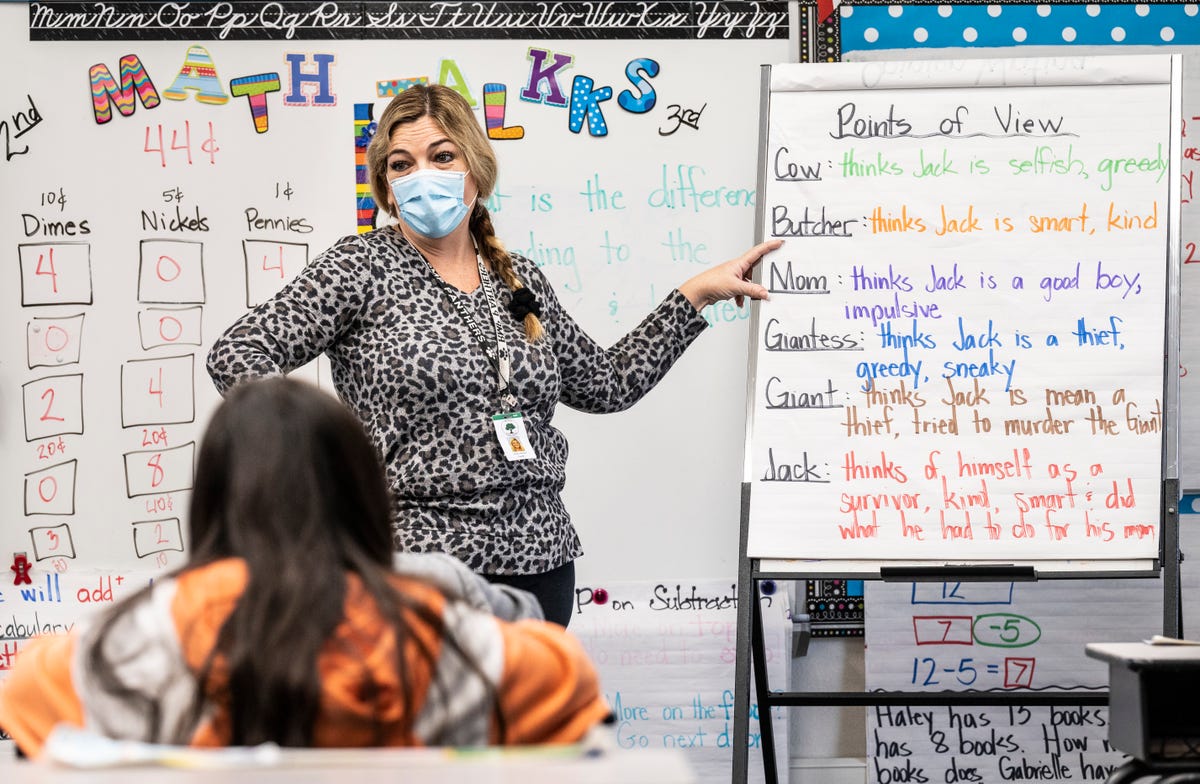
A teacher in a classroom.

Teaching in California.

Getty Images

School districts usually try to pay special ed, STEM or English learner teachers a little bit more because those professionals are harder to recruit, said Sasha Pudelski, director of advocacy at AASA, the School Superintendents Association. But sometimes salary negotiations are constrained by other factors, including union negotiations around salary schedules.

The current teacher shortage dynamic is a magnified version of the dynamic from before, especially at "high poverty schools [and among] high school teachers [in] specialized roles," said ERS' Rosenberg. Staffing for those roles is particularly difficult in "communities where there's already high turnover, which feeds itself because high turnover means you hire early career teachers and they also have high turnover," he said.

That's why Goldhaber would "make it relatively more desirable to teach disadvantaged students, because it's chronically harder to staff disadvantaged schools and districts." A study published in 2019 by ASU found that teacher turnover rates were 50% higher in Title I schools than other schools. Turnover rates among Title I math and science teachers were nearly 70% higher.

The Great Resignation that's coming -- or not

Meanwhile, the clock is ticking and parents and school administrators keep bracing for a tide of teacher resignations. So far, however, the available data and expert analysis suggest otherwise. 

Last year, ERS conducted a study among six school districts across the country to see how turnover had changed compared with pre-pandemic years. "In all six districts, turnover going into fall 2020 went down," said Rosenberg, one of the authors of the study.

Reports from the Bureau of Labor Statistics published in the last six months reflected turnover rates in the private sector reaching new highs, leading to talk about the Great Resignation. But "we actually don't have any empirical evidence suggesting that teacher turnover is rising this year," Georgetown's Aldeman said.

In reality, said Goldhaber, there's not a single comprehensive national data set about teacher employment. Besides surveys from the Bureau of Labor Statistics, the other source of the best information about teacher attrition is states' administrative databases. "We would only know if people are resigning en masse in the '21-'22 school year next fall," he said over Zoom.

But many experts I interviewed think this time it could be different. The labor market is very tight, and employees have more bargaining power than before. "It's a good time for people who want to leave teaching to leave," the University of Washington's Goldhaber said.

It's tricky because, despite all its problems, teaching can also be rewarding. When I asked the teachers about their reasons to stay, all of them replied with their own version of, "I don't think I will find a more meaningful job than this one" (as Austin teacher J.J. put it in an email).

"The relationships and interactions with my students are what drives my passion for my job and brings me joy," A.C., another teacher from Austin, who's been teaching for about 25 years, said in an email. The pandemic has taken a toll on her. Now "the things about teaching I never thought about start finding real estate in my brain. ... Every other week or so, when I am feeling particularly down and out, I entertain the idea of leaving."

Will she end up joining teachers who are leaving? "Probably not," she replied. "I teach because of the kids. They are not going anywhere so, how can I?"

After eight months at the transportation company, Nelson is teaching again. She's now offering online courses for a tutoring company, and she misses the classroom and her middle school students. "They're the love of my life. I love their stinky little hilarious selves."

Money was never the reason she left. "I was OK with [earning] $55,000 and I loved my job every day and seeing those kids every day. Sure, it'd be great to make $80,000 a year for it, but that's not why I was doing it."

The information contained in this article is for educational and informational purposes only and is not intended as health or medical advice. Always consult a physician or other qualified health provider regarding any questions you may have about a medical condition or health objectives.


Source

Tags:

IPhone SE Vs. Pixel 6A Camera Comparison: One Outshines The Other


Iphone se 2 vs pixel 6 iphone se vs pixel 5a iphone se vs iphone 6 camera google pixel 6 vs iphone se iphone se vs pixel 5a google pixel 6a vs iphone se 2022 google pixel 6a vs iphone se iphone se vs iphone 11 iphone se vs xr
iPhone SE vs. Pixel 6A Camera Comparison: One Outshines the Other


iPhone SE vs. Pixel 6A Camera Comparison: One Outshines the Other

What's happening

Google released the $449 Pixel 6A, which directly competes with the $429 iPhone SE (the 2022 version).

Why it matters

Typically phones under $500 don't have great cameras, but the Pixel 6A and iPhone SE are two of the exceptions.

What's next

We were curious which phone had better cameras, the iPhone SE or the Pixel 6A. So we spent 10 days testing both.

The new $449 Pixel 6A from Google is undoubtedly a great value in terms of cost and the features you get. But in order for a phone to be affordable, companies have to make compromises. Typically the two most common trade-offs involve downgrading a phone's processor and cameras. But with the Pixel 6A, Google took a different route than most low-cost Android phones. It has the same Google Tensor chip that powers the more expensive Pixel 6 and Pixel 6 Pro and the tried-and-true camera hardware from the Google Pixel 5.

The result? The Pixel 6A is both affordable and takes good photos and videos. But luckily for us, it's not the only phone to do so. Apple's $429 iPhone SE (2022) also aims to be thrifty and have a good camera. So naturally, I had to compare the two.

Keep in mind that both Apple and Google use machine learning and processing to counter the limitations from their tiny lenses and camera sensors. The iPhone SE gets its wallet-friendly price because it essentially has an iPhone 8 body and camera hardware but the A15 Bionic chip from the iPhone 13 Pro, which costs twice as much. That processor does a lot of heavy lifting to breathe new life into camera hardware that originally came out in 2017.

After spending 10 days taking photos and recording videos around San Francisco, I realized two things. The first is that the Pixel 6A and iPhone SE are two of the best low-cost phones you can buy that have good cameras. The second is that one of these phones consistently took better photos than the other. And this surprised me.

Read more: Google Pixel 6A Review: The Best Android Phone Under $500

Sometimes two cameras are better than one

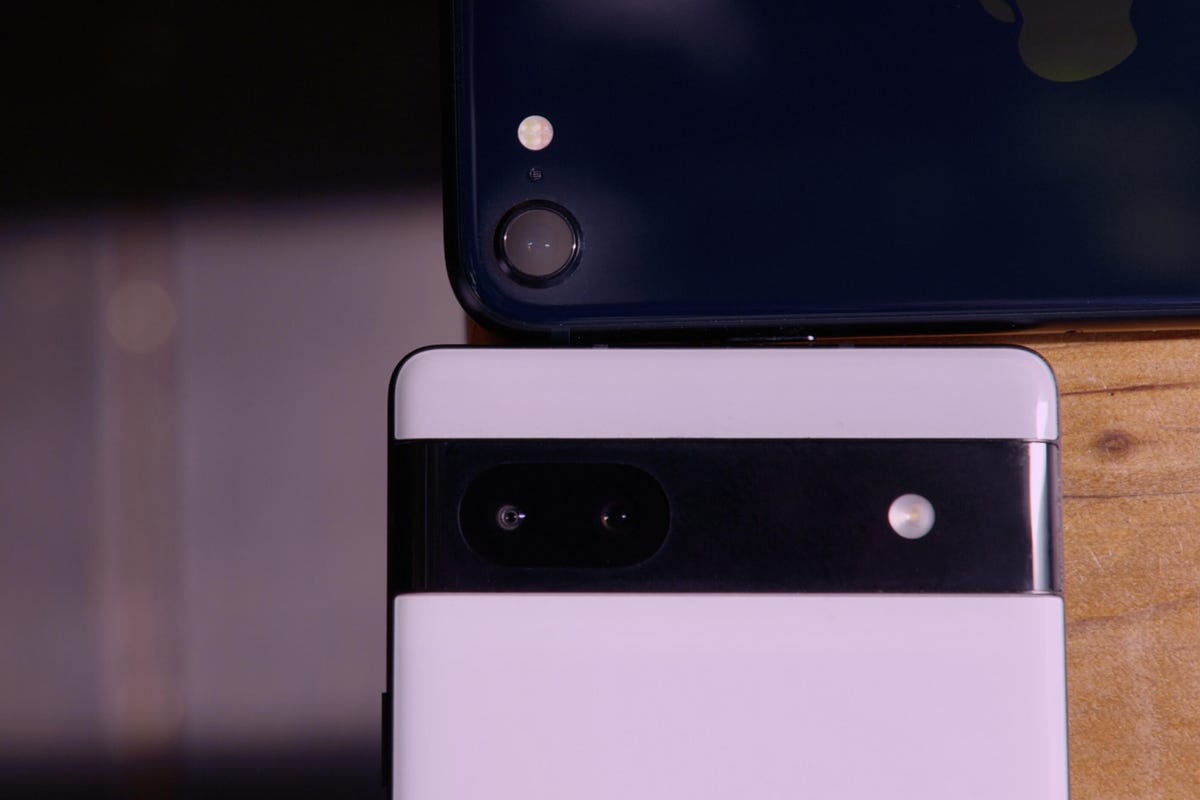
In a world where companies try to cram as many cameras, even if they're mediocre, into a low-cost phone, it's refreshing to see that Apple and Google don't. Thankfully you won't find a sub-par telephoto camera or a craptacular macro camera on either phone. Instead, the iPhone SE has a single 7-megapixel selfie camera and a single 12-megapixel, wide-angle camera with OIS (optical image stabilization) on the back.

The Pixel 6A has a single 8-megapixel selfie camera, and two rear cameras: a 12.2-megapixel camera with an optically stabilized wide-angle lens and a 12-megapixel camera with ultrawide-angle optics. Right off the bat, this gives the Pixel a bit of an edge as it instantly becomes more versatile to use, especially in tight spaces.

The Pixel 6A can shoot raw or JPEG photos, while the iPhone SE can only take JPEG pictures.

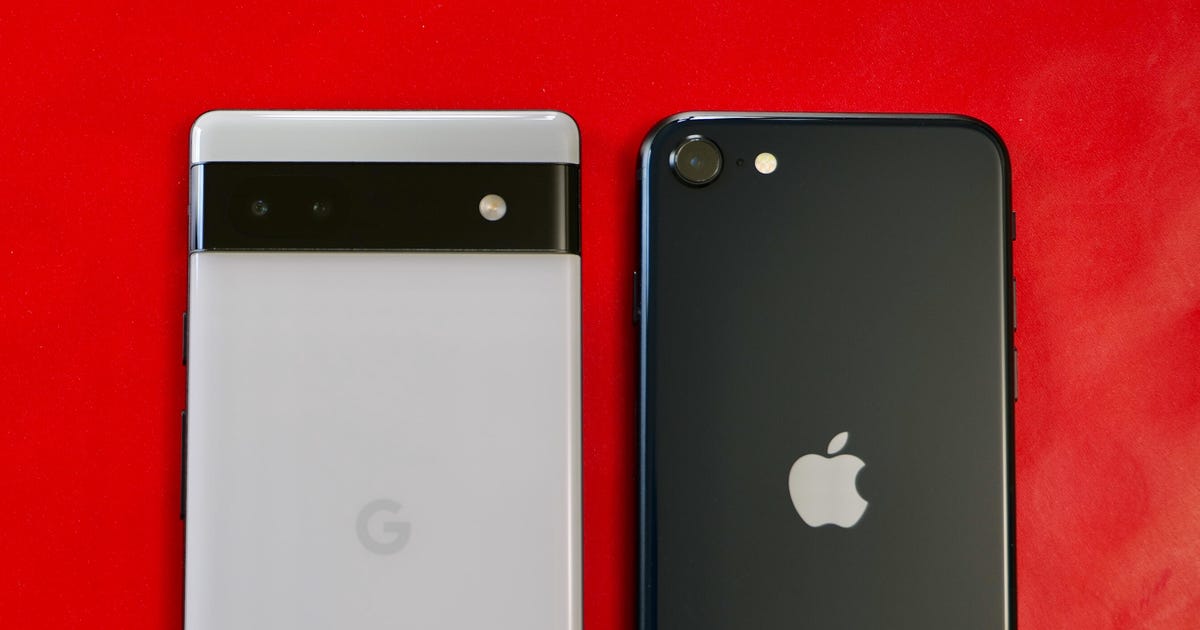
The iPhone SE next to a Pixel 6A

The iPhone SE has a single rear camera while the Pixel 6A has two: one with a wide-angle lens and the other with an ultrawide.

Celso Bulgatti/CNET

Photos taken under good lighting

I am genuinely impressed by photos from both phones. Below are some of my favorite pictures that I took with the iPhone SE and Pixel 6A.

A row of houses each painted a different color

I like the way the Pixel 6A captures the colors of these houses.

Patrick Holland/CNET
three people wearing masks posing for a selfie

A group selfie taken with the Pixel 6A.

Caitlin Petrakovitz/CNET
A brass skull

Notice the texture and patina that the Pixel 6A captured.

Patrick Holland/CNET
A line of people waiting outside a bakery

This iPhone SE photo was taken under some very bright morning sunshine.

Patrick Holland/CNET
A cluster of palm trees in a park

I like the detail and colors in the palm trees in this photo from the iPhone SE.

Patrick Holland/CNET
The corner of the San Francisco Women's Building

This iPhone SE photo of the Women's Building in San Francisco has a nice mix of colors and detail.

Patrick Holland/CNET

But let's take a look at some photos from both phones to compare their quality. Below are photos I took outdoors of a cappuccino. The Pixel's photo has more contrast, whereas the iPhone's picture emphasizes brightness.

The photos below were taken while we were filming the companion video for this comparison. I was shocked by the different ways each phone made my pal and CNET colleague Celso Bulgatti look. The iPhone's photo made his hair look all gray, which I must stress it isn't. My guess is that the SE is trying to boost the shadows and reduce the contrast too much in order to make the photo brighter. On the other hand, everything in the Pixel's photo is more accurate.

Pictures taken in medium lighting and indoors are typically where cameras at this price point start to fall apart. Take a look below at photos I took of Maisie the cat. The photo from the Pixel 6 nails the texture of my cat's fur. It also has more detail and a better dynamic range than the iPhone's photo.

Ultrawide vs. wide-angle

One of the most obvious differences between the two phones is the fact that the Pixel 6A has a second camera with an ultrawide-angle lens and the iPhone SE doesn't.

A view from the balcony of a coffeeshop

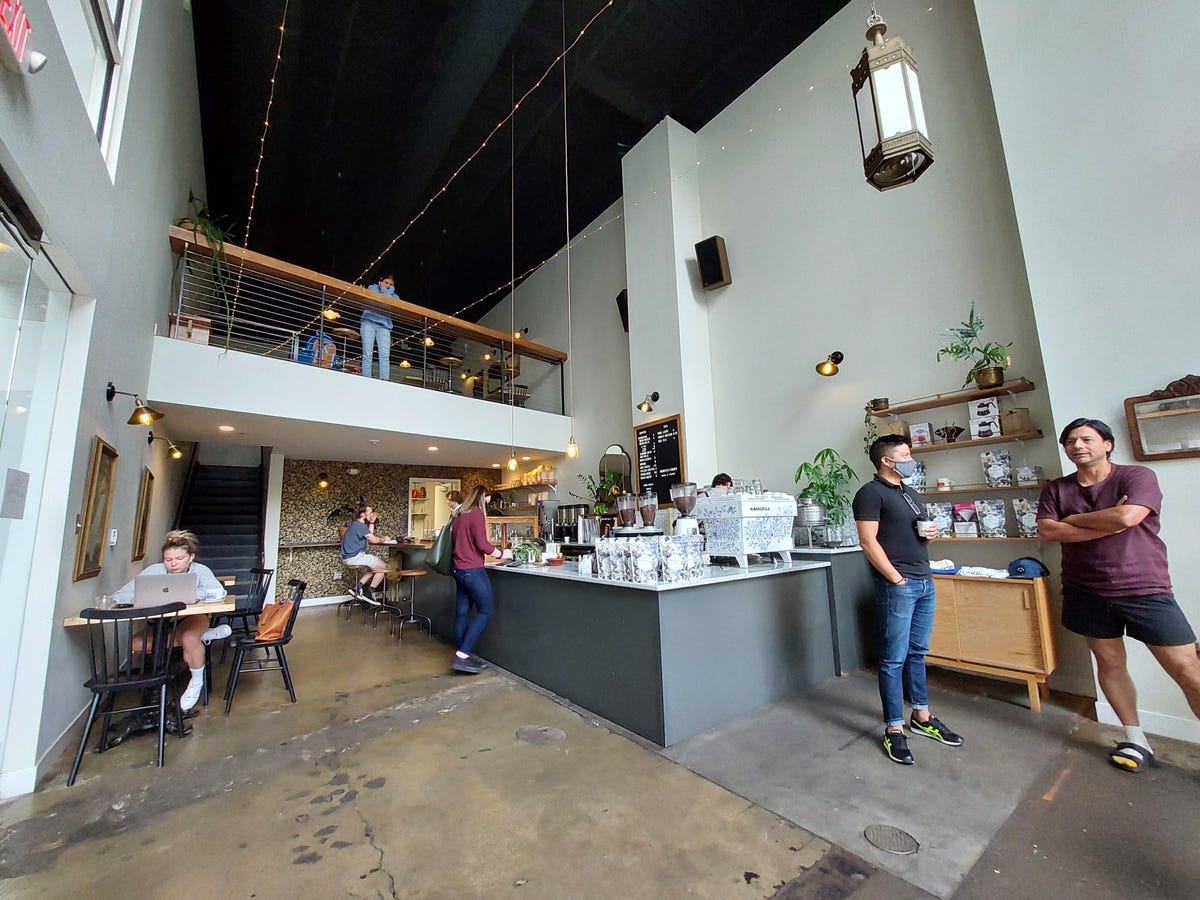
The Pixel's ultrawide perfectly captures the dramatic view from the balcony inside Sightglass Coffee in San Francisco.

Patrick Holland/CNET

It's one of those things that you don't realize how much you use until you don't have it. There were numerous times where it came in handy whether that's capturing a city skyline without cutting off the tops of buildings like in the photos below.

Below are photos I took from the Craftsman and Wolves cafe in the Mission. The iPhone's photo barely fits all of the people in line. The Pixel's ultrawide photo shows more of the restaurant including the bakery counter, menus and ceiling.

Portrait mode: It's all about the cutout

Apple and Google are no stranger to Portrait mode which adds an artistic blur to the background of a photo. Previous iPhone and Pixel models offer some of the best Portrait modes you can find on any phone right now. But they're also very different.

Check out the Portrait mode photos below of my pal and CNET colleague Claire Reilly. The most obvious difference between the two pictures is that the Pixel's photo has a more out-of-focus background. On the iPhone SE, you can change how much background blur there is before or after taking a photo, which is helpful. But in the photo of Claire, I opted to let the SE choose how blurry to make the background.

Claire's cutout is good in both photos, but take a close look at the inside of her elbow. The SE didn't blur the background in that area.

The iPhone SE is missing night mode

Let's move on to night mode, which typically takes multiple images and combines them into a photo in order to improve the brightness and detail. This is an unfair comparison, because the Pixel 6A has a night mode, called Night Sight, and the iPhone SE doesn't.

The marques for the Roxie movie theater

This photo was taken using the Pixel 6A's Night Sight mode.

Patrick Holland/CNET

I took the photos below of a dark street around 10 o'clock at night. The iPhone's photo is much darker than the Pixel's Night Sight picture. To compensate for the darkness, the iPhone applies a lot of noise reduction, which makes the details soft. In particular look at the no parking signs in the background. You can't really read them in either photo, but you can at least see the words "parking" and "anytime" in the Pixel's picture. In the iPhone's photo, it looks like someone smeared the signs out.

Below are a couple photos I took inside a bar. Again, you can see the iPhone's photo is much darker with the shadows crunched to black. There's a lot less detail. The Pixel's Night Sight photo is brighter. Take a look under the bar where the stools are. Those stools are almost in complete darkness in the iPhone's photo. But in the Pixel's photo, you can see the detail of the wood slats that the stools are pressed up against.

The Pixel 6A offers wide and wider selfies

Each of these phones has a single selfie camera but the one on the Pixel 6A can switch between a wide view to an ultrawide view for group selfies. The iPhone's selfie camera is stuck at a rather narrow field of view. 

In the selfies below, notice the difference in details. The iPhone's picture is soft while the Pixel's photo is sharper and has a bigger depth of field, which helps keep everyone in focus for group shots.

The iPhone's video quality is hard to top

Both phones record 4K or 1080p resolution video at 30 or 60 frames per second. But the iPhone can also record at a more cinematic 24fps. Both phones have video stabilization, but you can dial in what kind of stability you want on the Pixel 6A. For example, there's an option called Cinematic Pan that steadies a panning shot.

In terms of image quality, the iPhone SE is a step ahead here. Videos have good dynamic range, little to no noise and details look crisp. Videos from the Pixel 6A look soft and often have image noise in the shadows. For video examples from both phones check out the companion video to this story.

Final verdict

After all of this testing, I do have a favorite. But let me say this. For phones that are under $450, both the iPhone SE and Pixel 6A are among the best you can buy to capture good photos and videos. But after doing this comparison, I'd grab a Pixel 6A. It's got an ultrawide-angle camera, and that Night Sight mode, which means more versatility. The iPhone SE does capture better video in terms of image quality, but the Pixel 6A's videos are still pretty good.


Source

Galaxy A52 5G Review: Samsung's Best Budget Phone With Flagship Features


Samsung galaxy a52 5g review samsung galaxy a52 5g 128gb black review samsung galaxy a52 5g review youtube samsung galaxy a52 5g review uk galaxy a52 5g specs galaxy a52 5g manual galaxy a52 5g galaxy a52s review
Galaxy A52 5G review: Samsung's best budget phone with flagship features


Galaxy A52 5G review: Samsung's best budget phone with flagship features

With the Galaxy A52 5G, Samsung found an appealing balance between price, features and making smart compromises. It's the latest good sub-$500 5G phone and joins the nearly half a dozen phones from Motorola, OnePlus and TCL. The Galaxy A52 5G costs $500 or £399 (it isn't sold in Australia but that converts to AU$740). That's at the higher end of what's considered an affordable phone. The A52 5G also straddles the line between being a good affordable 5G phone and a fantastic one. The only other sub-$500 phones that do that are the iPhone SE, which doesn't have 5G, and the Google Pixel 4A 5G, which is now almost a year old.

The A52 5G has a high refresh rate display, years of OS and security support, a good main camera and good battery life. It has features that the more expensive Galaxy S21 and S21 Ultra lack like: a headphone jack, expandable storage and the inclusion of a wall charger in the box.

Read more: The best USB-C PD chargers of 2021

Like

  • 120Hz high refresh-rate display
  • Good battery life on 5G
  • Wonderful software upgrade support
  • Simple, clean, unified design
  • Good main camera with OIS

Don't Like

  • Fingerprint sensor is too low on screen
  • Macro camera is mediocre
  • Duplicate apps
  • 4K video recording lacks stabilization

As with any phone, even a good one, not everything is roses and sunshine. The in-screen fingerprint reader is so annoying to use that I preferred to enter my PIN to unlock the phone. The mediocre macro camera seems like a frivolous add-on that is only there to boost the total number of cameras on the phone. More is definitely not better. There are many duplicate apps like Samsung's version of an internet browser and photo gallery app in addition to the ones from Google.

But after two months, when I step back and consider everything, the Galaxy A52 5G is an all-around good phone with some great features and a few minor and annoying flaws. It's a solid buy for $500, but as I write this review, you can get a Galaxy A52 5G unlocked on Samsung's website for $425, which makes it even harder to pass up.

Samsung Galaxy A52 5G
Sarah Tew/CNET

Galaxy S21 Ultra-inspired looks in a plastic reality

The build is good. It's not premium and that's fine, because it feels good. When you tap on the back you can definitely tell it's plastic. (So don't tap on the back.) The look of the phone is clean. It has curved plastic edges, symmetrical thin bezels around the screen and a matte finish. The camera bump loosely echoes the one on the Galaxy S21 Ultra, in the same way my haircut does Kit Harrington's.

Over two months, the phone collected its share of nicks along the sides. The matte finish back definitely doesn't look fresh or new. Most people will inevitably put the phone in a case, so that shouldn't be an issue.

The A52 5G is rated IP67 for water and dust resistance and can be submerged under three feet of water for up to 30 minutes.

Galaxy A52 5G has a 120Hz high refresh rate display

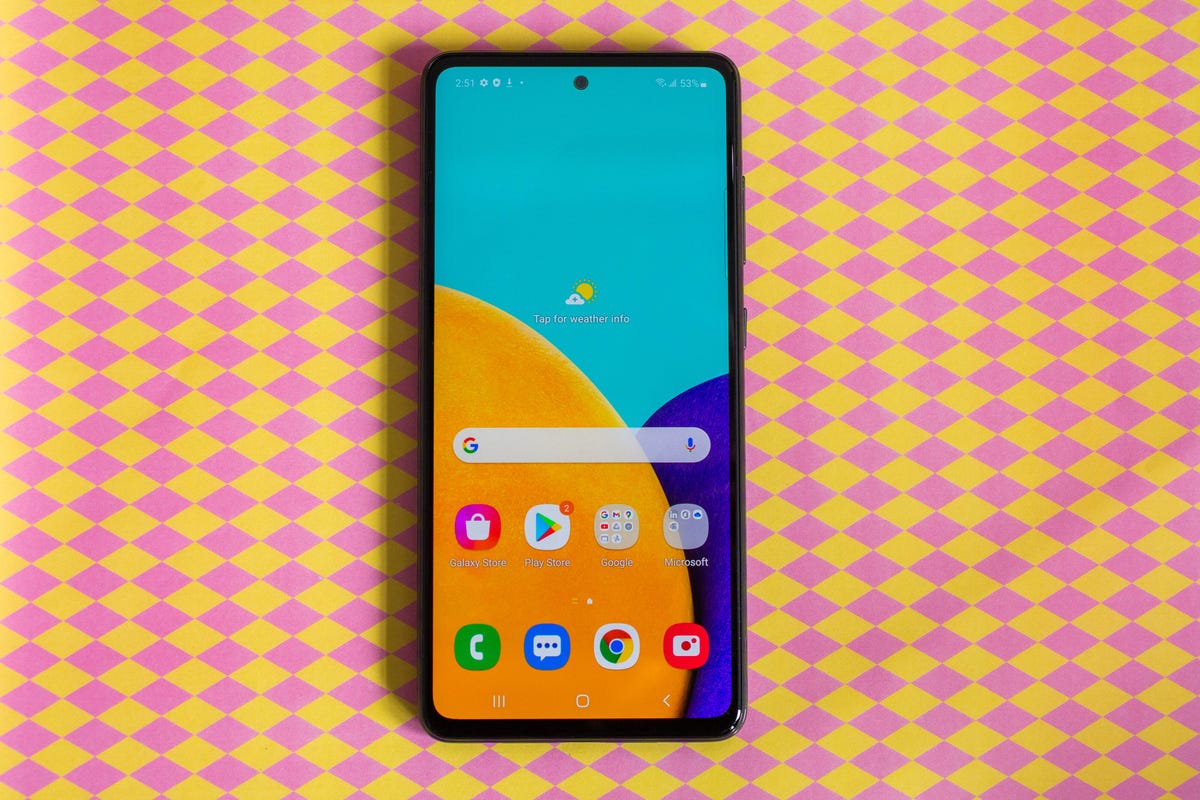
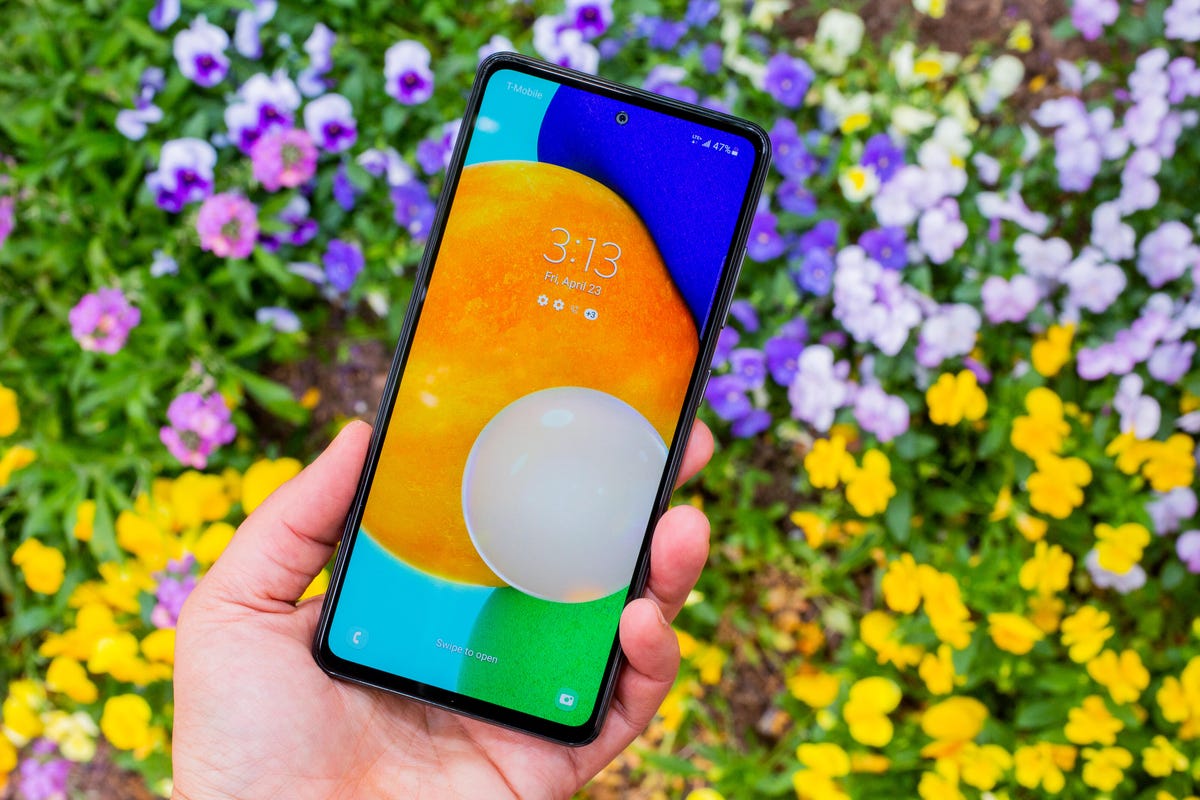
On the front is a 6.5-inch full-HD display with a hole-punch cutout for the selfie camera. The display is high-refresh rate and can be set to either 120Hz or 60Hz. At 120Hz, animations look smooth, gaming feels more immersive and even mundane things like scrolling through a feed look crisp. The display is without a doubt the best feature on the phone.

Brightness is good. Most displays on budget phones have horrible brightness, especially outdoors. Topping it all off is a slab of Gorilla Glass 5. Beware if you leave your phone screen down on a table and unattended. The coating will make it slide off a seemingly flat surface all on its own.

Let me level some expectations. This display isn't as good as the one on the Galaxy S21. But it is really good for $500.

The biggest downside to the design and display is the in-screen optical fingerprint sensor. The position of it feels low for one-handed use. I can rarely get the fingerprint reader to unlock the phone on the first attempt. I find it easier to just swipe up and enter a PIN.

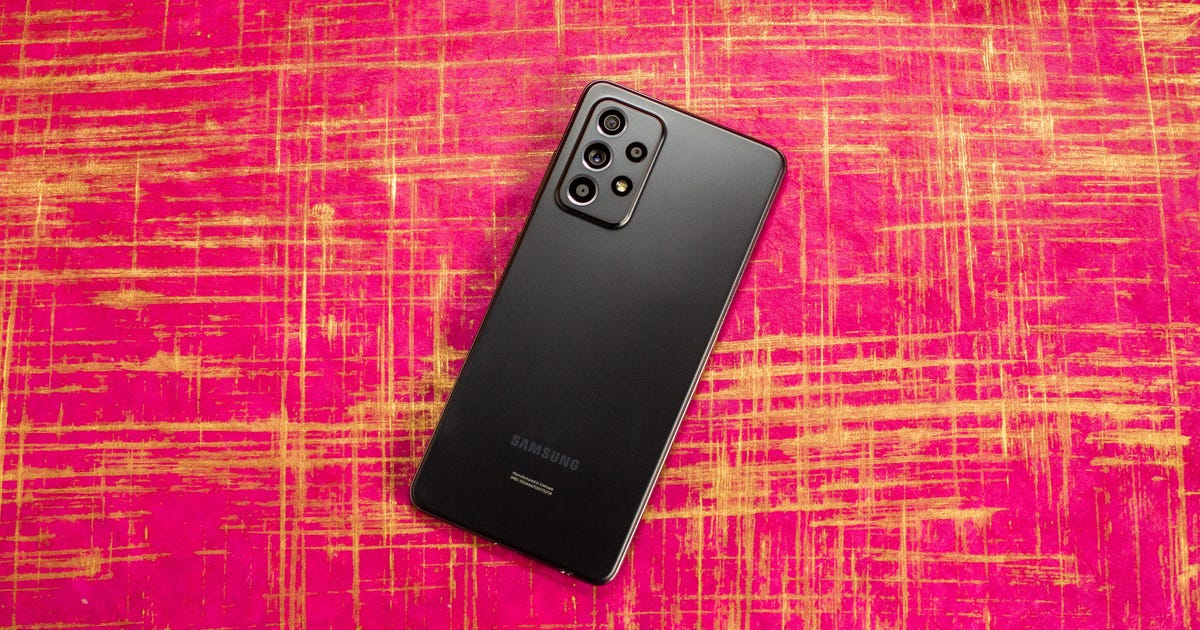
Samsung Galaxy A52 5G

There are four cameras on the rear of the Galaxy A52 5G: A main wide-angle camera, an ultrawide camera, a macro camera and a depth camera.

Sarah Tew/CNET

The Galaxy A52 5G has four rear cameras, but only the main one is good

There are four rear cameras on the A52 5G, one of which is a depth-sensor that works with the main camera to give you some absolutely fun and ridiculous AR effects and decent portrait mode photos.

Galaxy A52 5G macro camera

The macro camera is a bit of an odd duck. It allows you to focus close like on the foam of a cortado. But the margin of error between your subject being in-focus and out-of-focus is incredibly thin. I wish there was focus peaking available to see when you have focus on your subject.

Patrick Holland/CNET

There's a macro camera. And (sigh) we've seen this from other phone companies. It's not that most people probably won't use a macro camera on a phone, it's that compared to the main camera on the A52 5G, the macro camera isn't great. It allows you to focus closer, but you need to be steady. You're just a handshake or breath away from being out of focus. I wish there was focus peaking on the macro camera to help you see when your subject is in focus and when it's not. Pro Mode offers focus peaking but for the main camera only.

Galaxy A52 5G ultrawide camera

The ultrawide camera is fun. It gives you a great exaggerated perspective.

Patrick Holland/CNET

The A52 5G has a decent ultrawide-angle camera. The main camera has optical image stabilization and a 64-megapixel sensor that combines pixels for a 16-megapixel photo with good detail and brightness.

Galaxy A52 5G ultrawide camera

In good light, image quality from the ultrawide camera is decent. It's still a step behind the main camera in terms of dynamic range and image noise.

Patrick Holland/CNET

Photos from the main camera are good. Your personal taste will vary when it comes to the amount of color saturation. To me, it's a touch oversaturated but still looks good.

Galaxy A52 5G main camera

Red cars go faster, right? Colors from the A52 5G are punchy.

Patrick Holland/CNET
Galaxy A52 5G main camera

The A52 5G did well grabbing focus on a very curious beagle. 

Patrick Holland/CNET
Galaxy A52 5G main camera

This shot really pushed the A52 5G to its limits. Highlights start to blow out, but details are pretty good in the leaves.

Patrick Holland/CNET
Galaxy A52 5G main camera

The A52 5G doesn't have a dedicated telephoto camera and instead relies solely on digital zoom. I took this photo with 3x digital zoom.

Patrick Holland/CNET

In lower light situations, you start to see the main camera's weakness. There is a Night mode to help, and photos look decent but you're not going to get the same results as Night mode on the Galaxy S21.

Galaxy A52 5G main camera

In mixed lighting, the main camera does OK. Details start to look soft and noise correction starts to make skin tones smudge.

Patrick Holland/CNET
Galaxy A52 5G main camera

In low light, details start to look soft almost like a painting with all the noise reduction the A52 5G applies.

Patrick Holland/CNET
Galaxy A52 5G main camera

Night mode can create some eye-catching shots. But things look very processed compared to Night mode photos from the Galaxy S21 and S21 Ultra.

Patrick Holland/CNET

The A52 5G can record 4K video which in good light is good but as it gets darker, image noise and artifacts become more apparent. Curiously, you can't use the optical image stabilization when recording 4K video. But if you drop down in resolution to 1,080P video, you can use Super Steady which works very well. Take a look at the video below to see sample clips shot with the Galaxy A52 5G.

The selfie camera has a 32-megapixel sensor and Samsung's full-arsenal of face-smoothing, jawline-defining and eye-enlarging tools. And then there's Fun mode that lets you use Snapchat AR filters without using Snapchat. You can use Fun mode with the main and depth cameras on the back or the selfie camera. Fun mode actually lives up to its name.

Galaxy A52 5G Fun mode

With Fun mode, I can finally be the brunette with cat-eye glasses I've always wanted to be.

Patrick Holland/CNET

To put this all into perspective, both the iPhone SE and Google Pixel 4A 5G have better overall camera systems for photos and videos -- both also have fewer cameras. That speaks less about the A52 5G's camera prowess and more about what Apple and Google are able to put into their phones.

Peppy Android performance for the price

The A52 5G has a Qualcomm Snapdragon 750G chip with 6GB of RAM. It runs Android 11 and at the time I'm writing this, runs the July 2021 software update. Performance is good. It's not blazing fast which is apparent with the small delay that occurs when I open the camera from the lock screen, or rotate the phone between portrait and landscape.

In benchmark tests it scored ahead of the Google Pixel 4A 5G and just behind the Motorola One Ace 5G. See the results of our benchmark tests below.

GEEKBENCH V.5.0 SINGLE-CORE

Note:

Longer bars indicate better performance

GEEKBENCH V.5.0 MULTICORE

Samsung Galaxy A52 5G

Note:

Longer bars indicate better performance

3DMARK SLINGSHOT UNLIMITED

Samsung Galaxy A52 5G

Note:

Longer bars indicate better performance

It has Samsung's OneUI 3 interface, which I enjoy using. It's clean and friendly to one-handed use. There are several duplicate apps, which is annoying. But all Samsung phones, no matter the price, do as well. One of the best parts of the Galaxy A52 5G is that you get three generations of Android OS updates and at least four years of security updates. This is still a rarity for Android budget phones.

5G for less than $500 and good battery life

As the name indicates, this is a 5G phone that works on sub-6 5G networks in the US. I tested it in Greenville, South Carolina on T-Mobile and speeds were just OK. Despite an onscreen 5G indicator, many times the phone was actually connected to 4G LTE. This has everything to do with T-Mobile's coverage as the same thing happened when I tested other phones on T-Mobile here.

The A52 5G has a 4,500-mAh battery. Samsung claims two days of use when fully charged. I reliably got one day with the display at 120Hz. On days with lighter use or when the display was set to 60Hz, it easily lasted a day and a half.

Samsung Galaxy A52 5G

Even with the screen's refresh rate set to 120Hz, the Galaxy A52 5G lasted 17 hours and 40 minutes in our battery tests.

Sarah Tew/CNET

In our CNET battery tests with continuous video playback in airplane mode, it lasted a respectable 17 hours, 40 minutes and that was with the display set to 120Hz. That's longer than the OnePlus 9 Pro and the iPhone SE. In the same test, Motorola and its budget phones scored four of the five longest times of any phone this year. Keep in mind, none of these Motorola phones have a high refresh rate display.

It doesn't have wireless charging which is a wise omission, but it does support 25-watt fast charging. It's just that the included charger is only 15 watts.

Samsung Galaxy A52 5G specs vs. Motorola One 5G Ace, Google Pixel 4A 5G, Apple iPhone SE


Samsung Galaxy A52 5G Motorola One 5G Ace Google Pixel 4A 5G Apple iPhone SE (2020)
Display size, resolution 6.5 inch FHD+ Super AMOLED, Infinity-O Display (1080 x 2400 pixels), 120Hz 6.7-inch FHD+ LCD, 2,400x1,080 pixels 6.2-inch FHD+ OLED; 2,340 x 1,080 pixels 4.7-inch Retina HD LCD; 1,334x750 pixels
Pixel density 407ppi 394ppi 413ppi 326ppi
Dimensions (Inches) 2.95 x 6.29 x 0.33 inches 6.54 x 3 x 0.39 in 6.1 x 2.9 x 0.3 in 5.45 x 2.65 x 0.29 in
Dimensions (Millimeters) 75.1 x 159.9 x 8.4mm 166.1 x 76.1 x 9.9mm 153.9 x 74 x 8.2 mm (Sub-6 only); 153.9 x 74 x 8.5 mm (mmWave + Sub-6) 138.4 x 67.3 x 7.3 mm
Weight (Ounces, Grams) 6.67 oz; 189g 7.49 oz; 212g 5.93 oz; 168g (Sub-6 only); 6.03 oz; 171g (mmWave + Sub-6) 5.22 oz; 148g
Mobile software Android 11 Android 10 Android 11 iOS 14
Camera 64-megapixel (main), 12-megapixel (ultrawide), 5-megapixel (depth), and 5-megapixel (macro) 48-megapixel (wide), 2-megapixel (macro), 8-megapixel (ultrawide) 12.2-megapixel (wide), 16-megapixel (ultrwide) 12-megapixel (wide)
Front-facing camera 32-megapixel 16-megapixel 8-megapixel 7-megapixel
Video capture 4K 4K 4K 4K
Processor Snapdragon 750G 5G Snapdragon 750G 5G Snapdragon 765G Apple A13 Bionic
Storage 128GBGB 128GB 128GB 64GB, 128GB, 256GB
RAM 6GB 6GB 6GB NA
Expandable storage Up to 1TB Up to 1TB No No
Battery 4,500 mAh 5,000 mAh 3,800 mAh NA, Apple claims it has the same battery life as iPhone 8
Fingerprint sensor Optical in-screen Rear Rear Home button
Connector USB-C USB-C USB-C Lightning
Headphone jack Yes Yes Yes No
Special features 5G-enabled, 120Hz display, IP67 rating for water and dust resistence, 25W Fast Charging 5G enabled, IP52/54 rating for water and dust resistence (IP54 for T-Mobile) 5G enabled; dual-SIM capabilities (nano-SIM and e-SIM); fast charging Water resistant (IP67); dual-SIM capabilities (nano-SIM and e-SIM); wireless charging
Price off-contract (USD) $500 $400 $499 $399 (64GB), $449 (128GB), $549 (256GB)
Price (GBP) £399 N/A, converts to £280 £499 £419 (64GB), £469 (128GB), £569 (256GB)
Price (AUD) N/A, converts to AU$740 N/A, converts to AU$500 AU$799 AU$749 (64GB), AU$829 (128GB), AU$999 (256GB)

Source

https://tersoalp.pops.my.id/

.

Search This Blog

Menu Halaman Statis

close