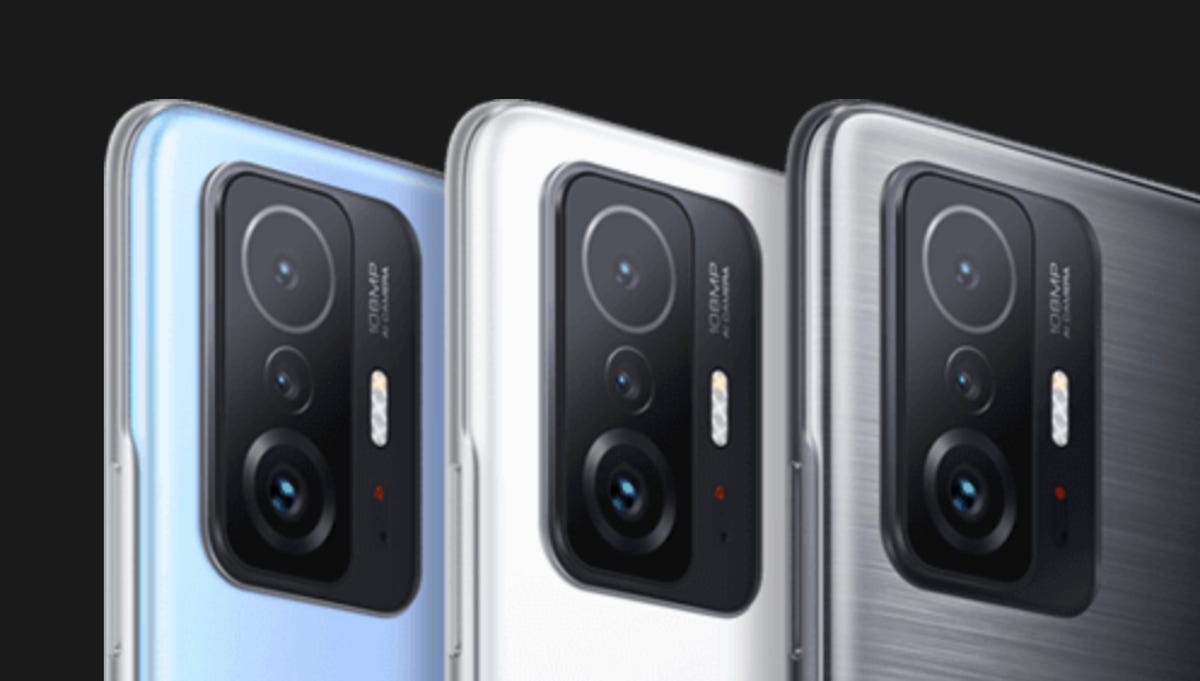
Here is one of the pictures featuring the Apple 11. Numerous images associated with the Apple 11 can be utilized as your point of reference. Below, you'll find some additional pictures related to the Apple 11.
Apple's 11-Inch iPad Pro (2021) With M1 Drops to Its Lowest Price Yet
Apple's 11-Inch iPad Pro (2021) With M1 Drops to Its Lowest Price Yet
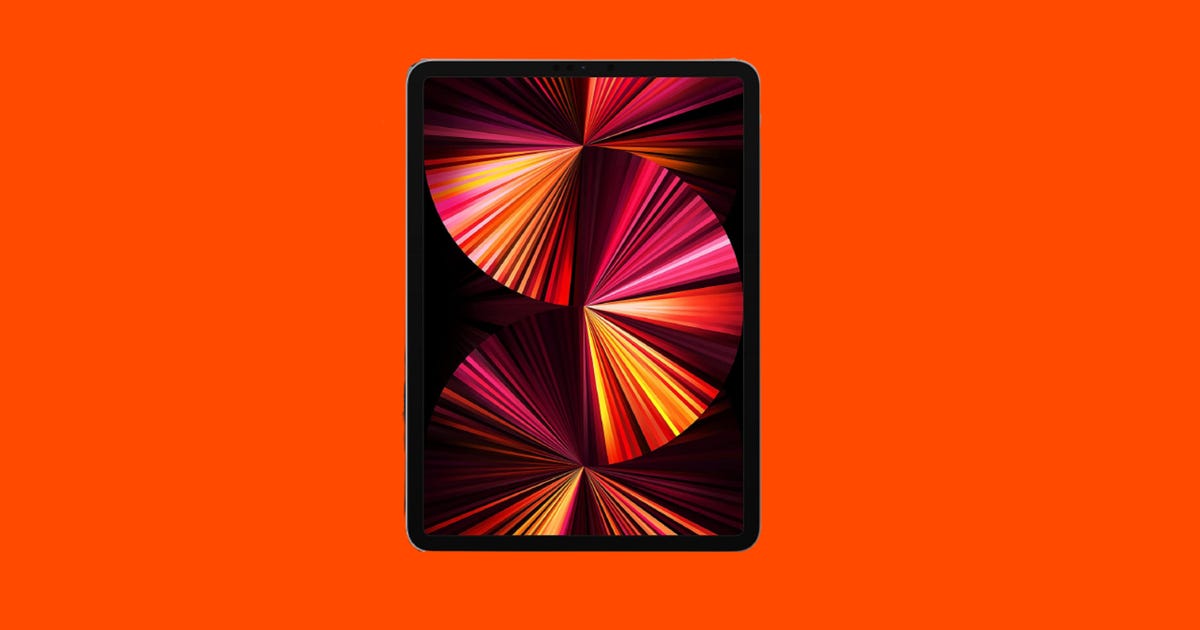
Apple pulled out all the stops when it unveiled the 2021 iPad Pro last year. It's equipped with an M1 chip, an 11-inch Liquid Retina display, Thunderbolt connectivity, Wi-Fi 6, Face ID and all-day battery life. All of this performance comes at a cost, but right now you can grab one for $384 off today on Amazon. It's not clear how long this deal will last, so grab yours at this low price while you can.
The 1TB tablet, which is usually $1,499, is now 25% off, so you can have it for $1,117. You can combine it with a 20% off offer on Beat Studio Earbuds or Beats Fit Pro. Go up in memory space and get the 2TB model for $1,650 (a $200 coupon will be applied at checkout), or go down to 512GB of storage for $946 (save $153).
Another apple event oct 18 could unleash next gen silicon labs another apple event oct 18 could unleash next gen silicone another apple event oct 18 could unleash the archers another apple event oct 18 could unleash meaning another apple event oct 18 could unleash the kraken another apple event oct 18 could unleash the light another apple event oct 18 could unleash the dragon another apple event oct 18 2021 how to use another apple id on iphone create another apple id
Another Apple event: Oct. 18 could unleash next-gen Silicon Macs
Another Apple event: Oct. 18 could unleash next-gen Silicon Macs
Apple's already had a busy fall, releasing the iPad Mini, Apple Watch Series 7 and iPhone 13. Now, it's got "one more thing" to show us. The tech giant announced a new online-only event planned for Monday, Oct. 18, at 10 a.m. PT, 1 p.m. ET, 6 p.m. UK and 3 a.m. Tuesday AEST. Apple's event will be streamed live via the company's website. (Here's everything we know about the October Apple Unleashed event so far.)
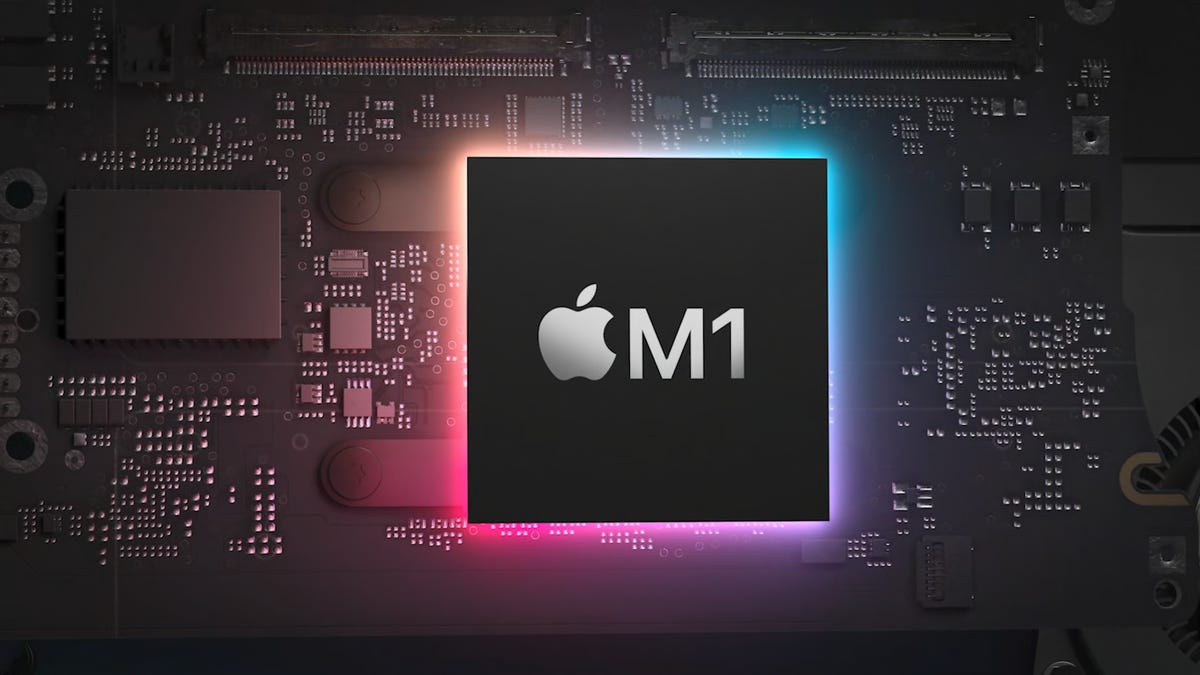
Apple is expected to announced its next-generation Mac computers, powered by the company's own Apple Silicon chips. Over the past year, it's released new versions of its MacBook Air, MacBook Pro, Mac Mini and iMac computers, powered by Apple's M1 chip. The company also released a surprise M1-powered iPad Pro last year.
Read more: Apple unveils new AirPods 3, Voice plan, HomePod Mini colors and MacBook Pro models
The company's October event won't have the same draw as its September one, during which it announced the Apple Watch Series 7, new iPads and iPhone 13 lineup ahead of the holiday shopping season. Last year, Apple held three major product releases around the fall months, separating out announcements for its latest Apple Watches, iPads, iPhones and Mac computers. The releases helped propel Apple's sales and profit to their highest levels in the company's history, setting revenue records for the company's iPhones, iPads and Mac computers.
Part of the company's standout success was its new M1 computers, which were praised by reviewers like CNET's own Dan Ackerman, who cited the MacBook Air M1's speed and battery life. Customers liked them too, Apple said, helping push Mac sales to record levels.
During this year's Mac-related event, Apple's expected to expand that lineup further with its rumored next-generation M1X chip. The chips are said to offer faster performance. Apple previously powered its computers with chips made by Intel, used in Apple laptop and desktop computers sold since 2006. (Intel, meanwhile, has released a series of ads bashing Apple while talking up its newest chips as well as Microsoft's new Windows 11 software.)
Apple's also expected to announce the release date of its latest free software update for Mac computers, called MacOS Monterey.
Read more:MacBook Pro 2021: Release date, price, M1X and all the other rumors we've heard
As is typical, the company didn't say what its product event will be about, but it offered some clues in its announcement. Apple SVP of Marketing Greg Joswiak tweeted an image similar to the announcement teaser about Apple being "unleashed."
Apple's used this type of language in the past when talking about its computers, and particularly its newest M1 devices. The company's highlighted their speed and performance over previous Intel-powered Macs, as well as the competition. So it's no surprise that whatever Apple has up its sleeves for this upcoming event, we'll be hearing a lot about how speedy they are.
Apple included an AR-experience on its website to coincide with its announcement that iPhone and iPad users can access by clicking on the event teaser image. The AR experience largely mirrors the invite, with lights passing by as if you're speeding through space. It also has guitar riffs reminiscent of 1980's-era Hollywood car chases, just to give it that extra-speedy vibe.
CNET's global team will cover Apple's event, as it's done with other conferences that have shifted online. Our coverage will include the real-time updates, commentary and analysis you can only get here.
§
Update, Oct. 25: At Apple's fourth product launch event of 2021, the company unveiled Apple Music's "Voice" plan, new HomePod Mini colors, the AirPods 3, an upgraded MacBook Pro M1 16-inch and 14-inch model with MagSafe charging, HDMI ports and updated cameras. The new laptop also ditches the Touch Bar. Here's how you can buy Apple's new MacBook Pros. Original story follows.
If you've been holding off on shelling out for a new MacBook Pro out of FOMO or indecision, Apple may soon hold the answers you've been waiting for. The company announced its next event, slated for today, with an invitation theme of "unleashed," indicating we're finally going to hear about Apple's high-performance systems. (Here's how to watch Apple's October event live and what we expect to see.)
As we get down to the wire, rumors signal that not only is a 14-inch MacBook Pro model on the horizon, both it and a new 16-inch may sport new, high pixel-density Mini-LED-based screens, along with a new higher-powered version of Apple's M1 processor similar to that of the 12.9-inch iPad Pro, the return of much-missed connectors and the ditching of the not-much-loved Touch Bar.
The upcoming announcements follow Apple's big event in mid-September where the company showed off the iPhone 13, Apple Watch 7, iPad Mini 6 and updated entry-level iPad.
Read more:No Macs at the Apple iPhone 13 event, but the year isn't over yet
When will the new MacBook Pros be announced?
It's almost a given that the company will launch new MacBook Pros and possibly other new Macs. This jibes with Mark Gurman's assertion in a recent Power On newsletter that he expects new MacBook Pro models to debut sometime this month. He previously speculated the new models would arrive by the end of this year.
Apple's "Unleashed" invitation to its event on October 18.
Apple
A more powerful Apple M1X (or M2) CPU?
This is pretty much a given. Apple's M1 CPU has made it as far as the MacBook Air, 13-inch MacBook Pro, 24-inch iMac, Mac Mini and iPads, but thus far we haven't seen any of Apple's home-grown silicon in systems for power users. Multiple sources agree that there will be a new version of the CPU -- and it's reportedly already in production -- for the larger MacBook (currently a 16-inch screen version) and possibly for upcoming new desktops.
There've also been rumors that there will be two variants of the new chip, both with 10 cores (eight high-performance and two energy efficient), but with different integrated graphics core configurations: 16 or 32. In contrast, the M1 has eight cores, split equally between performance and power saving, and either seven or eight graphics cores. Doubling or quadrupling the number of cores promises significantly better performance that, in combination with the tight integration with MacOS, could rival the performance of a discrete AMD GPU. And it's unclear whether a discrete GPU remains an option.
A higher-power version of Apple's M1 chip may be on the horizon.
Screenshot/Apple
Having two variants (with rumors of future versions with even more core options intended for the Mac Mini and Mac Pro) makes a lot of sense: In my testing, the M1 chip has performed almost identically regardless of device, giving the iPad as much power as the Mac Mini. That doesn't make sense for buyers of high-end equipment, where opting for a lesser processor can potentially save you thousands or where a discrete GPU may be essential.
The two variants could explain why guesses about the name of the new CPU, M1X or M2, haven't tipped conclusively toward one or the other.
As for Intel offerings, we began hearing predictions that there wouldn't be Intel versions of the MacBook Pros as early as last January -- and there haven't been any indications to the contrary to date.
When will we be able to buy them?
Thanks to chip shortages, you probably won't be able to get one right after they're announced. Earlier this month there were reports that the shortages would at least delay shipments until around the end of October or early November. And those delays are independent of the roadblocks to producing the Mini-LED-based screens, which may result in only a limited volume of laptops available in 2021.
A new size, but at a higher starting price?
In addition to an upgraded model of a 16-inch MacBook Pro, we might be in for a 14-inch replacement for the 13-inch MacBook Pro, which could mean a 14-inch screen that fits into the chassis roughly the same size as the 13 -- thanks to smaller screen bezels. That follows a similar trend we've seen in Windows laptops and the same approach Apple took when it transitioned from the 15-inch to 16-inch MacBook Pro models. If the 14-inch uses a new panel technology as indicated by the resolution rumor below, that would explain a price hike as well.
Most industry watchers think there will be a price hike for the 14-inch model over the 13-inch, starting at closer to the top end of the latter's price range. Given the more expensive screen technology and current shortages, I wouldn't be surprised. It makes you wonder if Apple will continue to offer the M1-based MacBook Pro 13 as a lower-cost option.
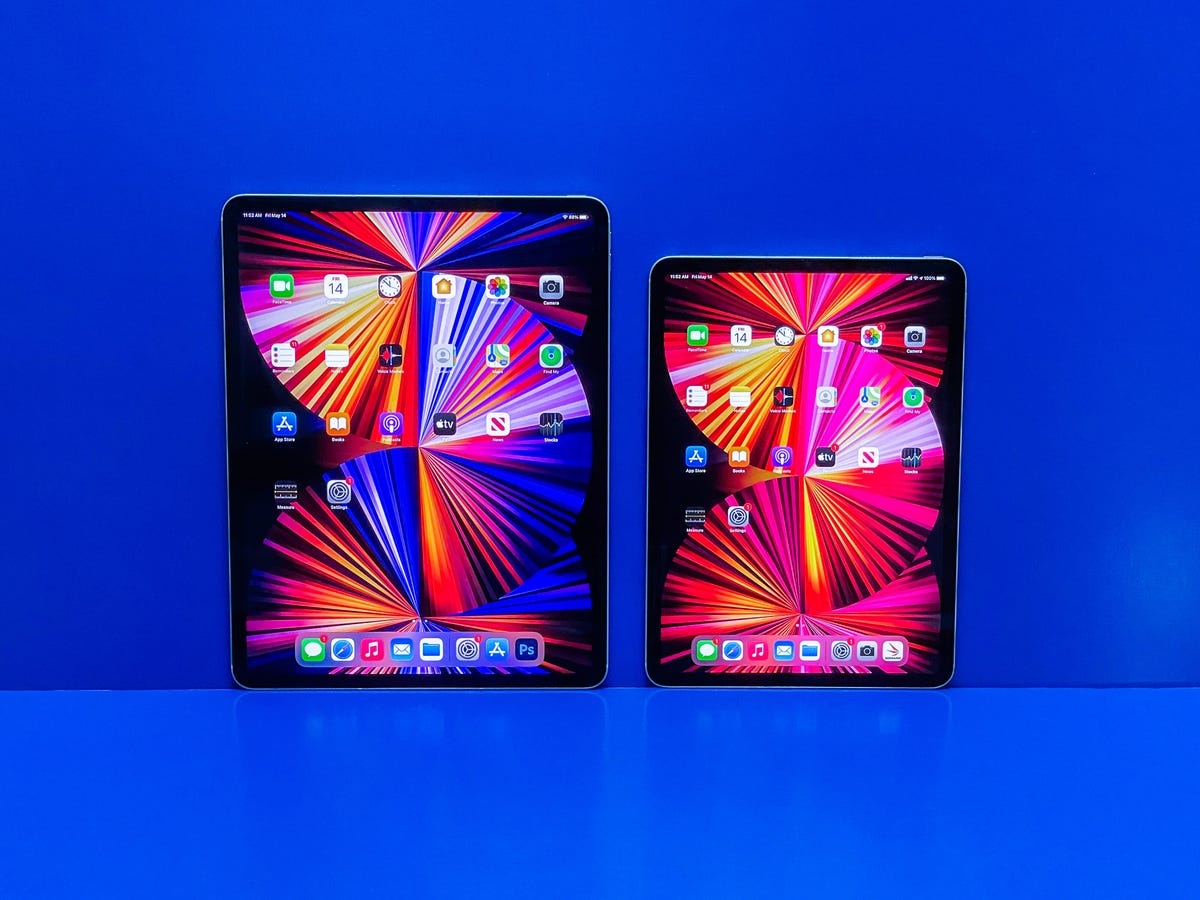
We expect the MacBook Pros to have Mini-LED backlit displays like the iPad Pro 12.9 (left).
Scott Stein/CNET
A whizzy new Mini-LED screen?
A Mini-LED backlight-based display seems to be another given and an extremely welcome one: It would allow MacBook Pros to better support HDR at higher brightness and with better local dimming, essential for video editing or producing content for the 12.9-inch iPad Pro and its Mini-LED screen. Hopefully, it will be accompanied by an update allowing the MacBook Pro to play HDR content in 4K.
Most recently, Ross Young, CEO of Display Supply Chain Consultants (who correctly described the iPad Mini months before it was announced), tweeted that Apple would use screens from LG Display and Sharp -- "MiniLEDs, 100% confirmed."
The oxide backplane and Mini LED (but not the 120Hz refresh rate) backlight are two technologies utilized by Apple's Pro Display XDR, which bodes well for black levels.
MacRumors spotted a reference to new screen resolutions in a late beta of MacOS Monterey: "3,456x2,234 Retina" and "3,024x1,964 Retina." The first would deliver almost the identical pixel density -- 226 ppi -- as the current 16-inch MacBook display. Apple always likes to keep to a given range for its Retina screens, but the latter differs only slightly from the current 3,072x1,920; that's a strong sign that Apple will be offering a new panel. Alternatively, both resolutions would deliver the same 257 ppi on the 16-inch and 14-inch models, respectively.
A new aesthetic?
Rumors here vary. Almost every device Apple has announced this year, from the iPad to the iMac, has adopted the flat-edged profile aesthetic that harkens back to the iPhone 4. But it remains to be seen if Apple will adopt that for the MacBook Pro, given its clamshell design. And there hasn't been much traction to suggestions that the MacBooks might come in bright colors a la the iMac 24.
Goodbye, Touch Bar?
I have never been a fan of the Touch Bar, especially as a replacement for fixed function keys, so I receive these well-regarded rumors about the deprecation of the Touch Bar and return of real function keys with a bit of chair dancing -- and will be very disappointed if they turn out to be untrue. Also, since Mini-LED typically generates more heat than other backlights, Apple could probably do with less need for heat dissipation near the display.
Return of old favorites?
Apple had stripped its MacBook Pros of connectors a lot of people had come to rely on, including an HDMI connection, SD card slot and MagSafe connector (not to be confused with the MagSafe charger for the iPhone). Some rumors indicate that we're getting those back, along with another pair of USB4/Thunderbolt ports. Some news has also indicated a return of the MagSafe connection, but it's also possible they're confusing them with rumors about a new version of the recent filing with the Federal Communications Commission for a MagSafe charger for the iPhone.
A 1080p webcam, but still no Face ID?
As Apple introduced an upgraded 1080p webcam first with the 27-inch iMac (and discontinued iMac Pro), then with the 24-inch iMac, it makes sense to integrate one into the MacBook Pro as widely rumored, since it's probably used for videoconferencing more than many other of its systems. But while Touch ID is likely to remain, there hasn't been any welcome word about much-requested Face ID (or 5G) since we heard in January that it wouldn't be included.
Boost iphone for sale upcoming sales on iphone how to boost marketplace listing on iphone boost mobile deals on iphone iphone deals boost mobile boost iphones for sell boost mobile iphone deal iphone deals boost mobile boost mobile apple iphones on sale iphone sales india
iPhone sales see a boost after four quarters of decline, Gartner says
iPhone sales see a boost after four quarters of decline, Gartner says
Apple's iPhone once again saw growth after four consecutive quarters of decline, according to a Tuesday report by Gartner. The phone grew 7.8% in the fourth quarter of 2019, the report says.
"A slight lowering of the prices of the iPhone 11 series, compared with the iPhone XR, and other price reductions for previous-generation iPhone models, increased demand," Annette Zimmermann, research vice president at Gartner, said in a release.
In China, iPhone sales were particularly strong, growing by 39% in Q4. Apple also saw strong performance in areas such as the UK, France, Germany, Brazil and India. Gartner analysts anticipate Apple will roll out its first 5G phone in the third quarter of this year.
Overall, though, global sales of smartphones dropped 0.4% year over year in the fourth quarter of 2019, Gartner says. Sales declined by 1% in the full year.
"2019 ended a little better than expected, due to slightly improved performances from North America and emerging Asia/Pacific," Anshul Gupta, senior research analyst at Gartner, said in the statement. "However, India, which sold 151.9 million units, overtook the US to become the No. 2 country for smartphone sales in 2019. China maintained the lead, with sales of 390.8 million smartphones over the full year."
The top vendors include Samsung, Apple, Huawei, Xiaomi and Oppo. Apple and Xiaomi were the only companies in the top five that saw growth in Q4 of 2019. Although Samsung saw a drop in sales, it maintained the No. 1 spot with 17.3% market share. Apple landed the No. 2 spot with 17.1% market share.
The top five phone vendors in Q4 of 2019 were Samsung, Apple, Huawei, Xiaomi and Oppo.
Screenshot by Abrar Al-Heeti/CNET
Xiaomi's smartphone sales increased 16.5% year over year, reaching 32.4 million units in Q4. "The price and performance of Redmi models drove Xiaomi's smartphone sales growth, and the company did particularly well in emerging Asia/Pacific," Gupta said.
The outbreak of the novel coronavirus SARS-CoV-2 and the disease it causes, COVID-19, could bring challenges for retail-focused vendors like Oppo and Vivo, Gartner says, but could present opportunities for Xiaomi, which has been amping up its online presence.
"Looking forward, while the COVID-19 outbreak will impact smartphone demand negatively in China in the first quarter of 2020, we do not expect a demand contraction in the international smartphone market during that period," Zimmermann said.
Last week, market researcher IDC estimated coronavirus would negatively impact the global smartphone market in 2020.
Samsung, despite a 0.5% year-over-year decline in phone sales in the fourth quarter, kept its No. 1 spot in last year's global ranking. Its full-year sales rose by 0.4% to 296.2 million units.
Huawei saw the highest growth last year, with an overall increase of 18.6%, despite a ban from the US. The company boosted its market share in China by 37% in 2019, according to Gartner. For the overall year, it landed ahead of Apple in the No. 2 spot, with 15.6% market share.
"If Huawei continues to face a ban on accessing technology from the US in 2020, its smartphone prospects in the international smartphone market will be severely impacted," Gupta said.
Xiaomi 11t pro 4 reasons you should be excited about reading xiaomi 11t pro 4 reasons you should be excited about life xiaomi 11t pro 4 reasons you should be excited about xiaomi 11t pro 4 reasons you should get a dog xiaomi 11t pro 4 reasons you should hire xiaomi 11t pro 4 reasons you should use supportive stance xiaomi 11t pro specs xiaomi 11t pro worten xiaomi 11t harga
Xiaomi 11T Pro: 4 reasons you should be excited about this new flagship phone
Xiaomi 11T Pro: 4 reasons you should be excited about this new flagship phone
Xiaomi has unveiled the 11T smartphone series, its new midrange lineup, designed to succeed the Mi 10T series. The announcement was made at a virtual event on Wednesday, where the company introduced three models, the 11T Lite 5G, 11T and the 11T Pro.
The highest-end 11T Pro is the most compelling phone of the trio, and lets Xiaomi offer a more budget-friendly alternative to the Chinese phone-maker's pricier Mi 11 flagship series. The 11T has a 6.7-inch AMOLED screen, two powerful chipsets and an 108-megapixel lens leading its camera array, but the headline feature is the charger. The 11T comes with a 120-watt in-box charger, a first for Xiaomi as well as the broader industry.
The Xiaomi 11T Pro starts at 649 euros (roughly $770, £560 or AU$1,060) for the base model, which has 8GB of RAM and 128GB of storage, going up to 749 euros ($890, £640, AU$1,210) for 12GB/256GB. The 11T starts at 499 euros ($590), while the 11 Lite 5G NE starts at 369 euros ($440). The 11T series is slated for a global rollout, but as is the norm with Xiaomi phones, it will not get a stateside release. So if you're interested, you'll have to import.
I put out a Mi 11 review earlier this year, and I got my hands on its fancier sibling, the Mi 11 Ultra, so take a look at those pieces for a better understanding of how the 11T series fits into the lineup.
Need for charge speed: There's a 120W brick inside the box
At a time when industry juggernauts Samsung and Apple have removed their in-box chargers (for "environmental reasons" they say), Xiaomi is doubling down. The company says its 120-watt charger delivers a full charge of the 5,000-mAh battery in just 17 minutes. And a number of reviews seem to back that up, putting the charge time between 15 and 21 minutes, which blows the competition out of the water.
Xiaomi hasn't shied away from first debuting high-end features, or in this case best-in-class features, on its midrange phones, and it fits in with the Chinese phone-maker's strategy of offering exceptional value. This is also a feature I'd expect to make its way to the pricier Mi 12 flagship series (the name isn't yet confirmed), which is expected early next year.
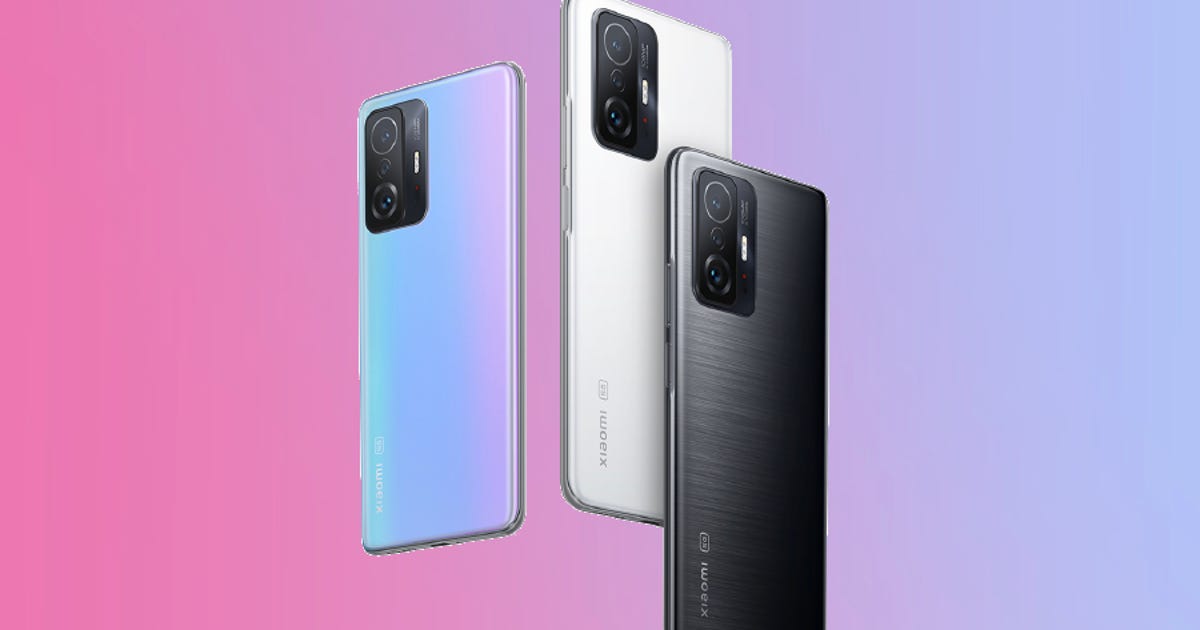
There are three rear cameras on Xiaomi's 11T Pro.
Xiaomi/Screenshot by CNET's Sareena Dayaram
Two Qualcomm chipsets, including the flagship Snapdragon 888
The 11T Pro has a flagship processor -- none other than Qualcomm's top-of-the line Snapdragon 888. This chipset is found in several of Samsung's premium phones including the $1,800 Galaxy Z Fold 3 5G and the $1,200 Galaxy S21 Ultra. Xiaomi's 11T Pro is by no means the first midrange phone to come with a flagship processor, but it's definitely a welcome addition, considering Qualcomm promises 25% to 35% better processing and graphics card performance with the 888 than the 865. There's also Qualcomm's X60 modem which the company says was "built to allow more networks to achieve faster, low-latency 5G," though the experience will likely vary depending on carrier support and 5G availability.
120Hz display makes for zippy scrolling
Xiaomi's 11T Pro has an adaptive 120 Hz display, which means it can automatically switch between 60Hz and 120Hz depending on the type of content displayed. It's also one way the phone saves on battery life. Most phones have a 60Hz refresh rate, which means the phone refreshes 60 times a second. With a 120z display, gaming and navigating between apps will be much zippier and you'll get a generally more fluid experience. Apple's newly announced iPhone 13 Pro and Pro Max also have 120Hz displays.
So how did Xiaomi save on costs?
With all these high-end features, you're probably wondering how Xiaomi managed to hit an affordable price tag for its 11T Pro. Compared to its flagship Mi 11 series, the company did dial down on some features. One of the hallmarks of a truly high-end phone is the coveted telephoto lens, which lets your phone capture crisp images of faraway subjects through far-reaching optical and digital zooms. While the 11T Pro has a respectable camera set-up -- one that includes a 108-megapixel wide shooter -- a telephoto lens is absent. Xiaomi's Mi 11 Ultra superphone, which launched at roughly $1,119 euros ($1,435, £970 or AU$1,860), has a periscope-style telephoto lens with 5x optical zoom.
The 11T Pro isn't the most durable of phones, based on the specs at least, as it's only splash-proof with an IP58 rating. That means it can't handle underwater submersion. The highest-end phones tend to have an IP68 rating making them waterproof. And finally, it doesn't have the same build quality as a true flagship, relying on a plastic back side apparently prone to lots of fingerprints to shield it from drops.
Also it's worth noting that part of Xiaomi's business strategy is capping net profit on margins at 5% for its hardware products. In turn, smartphone prices are kept at a reasonable level, and the company is able to deliver on a value-for-money promise that has helped the company grow from an upstart to the second-largest smartphone company in the world.
To learn more about Xiaomi's new 11T Pro, take a look at the specs chart below.
Windows 10 on a Mac: Here's How to Set It Up for Free
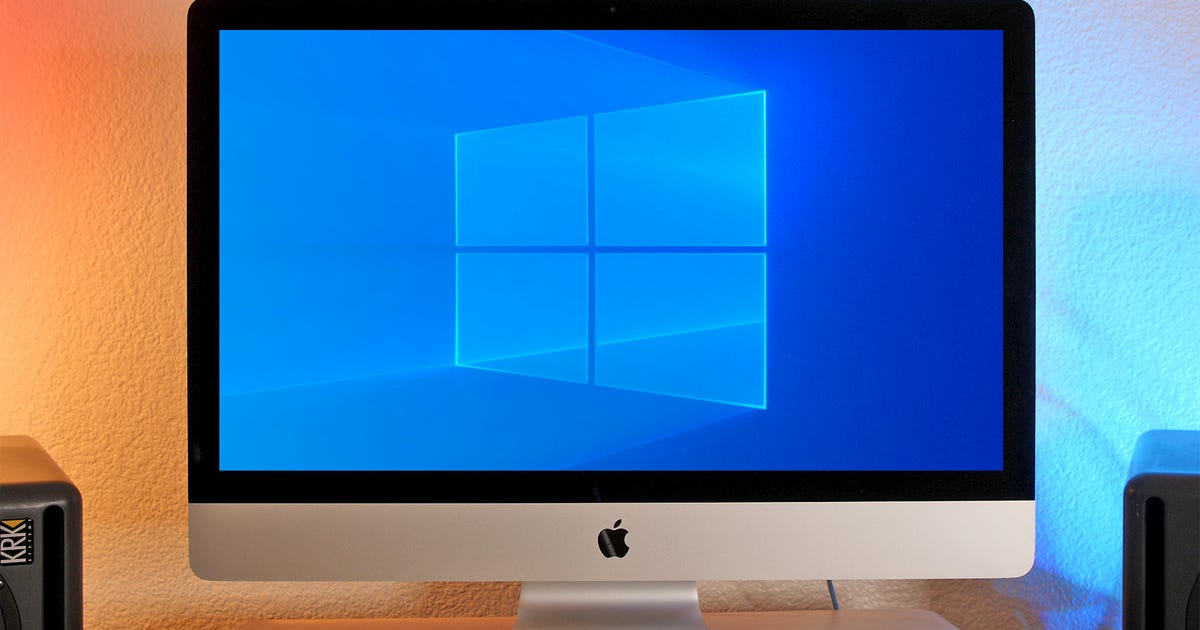
Windows 10 on a Mac: Here's How to Set It Up for Free
No matter how happy you are with your MacBook Pro, there's always something that Windows can offer that MacOS can't, whether it's exclusive software and video games or unique settings and features. And you might not know this, but if you only own an Apple computer, there's still a way to run Windows on it.
As long as you have an Intel-based Mac with enough storage and the correct Windows 10 ISO file -- which you can download for free from the official Windows website -- you can set up Windows 10 on your Apple computer in less than an hour. From then on, anytime you boot up your Mac, you can choose whether to run Windows 10 or MacOS. Here's how to do it.
Here's what you need before you start
To successfully run Windows 10 on your Mac computer, here's what you need to have:
An Intel-based Mac computer (if your computer is on this list, it's not supported).
64GB or more free storage space on your startup disk.
A power connection (if you're on a laptop).
If you're unsure whether your computer is Intel-based, click on the Apple logo on the menu bar, and then go into About This Mac. If you see the words Processor, followed by the name of an Intel processor, like "2.6GHz 6-Core Intel Core i7," then you have an Intel-based Mac.
Before you start, though, it's wise to back up your disk with Time Machine before partitioning just in case something goes wrong.
1. Download the Windows 10 ISO File
Windows 11 isn't currently compatible with Boot Camp Assistant on MacOS. So, you'll need to download Windows 10 instead. You can download a free disc image, also known as an ISO file, of Windows 10 from the official Windows website.
1. On your Mac, go to this Windows software download page.
2. Click on Select Edition, and choose Windows 10 (multi-edition ISO).
3. Hit Confirm, and wait for your request to be verified.
4. Once that finishes, choose your language and click on Confirm.
5. Finally, click on 64-bit Download to download the Windows 10 ISO file.
Download the 64-bit Windows 10 ISO file from the Windows website (most modern computers have a 64-bit capable processor).
Nelson Aguilar/CNET
The Windows 10 ISO file is nearly 6GB, so depending on your internet connection and speed, it could take up to 30 minutes to finish downloading. After the ISO file is done, leave it in your downloads, and move on to the next step.
2. Run Boot Camp Assistant
The software you'll use to run Windows 10 on your Mac is Boot Camp Assistant, which comes factory-installed on your Mac. Boot Camp Assistant is made specifically for installing Windows operating systems on your computer, and fortunately the setup process is pretty straightforward.
1. Launch Boot Camp Assistant on your Mac, and click Continue.
2. Click on Choose a Windows 10 ISO file, and upload the Windows 10 ISO file you downloaded in the previous step.
3. Drag the bar to choose a size for your Windows partition disk (42GB is the minimum).
4. Click Install,and wait roughly 10 minutes for the partition to be created.
Upload the Windows 10 ISO file and choose the partition size.
Nelson Aguilar/CNET
Once the Windows partition is finished, your laptop will restart.
3. Install Windows on your Mac
Your computer will boot up, but instead of showing you the Apple logo you're accustomed to, you should instead see the blue Windows logo appear. Here's what you need to do next:
1. Go through the Windows setup.
2. Enter a product key if you have one. If not, you can continue without one.
Even without a product key, you'll be able to access Windows on your Mac, so don't worry. During the installation, you'll see window files copied, features and updates installed and more. This should take another 10 minutes.
4. Set up Windows on a Mac
Your Mac will restart. But this time you'll be asked to set up Windows, just as you would on a Windows computer. You can use Cortana and your voice to complete the setup, but you're also welcome to use your keyboard, mouse and trackpad.
1. Choose your language, keyboard layout, Wi-Fi and more to begin.
2. If you have a Windows account, log in with your credentials.
3. Windows will boot up on your Mac. You'll be asked to create a passcode and/or PIN to enter your computer. Do that to protect your account.
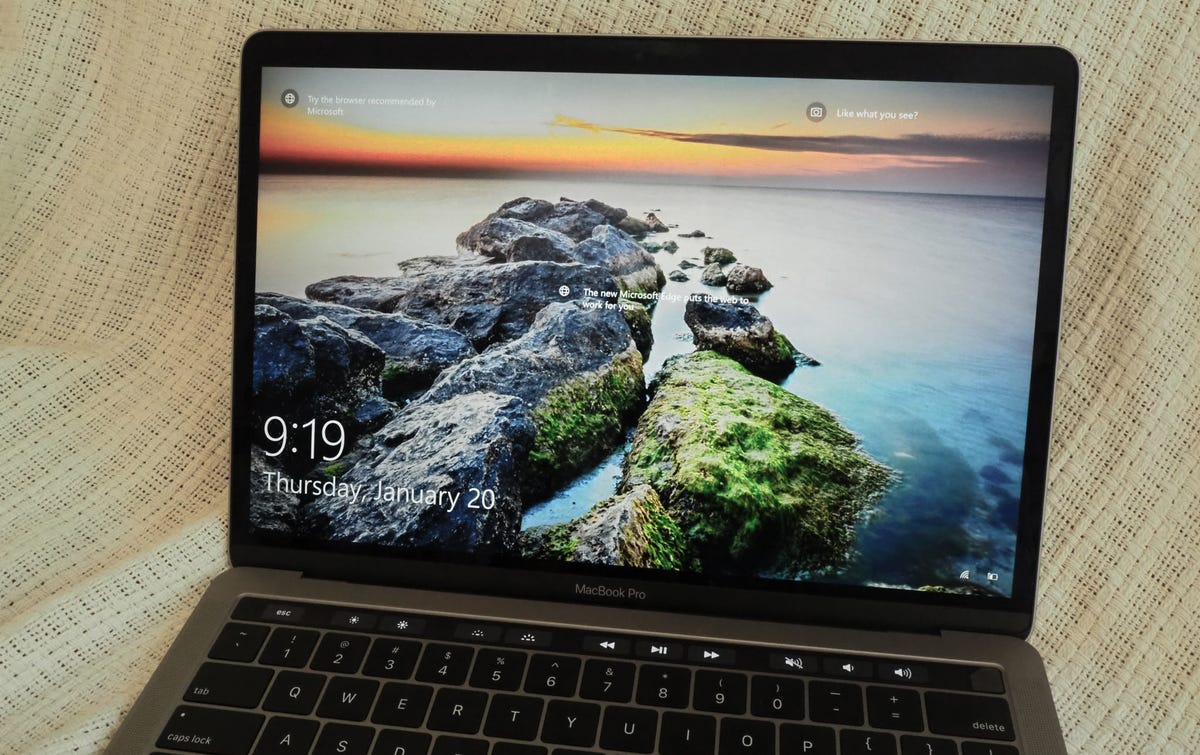
This is the Windows lock screen that appears after your Mac restarts.
Nelson Aguilar/CNET
5. Install Boot Camp on Windows
Finally, the last thing you'll need to do is install and update Boot Camp on Windows. That will let you make any additional changes to your partition or fix any issues while you're running Windows. When you access Windows for the first time, you should receive a notification to install Boot Camp. This will take 10 minutes to install, but it's the last thing you need to do before you can use Windows without any issues.
6. Use Windows on your Mac
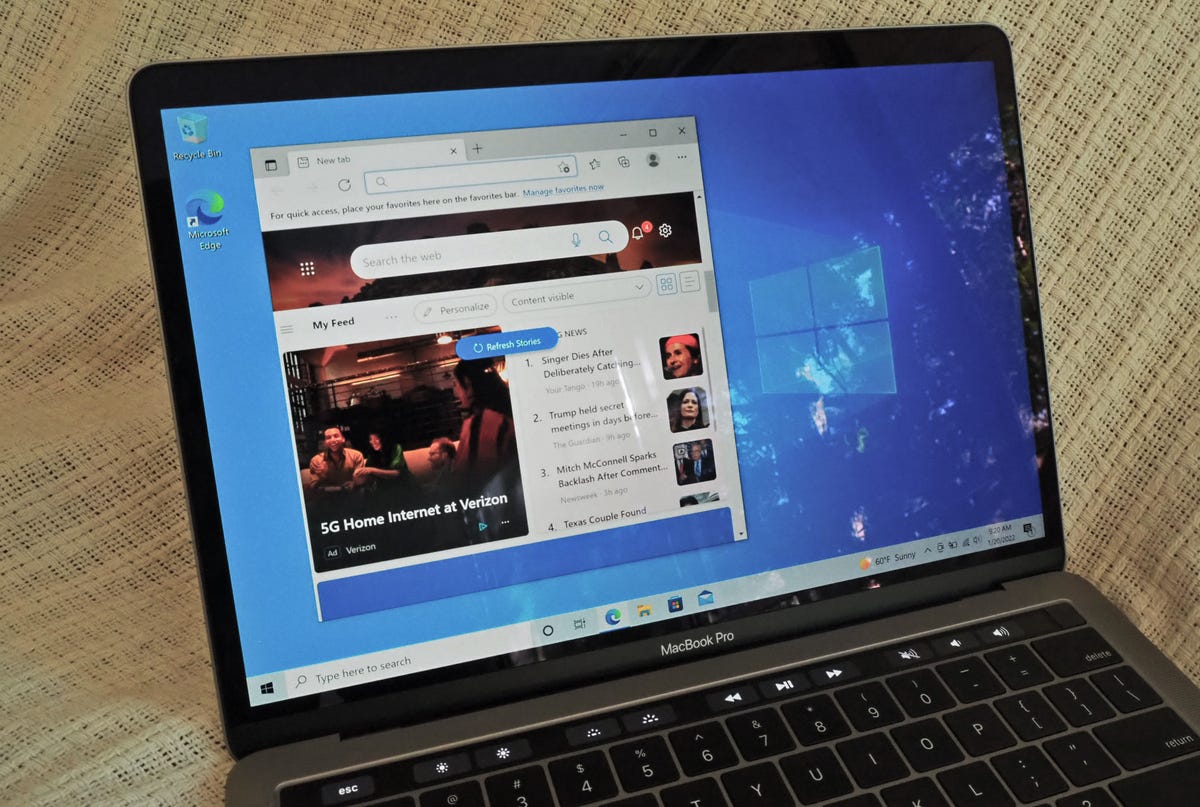
Feel free to use Windows how you want. Windows 10's default web browser is Microsoft Edge, but you can use it to download Chrome or anything else to surf the internet. You can then download files and install software you would only be able to install on a Windows-powered computer -- like Paint.NET and certain games from Steam -- but on your Mac.
Windows 10 on a MacBook Pro.
Nelson Aguilar/CNET
7. Switch Between Windows and Mac
If you ever want to go back to MacOS from Windows, do the following:
1. Restart your computer.
2. As soon as the screen goes black, hold down the Option key for 5 seconds.
3. On the screen, you'll then have the option to boot up MacOS or Windows.
4. Choose the partition you want to open.
Hold down the Option key when you reboot to choose a different partition.
Nelson Aguilar/CNET
Use this keyboard shortcut to switch between your disks as needed.
Streaming Services to Cancel or Keep in September 2022
Streaming Services to Cancel or Keep in September 2022
September ushers in fall premiere season for traditional and cable networks, bringing new episodes of primetime TV shows and sports back to the screen. Whether you're a cord-cutter or not, it's likely your streaming plate will get a little fuller. Between The Rings of Power on Prime Video, House of the Dragon on HBO Max and Hulu's lineup of network premieres it's a busy time, making the "keep" section of this month's list heftier.
Starting Sept. 19, Peacock will have new episodes of NBC and Bravo shows exclusively on its platform the day after their network debuts. Series such as Law & Order will no longer stream on Hulu, but Hulu has new content arriving from Fox, ABC and other networks. With that in mind, both services may be keepers for you in September -- or not.
Each month I give advice on which streaming services to cancel and which ones to keep, based on their new releases and current lineup. You may be thinking about canceling a few streaming subscriptions to cut costs, and I'd like to offer my strategy: Churn like ice cream.
This means you subscribe for a period, cancel, choose a different service and later resubscribe, putting your favorites in a rotation. Feel free to pick one or two must-haves for the year and treat other streaming platforms like seasonal add-ons. The upside is that you can save money when Netflix, Disney Plus, HBO Max and others don't have the content you want to watch at a given time. Just remember to shut off auto-renewal for your monthly subscriptions. Rotating may not be an option if you're sharing your accounts with people outside your household, but if you can work out a system with your streaming clique, go for it.
Here are my recommendations for which streamers to keep or drop for September, primarily based on new TV shows and movies arriving on each platform. This time, there's a little bit of live sports thrown in the mix because it's football season. Of course your tastes may be different, but if nothing else, I urge you to at least consider the concept of rotating for savings. It's easier than you might think.
Streaming Service Rotation for September 2022
Keep
Cancel
Prime Video
X
Hulu
X
Netflix
X
Apple TV Plus
X
Disney Plus
X
Paramount Plus
X
HBO Max
X
Peacock
X
Starz
X
You should probably keep these subscriptions in September
Prime Video: Don't miss The Lord of the Rings: The Rings of Power on Sept. 1 and its two-episode premiere. Season 1 has eight episodes total that will air into October. Sports fans can catch the NFL's Thursday Night Football beginning Sept. 15.
Netflix: The biggest drops this month are Cobra Kai season 5 on Sept. 9, anime Cyberpunk: Edgerunners (Sept. 13) and Blonde, the fictionalized story based on Marilyn Monroe's life. Debuting on Sept. 28, Blonde is Netflix's first NC-17 original movie. Other releases include the Ivy + Bean movie trilogy (Sept. 2), a K-Drama version of Little Women (Sept. 3), The Anthrax Attacks: In The Shadow of 9/11 (Sept. 8), Queen Latifah's End of the Road movie (Sept. 9), Do Revenge starring Maya Hawke and Camila Mendes (Sept. 16) and Fate: The Winx Saga season 2 (Sept. 16).
Hulu: The Handmaid's Tale returns with season 5 on Sept. 14 and The Kardashians are back on Sept. 22. If you watch Hulu for its network shows that air the next day, look out for new seasons of Atlanta (Sept. 16), 9-1-1 (Sept. 20), The Cleaning Lady (Sept. 20) and The Resident (Sept. 21). On Sept. 22, Hulu drops premieres for Abbott Elementary season 2, The Conners season 5, The Goldbergs season 10 and The Masked Singer season 8. You can also stream new episodes of The Simpsons, Bob's Burgers, Shark Tank and Bachelor in Paradise later this month.
Is June worth your Hulu subscription when The Handmaid's Tale drops season 5?
Hulu
HBO Max: House of the Dragon and Harley Quinn are still going strong. Additionally, The Nevers season 1 part 2 (Sept. 16) and the Elvis movie (Sept. 2) arrive in September. Wondering where The Vampire Diaries landed after leaving Netflix? Find the Salvatores here starting on Sept. 4. And if you're a fan of Chip and Joanna Gaines' Magnolia content from Discovery, 25 titles touch down on HBO Max this month.
Disney Plus: I only recommend keeping this service this month if you're a Marvel or Star Wars fan, or a parent with young kids. Disney Plus moved its new Andor show from Aug. 31 to Sept. 21 with a three-episode premiere. The show has 12 episodes that air into November, so if you want to wait a few months and binge, go for it. She-Hulk is still spinning, but new Disney Plus Day releases include Pinocchio (with Tom Hanks), Thor: Love and Thunder and the new Cars on the Road series, which all drop on Sept. 8. Dancing With the Stars season 31 debuts on Sept. 19 and Hocus Pocus 2 starts streaming on Sept. 30.
Peacock: Sunday Night Football starts with a kickoff game on Sept. 8 then switches to Sundays beginning Sept. 11. With NBC shows rolling in this month with next-day streaming, you can upgrade to a Premium account to see full episodes and seasons on Peacock. New subscribers can sign up in September for only $2. You can also catch the Vampire Academy TV series (from Julie Plec, showrunner behind Vampire Diaries and The Originals), Bravo's Real Girlfriends of Paris (debuts Sept. 6 with weekly releases), Days of Our Lives (Sept. 20) and NBC's lineup. Of course, you can also hold off on a Peacock subscription and binge what you want in October or November.
Starz: Stream the debut of The Serpent Queen on Sept. 11, which features Samantha Morton as French monarch Catherine de Medici. Raising Kanan will continue to air through September. You can either keep Starz or binge everything at the end of October, but there's a deal for $5 per month for three months available right now.
Read more: Best Streaming Service of 2022: Netflix, HBO Max, Disney Plus and More
Cancel at least two services in September
Apple TV Plus: While the service produces high-quality content and a nice lineup for kids, there isn't much must-see content here for September. Releases include Hillary Clinton's Gutsy (Sept. 9) which features guests like the Little Rock Nine, Megan Thee Stallion and Jane Goodall, Central Park season 3 (Sept. 9) and The Greatest Beer Run Ever with Zac Efron Russell Crowe (Sept. 30).
Paramount Plus: Nothing hot on Paramount Plus this month. But you can stream new episodes of reality shows like Big Brother or Ink Master, or catch the season 6 premiere of The Good Wife.
Honestly, Disney Plus and Peacock could have dual membership in the keep and cancel columns this month, especially if you're not a football fan or don't mind waiting to binge-watch certain series. And there's nothing wrong with watching Hocus Pocus 2 in October. It's your choice.
Sorry, there's still no reason to cancel Netflix when releases like Cobra Kai are arriving this month.
Netflix
Save money by holding off a few weeks
If you're not someone who routinely gets FOMO, then a smart method is to wait until the bulk or all episodes of your favorite series land on a platform. That way, rather than pay for a service for several months to cover the 6- to 10-week run of a show, you can catch up on everything by subscribing for one month. And then repeat the cycle again.
As an example, there are 12 episodes of Andor coming to Disney Plus. The finale airs in November, so all episodes will be available to stream at that time. Though it premieres on Sept. 21 and continues through the fall, why pay for three months of Disney Plus when you can wait to watch it in full anytime in November? If this is the only series you want to watch during this period, it makes sense to be patient to save money.
Cassian Andor broods in upcoming Star Wars series Andor, which airs on Disney Plus into November.
Lucasfilm
How much do you pay each month for your streaming services? Netflix is $10 to $20, Disney Plus is anywhere from $3 to $8 depending on bundles, HBO Max costs $10-$15, Hulu starts at $7 and Starz runs $9. The others have a base rate of $5 per month. Should you decide to churn, set a calendar reminder to ping you when it's time to re-subscribe or cancel. We'll see you in October for another streaming breakdown.
Galaxy A52 5G review: Samsung's best budget phone with flagship features
Galaxy A52 5G review: Samsung's best budget phone with flagship features
With the Galaxy A52 5G, Samsung found an appealing balance between price, features and making smart compromises. It's the latest good sub-$500 5G phone and joins the nearly half a dozen phones from Motorola, OnePlus and TCL. The Galaxy A52 5G costs $500 or £399 (it isn't sold in Australia but that converts to AU$740). That's at the higher end of what's considered an affordable phone. The A52 5G also straddles the line between being a good affordable 5G phone and a fantastic one. The only other sub-$500 phones that do that are the iPhone SE, which doesn't have 5G, and the Google Pixel 4A 5G, which is now almost a year old.
The A52 5G has a high refresh rate display, years of OS and security support, a good main camera and good battery life. It has features that the more expensive Galaxy S21 and S21 Ultra lack like: a headphone jack, expandable storage and the inclusion of a wall charger in the box.
Read more: The best USB-C PD chargers of 2021
Like
120Hz high refresh-rate display
Good battery life on 5G
Wonderful software upgrade support
Simple, clean, unified design
Good main camera with OIS
Don't Like
Fingerprint sensor is too low on screen
Macro camera is mediocre
Duplicate apps
4K video recording lacks stabilization
As with any phone, even a good one, not everything is roses and sunshine. The in-screen fingerprint reader is so annoying to use that I preferred to enter my PIN to unlock the phone. The mediocre macro camera seems like a frivolous add-on that is only there to boost the total number of cameras on the phone. More is definitely not better. There are many duplicate apps like Samsung's version of an internet browser and photo gallery app in addition to the ones from Google.
But after two months, when I step back and consider everything, the Galaxy A52 5G is an all-around good phone with some great features and a few minor and annoying flaws. It's a solid buy for $500, but as I write this review, you can get a Galaxy A52 5G unlocked on Samsung's website for $425, which makes it even harder to pass up.
Sarah Tew/CNET
Galaxy S21 Ultra-inspired looks in a plastic reality
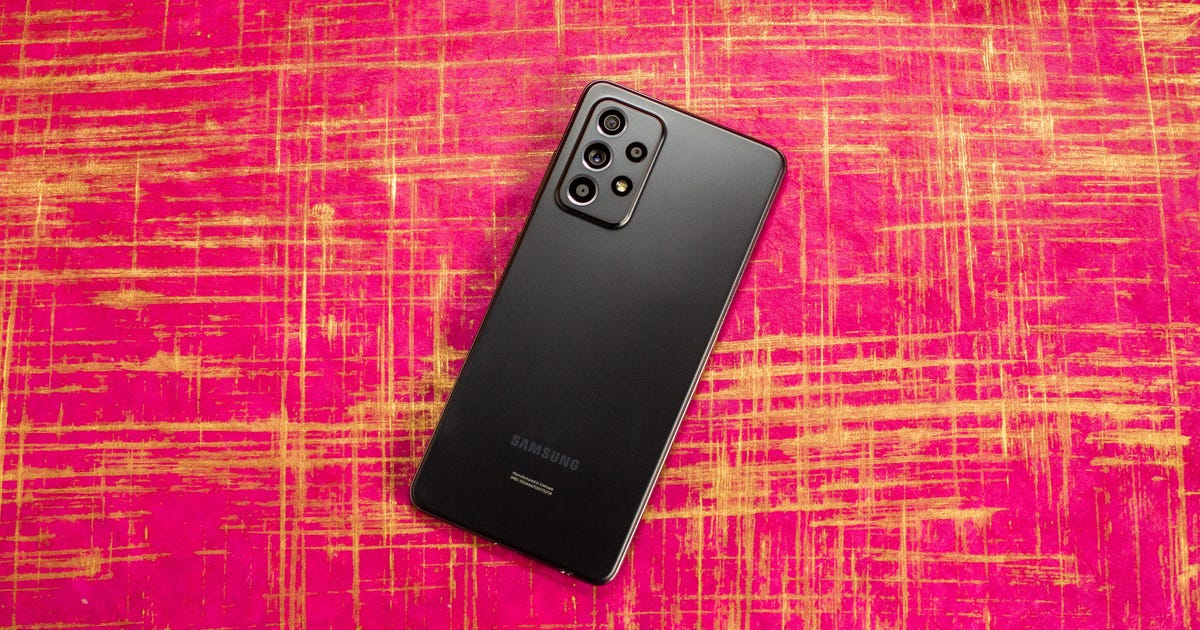
The build is good. It's not premium and that's fine, because it feels good. When you tap on the back you can definitely tell it's plastic. (So don't tap on the back.) The look of the phone is clean. It has curved plastic edges, symmetrical thin bezels around the screen and a matte finish. The camera bump loosely echoes the one on the Galaxy S21 Ultra, in the same way my haircut does Kit Harrington's.
Over two months, the phone collected its share of nicks along the sides. The matte finish back definitely doesn't look fresh or new. Most people will inevitably put the phone in a case, so that shouldn't be an issue.
The A52 5G is rated IP67 for water and dust resistance and can be submerged under three feet of water for up to 30 minutes.
Galaxy A52 5G has a 120Hz high refresh rate display
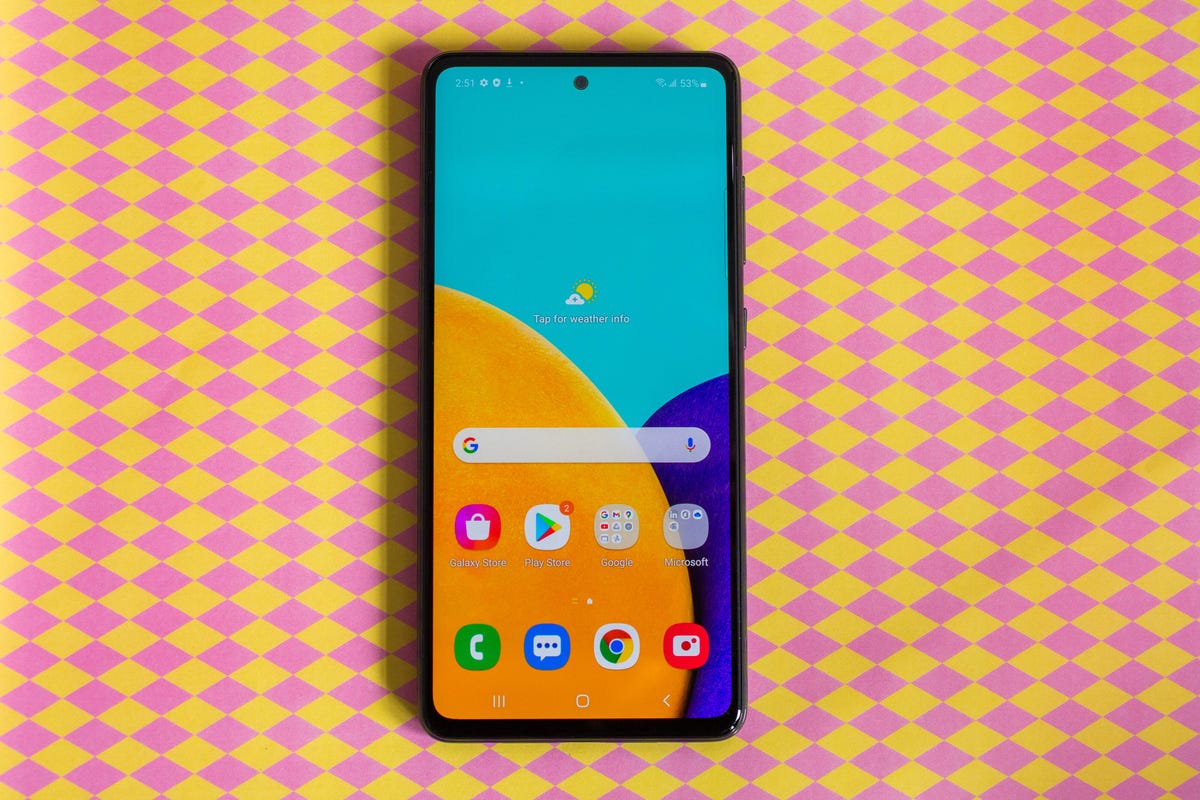
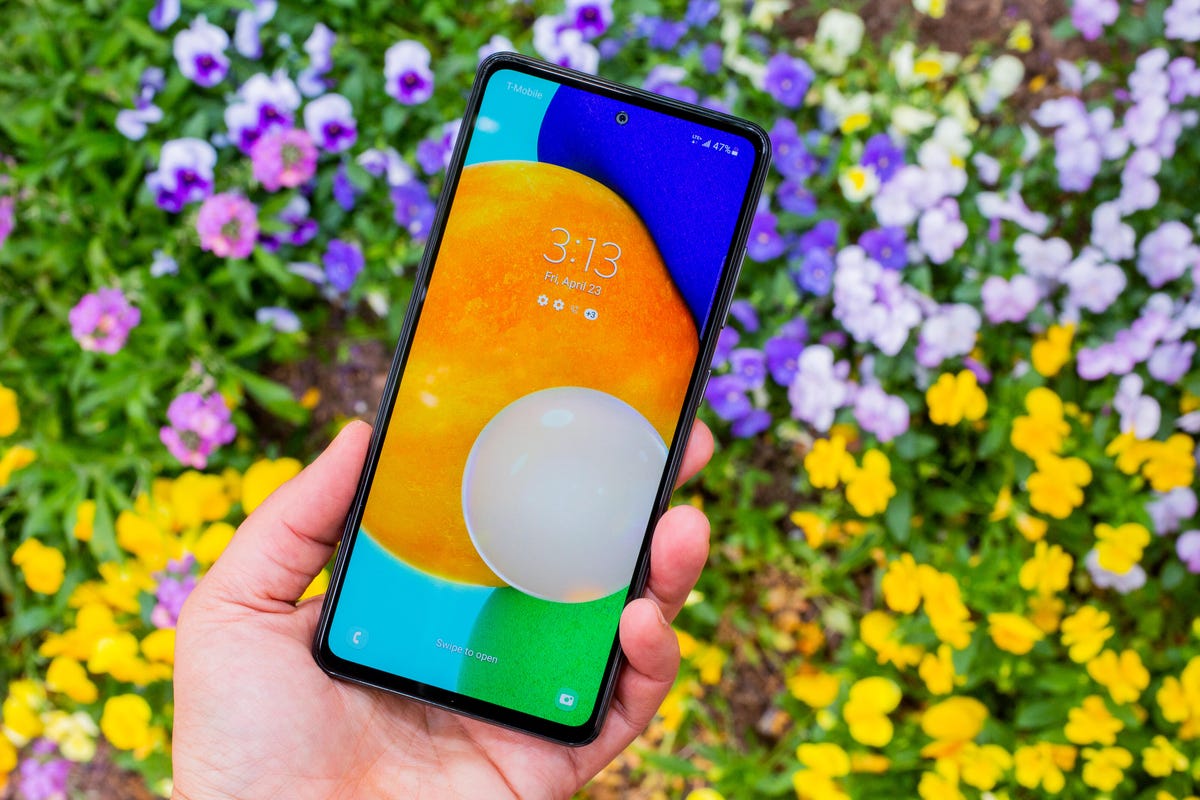
On the front is a 6.5-inch full-HD display with a hole-punch cutout for the selfie camera. The display is high-refresh rate and can be set to either 120Hz or 60Hz. At 120Hz, animations look smooth, gaming feels more immersive and even mundane things like scrolling through a feed look crisp. The display is without a doubt the best feature on the phone.
Brightness is good. Most displays on budget phones have horrible brightness, especially outdoors. Topping it all off is a slab of Gorilla Glass 5. Beware if you leave your phone screen down on a table and unattended. The coating will make it slide off a seemingly flat surface all on its own.
Let me level some expectations. This display isn't as good as the one on the Galaxy S21. But it is really good for $500.
The biggest downside to the design and display is the in-screen optical fingerprint sensor. The position of it feels low for one-handed use. I can rarely get the fingerprint reader to unlock the phone on the first attempt. I find it easier to just swipe up and enter a PIN.
There are four cameras on the rear of the Galaxy A52 5G: A main wide-angle camera, an ultrawide camera, a macro camera and a depth camera.
Sarah Tew/CNET
The Galaxy A52 5G has four rear cameras, but only the main one is good
There are four rear cameras on the A52 5G, one of which is a depth-sensor that works with the main camera to give you some absolutely fun and ridiculous AR effects and decent portrait mode photos.
The macro camera is a bit of an odd duck. It allows you to focus close like on the foam of a cortado. But the margin of error between your subject being in-focus and out-of-focus is incredibly thin. I wish there was focus peaking available to see when you have focus on your subject.
Patrick Holland/CNET
There's a macro camera. And (sigh) we've seen this from other phone companies. It's not that most people probably won't use a macro camera on a phone, it's that compared to the main camera on the A52 5G, the macro camera isn't great. It allows you to focus closer, but you need to be steady. You're just a handshake or breath away from being out of focus. I wish there was focus peaking on the macro camera to help you see when your subject is in focus and when it's not. Pro Mode offers focus peaking but for the main camera only.
The ultrawide camera is fun. It gives you a great exaggerated perspective.
Patrick Holland/CNET
The A52 5G has a decent ultrawide-angle camera. The main camera has optical image stabilization and a 64-megapixel sensor that combines pixels for a 16-megapixel photo with good detail and brightness.
In good light, image quality from the ultrawide camera is decent. It's still a step behind the main camera in terms of dynamic range and image noise.
Patrick Holland/CNET
Photos from the main camera are good. Your personal taste will vary when it comes to the amount of color saturation. To me, it's a touch oversaturated but still looks good.
Red cars go faster, right? Colors from the A52 5G are punchy.
Patrick Holland/CNET
The A52 5G did well grabbing focus on a very curious beagle.
Patrick Holland/CNET
This shot really pushed the A52 5G to its limits. Highlights start to blow out, but details are pretty good in the leaves.
Patrick Holland/CNET
The A52 5G doesn't have a dedicated telephoto camera and instead relies solely on digital zoom. I took this photo with 3x digital zoom.
Patrick Holland/CNET
In lower light situations, you start to see the main camera's weakness. There is a Night mode to help, and photos look decent but you're not going to get the same results as Night mode on the Galaxy S21.
In mixed lighting, the main camera does OK. Details start to look soft and noise correction starts to make skin tones smudge.
Patrick Holland/CNET
In low light, details start to look soft almost like a painting with all the noise reduction the A52 5G applies.
Patrick Holland/CNET
Night mode can create some eye-catching shots. But things look very processed compared to Night mode photos from the Galaxy S21 and S21 Ultra.
Patrick Holland/CNET
The A52 5G can record 4K video which in good light is good but as it gets darker, image noise and artifacts become more apparent. Curiously, you can't use the optical image stabilization when recording 4K video. But if you drop down in resolution to 1,080P video, you can use Super Steady which works very well. Take a look at the video below to see sample clips shot with the Galaxy A52 5G.
The selfie camera has a 32-megapixel sensor and Samsung's full-arsenal of face-smoothing, jawline-defining and eye-enlarging tools. And then there's Fun mode that lets you use Snapchat AR filters without using Snapchat. You can use Fun mode with the main and depth cameras on the back or the selfie camera. Fun mode actually lives up to its name.
With Fun mode, I can finally be the brunette with cat-eye glasses I've always wanted to be.
Patrick Holland/CNET
To put this all into perspective, both the iPhone SE and Google Pixel 4A 5G have better overall camera systems for photos and videos -- both also have fewer cameras. That speaks less about the A52 5G's camera prowess and more about what Apple and Google are able to put into their phones.
Peppy Android performance for the price
The A52 5G has a Qualcomm Snapdragon 750G chip with 6GB of RAM. It runs Android 11 and at the time I'm writing this, runs the July 2021 software update. Performance is good. It's not blazing fast which is apparent with the small delay that occurs when I open the camera from the lock screen, or rotate the phone between portrait and landscape.
In benchmark tests it scored ahead of the Google Pixel 4A 5G and just behind the Motorola One Ace 5G. See the results of our benchmark tests below.
GEEKBENCH V.5.0 SINGLE-CORE
Note:
Longer bars indicate better performance
GEEKBENCH V.5.0 MULTICORE
Samsung Galaxy A52 5G
Note:
Longer bars indicate better performance
3DMARK SLINGSHOT UNLIMITED
Samsung Galaxy A52 5G
Note:
Longer bars indicate better performance
It has Samsung's OneUI 3 interface, which I enjoy using. It's clean and friendly to one-handed use. There are several duplicate apps, which is annoying. But all Samsung phones, no matter the price, do as well. One of the best parts of the Galaxy A52 5G is that you get three generations of Android OS updates and at least four years of security updates. This is still a rarity for Android budget phones.
5G for less than $500 and good battery life
As the name indicates, this is a 5G phone that works on sub-6 5G networks in the US. I tested it in Greenville, South Carolina on T-Mobile and speeds were just OK. Despite an onscreen 5G indicator, many times the phone was actually connected to 4G LTE. This has everything to do with T-Mobile's coverage as the same thing happened when I tested other phones on T-Mobile here.
The A52 5G has a 4,500-mAh battery. Samsung claims two days of use when fully charged. I reliably got one day with the display at 120Hz. On days with lighter use or when the display was set to 60Hz, it easily lasted a day and a half.
Even with the screen's refresh rate set to 120Hz, the Galaxy A52 5G lasted 17 hours and 40 minutes in our battery tests.
Sarah Tew/CNET
In our CNET battery tests with continuous video playback in airplane mode, it lasted a respectable 17 hours, 40 minutes and that was with the display set to 120Hz. That's longer than the OnePlus 9 Pro and the iPhone SE. In the same test, Motorola and its budget phones scored four of the five longest times of any phone this year. Keep in mind, none of these Motorola phones have a high refresh rate display.
It doesn't have wireless charging which is a wise omission, but it does support 25-watt fast charging. It's just that the included charger is only 15 watts.
Samsung Galaxy A52 5G specs vs. Motorola One 5G Ace, Google Pixel 4A 5G, Apple iPhone SE
Samsung Galaxy A52 5G
Motorola One 5G Ace
Google Pixel 4A 5G
Apple iPhone SE (2020)
Display size, resolution
6.5 inch FHD+ Super AMOLED, Infinity-O Display (1080 x 2400 pixels), 120Hz
6.7-inch FHD+ LCD, 2,400x1,080 pixels
6.2-inch FHD+ OLED; 2,340 x 1,080 pixels
4.7-inch Retina HD LCD; 1,334x750 pixels
Pixel density
407ppi
394ppi
413ppi
326ppi
Dimensions (Inches)
2.95 x 6.29 x 0.33 inches
6.54 x 3 x 0.39 in
6.1 x 2.9 x 0.3 in
5.45 x 2.65 x 0.29 in
Dimensions (Millimeters)
75.1 x 159.9 x 8.4mm
166.1 x 76.1 x 9.9mm
153.9 x 74 x 8.2 mm (Sub-6 only); 153.9 x 74 x 8.5 mm (mmWave + Sub-6)