Get a 3-Year Subscription for Online Classes on Music Theory, Production, Mixing and More
Get a 3-Year Subscription for Online Classes on Music Theory, Production, Mixing and More
Interested in music production? You can learn everything you need to know to realize your dreams from your own home with a Punkademic subscription. With access to all of Punkademic's lessons and professors, you'll be able to get a university-level education in classes covering music production, music theory, sound design, mixing and more for a fraction of the cost. Right now at StackSocial you can get a whopping get a whopping 86% off the cost of an all-access, three-year subscription to the Punkademic Music e-learning platform, meaning you'll get over 1,000 hours of content for just $99. Just note this offer ends March 16.
Membership to Punkademic gives you access to Ableton Certified trainers and courses such as FL Studio, Pro Tools, Drum Programming Techniques, Recording and many more, with automatic access to new classes, which roll out every month. Most instructors are currently or have formerly been university professors, but with Punkademic, these teachers and content creators get paid directly from your membership, cutting out the middle man and the need for expensive student loans.
You'll also get over 1,000 hours of video content, access to private student communities on Discord and Facebook, a 24-hour response time to questions from professors and many other benefits.
Nvidia Star Wars GPUs embrace the light *and* dark sides
Nvidia Star Wars GPUs embrace the light *and* dark sides
Nvidia is giving you a new reason to have a see-through side panel on your giant gaming desktop. The high-end Nvidia Titan Xp graphics card now comes in two Star Wars-themed versions -- a Jedi Order GPU representing the light side and a Galactic Empire version for the dark.
The Jedi GPU lights up in green, while the Empire model is red. Nvidia says there's even more that went into the design, which is a surprising amount of detail for a component that's going to be locked away inside a computer case:
"The Jedi Order GPU simulates the wear and tear and battle-worn finish of many items used by the Rebel Alliance, resulting from its diecast aluminum cover being subjected to an extensive, corrosive salt spray. Conversely, the Galactic Empire GPU's finish features simple, clean lines, emulating the high-end, orderly nature of the resource-rich Empire."
The Star Wars cards will be available in mid-November for $1,200. There's no price or date for other territories yet, but the standard non-Star-Wars Titan Xp card costs £1,149 or $AU1,950. As a bonus, users of Nvidia's GeForce Experience software (which optimizes game settings and updates drivers) can preorder starting Nov. 8.
There are lots of good places to mount your TV, but there are also a few places where mounting a TV is not the best idea. The bathroom is one of those places. In fact, it's just about the worst environment for any type of electronics, let alone a TV. But if you're so hooked on a show you're streaming that you don't want to hit pause even for a bathroom break, you may think mounting a TV above the bath or toilet is a good solution. It's not. Really. Just don't.
But if you absolutely must, mounting a TV in the bathroom is technically doable, as long as you know what you're getting into. Here's what you need to know before you start watching National Treasure during your morning constitutional.
Bathroom TV (doo)do's and don'ts
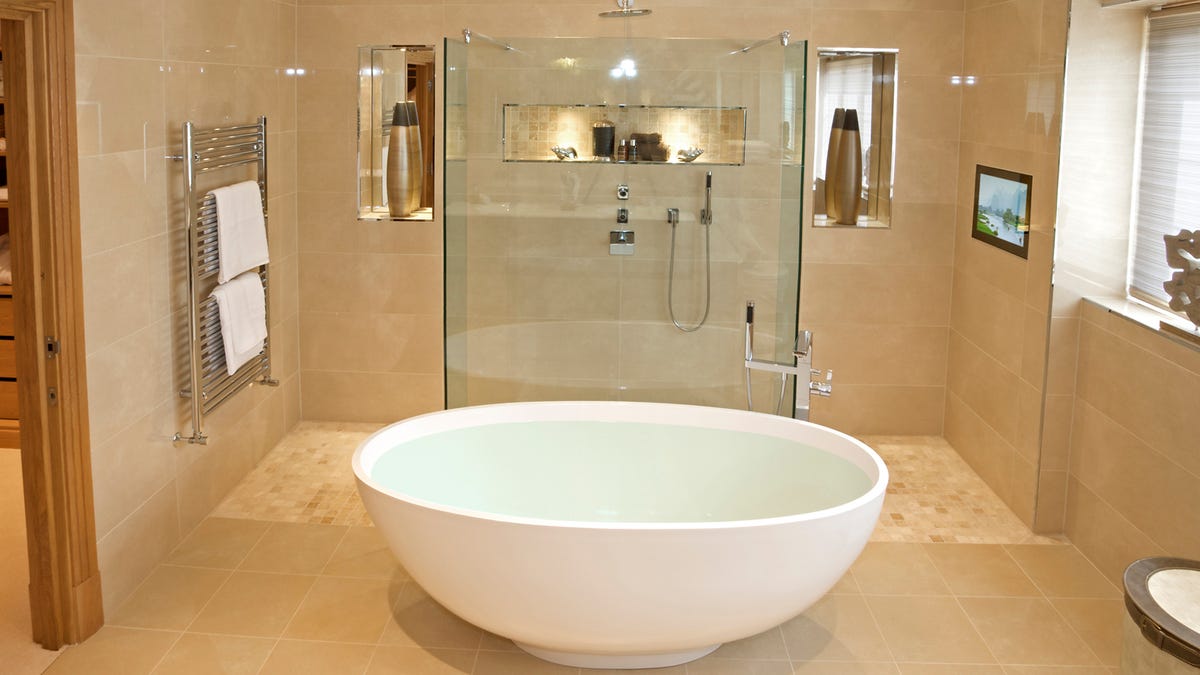
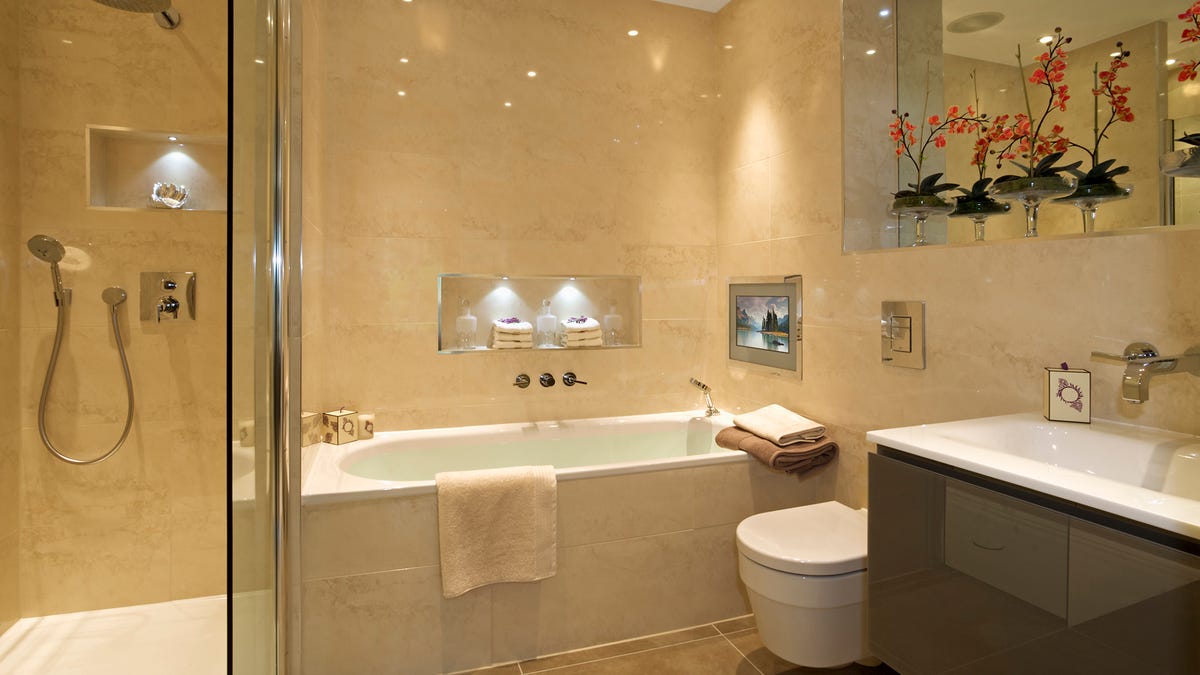
This bathroom is nicer than my entire house.
Getty Images/Experience Interiors
A bathroom is a bad place for a TV. Two of the worst things for electronic gadgets are moisture and heat. The latter is also one of the reasons why we don't recommend placing a TV above a fireplace. Even if you have a large, well-ventilated bathroom, it's likely much more humid than a typical living room.
For example, here's what Samsung has to say about bathroom TVs:
In general, you should not put your Samsung TV in extremely hot, cold, humid or dusty places. Consequently, we recommend that you do not install your Samsung TV in a bathroom or any other room with high humidity.
Here's the relevant section in LG owner's manual for its 2022 LED LCDs:
Do not place the TV and/or remote control in the following environments: - An area with high humidity such as a bathroom. - Near kitchen counters or humidifiers where they can easily be exposed to steam or oil. - Do not expose to dripping or splashing and do not place objects filled with liquids, such as vases, cups, etc. on or over the apparatus (e.g., on shelves above the unit).
Otherwise, this may result in fire, electric shock, combustion/ explosion, malfunction or product deformation.
Sony's TV warranty, for its part, doesn't cover "contact with liquid, heat, humidity or perspiration," all of which are pretty much par for the bathroom course.
Will humidity destroy the TV instantly? Probably not, and that's part of the problem. You'll likely hear or read plenty of anecdotal stories about how someone put a regular TV in their bathroom and it was "fine." However, these people probably won't follow up with how the TV later died "for no reason."
To compound the problem most people will want to put the TV where it's easily viewable from the tub or shower, namely up out of the way. Unfortunately heat and steam rise, especially when drawn ceiling-ward by a bathroom fan.
I could tub here.
Getty Images/Phototropic
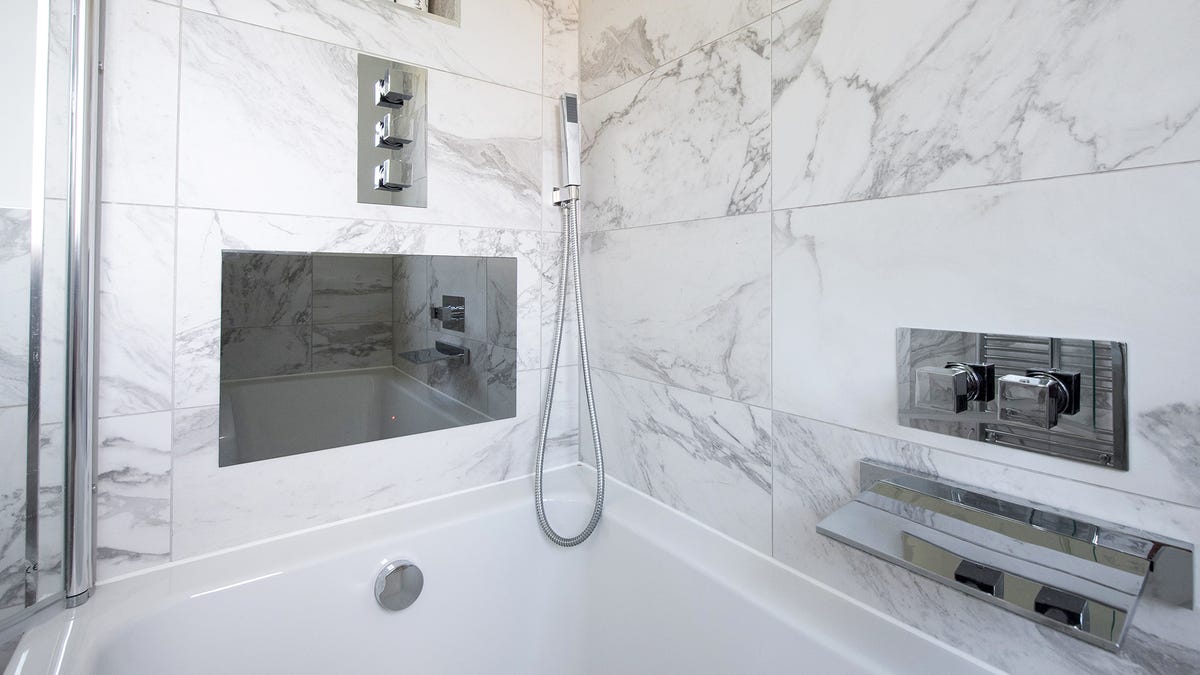
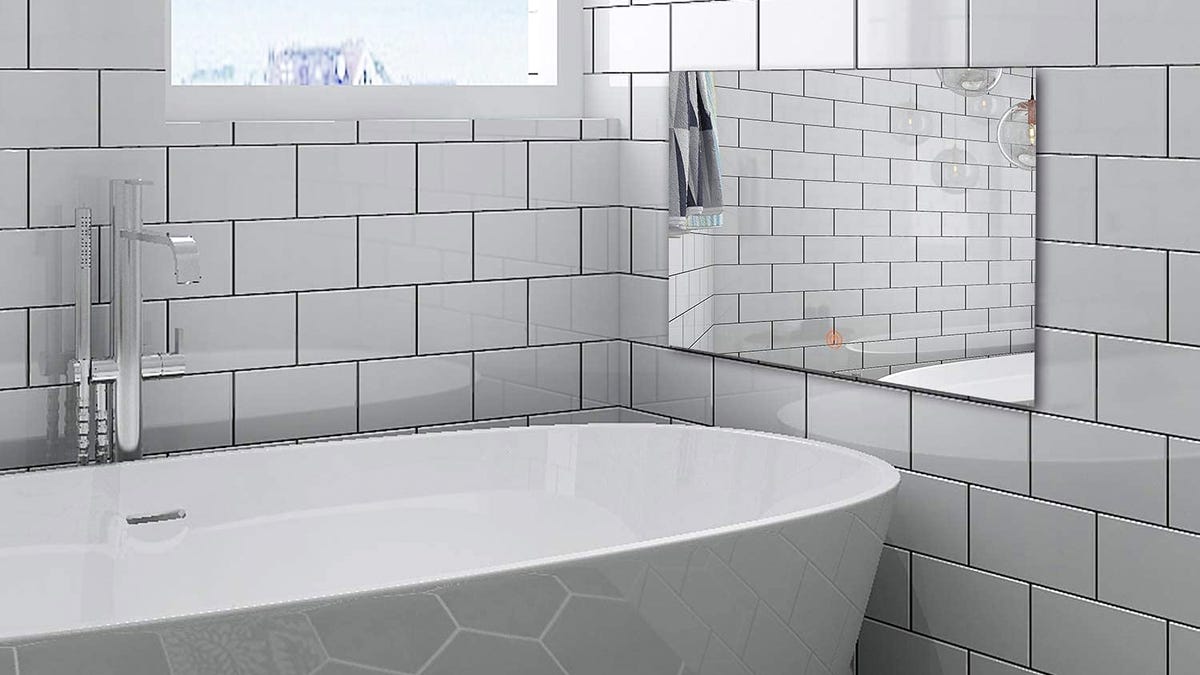
There are waterproof TVs designed for high-humidity areas but, as you'd guess, they're more expensive than regular models. They also don't feature names you'd recognize: Elecsung, Soulaca, Haocrown and others. Many have streaming apps built in. Some even double as a mirror when turned off. We haven't tested any of these models, but they cost at least three or four times as much as standard TVs of similar size.
Also, be wary of any lists on sites like Best Buy or Amazon that seem to suggest "bathroom TVs." These are filled with normal, small TVs that shouldn't be in a bathroom.
Things to consider for a bathroom TV
Add a fridge and I think I could live here.
Getty Images/John Keeble
Like other waterproof gear, for example headphones and Bluetooth speakers, waterproof TVs should have an IP rating. For example, "IP66-Certified Waterproof" means it's sealed against dust and jets of water aimed directly at the device.
Voice control would be a plus, for sure, but don't expect waterproof TVs to have the same features as a typical TV. For that matter, their smart TV interfaces are likely worse than you're used to, and might not have all the streaming services you'd want. Check user reviews carefully, if you can find any.
What's not important? Resolution. Don't worry if the TV is 1080p or 720p. With small TVs you're not likely to see much of a difference, if any.
Better hope it's splash-proof.
Getty Images/John Keeble
It's also worth checking to see if your Wi-Fi is up to the task. The signal might be strong enough to surf the web while you're enshrined on your throne, but streaming video is another story. You probably don't need to get any new gear, just give your current Wi-Fi a tuneup.
Check local building codes for any specific regulations for installing or mounting an electrical device in your bathroom. You can also mount a TV in the wall, but that's well beyond the scope of this guide and likely not something for the average DIYer.
Alternate options (tablets, smart displays and more)
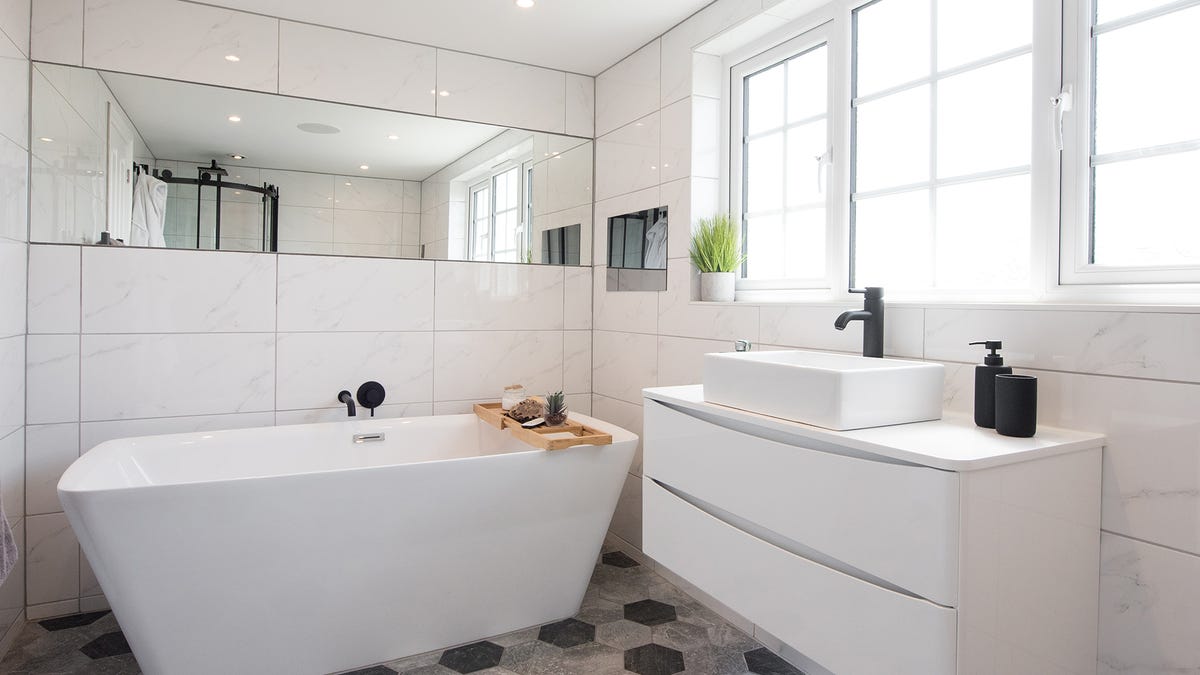
Totally natural towel placement.
Getty Images/Phototropic
Maybe you don't need a "TV." Smart home displays like the Amazon Echo Show and Google Nest Hub can fit just about anywhere. They'll run Netflix and some other streaming services. You won't get full TV functionality, nor are they waterproof, but they're cheap and far easier to fit in your bathroom. Just keep them away from the tub.
Another possibility is a simple waterproof Bluetooth speaker. I've had one of these in my shower for years. Certainly not a TV, but you can listen to music, news or podcasts. They have the added benefit of being inexpensive and, of course, portable.
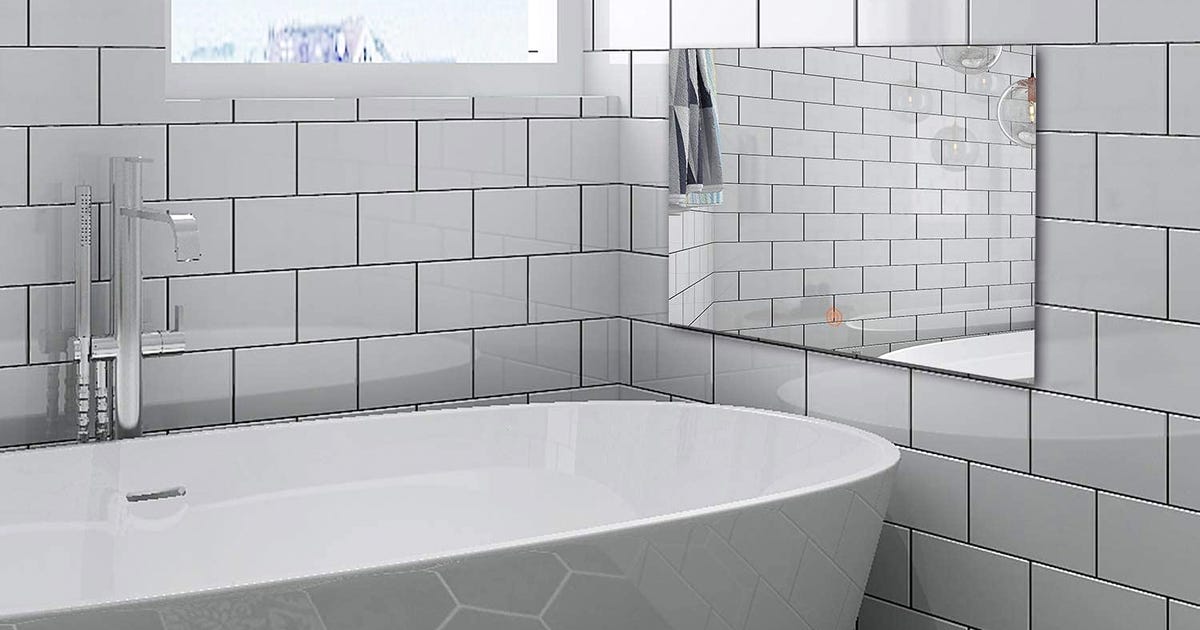
Mirror mirror on the wall, play for me The Gilded Age.
Haocrown
A common option is a tablet, usually with the addition of some kind of stand or bath tray. Certainly risky for an often-expensive device, but it's easier than mounting a TV in someplace that's essentially a temporary sauna.
It's also worth noting that most mid- and high-end phones are waterproof. Most tablets are not. So if you can handle a smaller screen, it's definitely a safer bath-time option.
'Bathroom TV, you're the one'
More than ever, we all need a place to relax. I have a close friend with an extremely stressful job who winds down after a long day by watching shows on a tablet while soaking in the tub. I absolutely get it.
Permanently mounting a TV in your bathroom, however, should be approached with caution. These are not good environments for electronics to live in, as evidenced by the warnings and warranties of manufacturers.
With a TV that's designed for it, or something inexpensive you don't mind replacing regularly, they're certainly better than holding your phone with one hand and your toothbrush in the other.
As well as covering TV and other display tech, Geoff does photo tours of cool museums and locations around the world, including nuclear submarines, massive aircraft carriers, medieval castles, epic 10,000 mile road trips, and more. Check out Tech Treks for all his tours and adventures.
He wrote a bestselling sci-fi novel about city-size submarines, along with a sequel. You can follow his adventures on Instagram and his YouTube channel.
Parenthood can be exciting and overwhelming, especially when it's your first child. It's a time filled with questions and frantic Google searches about what's best for your baby. Don't worry -- that's completely normal.
Making sure your baby is eating is one of the most important tasks you have. So you may be wondering how many bottles you need to buy and keep on hand. The exact number depends on several factors, including your baby's age and whether you are breastfeeding. Here's what to consider when shopping for bottles and what types of bottles are available.
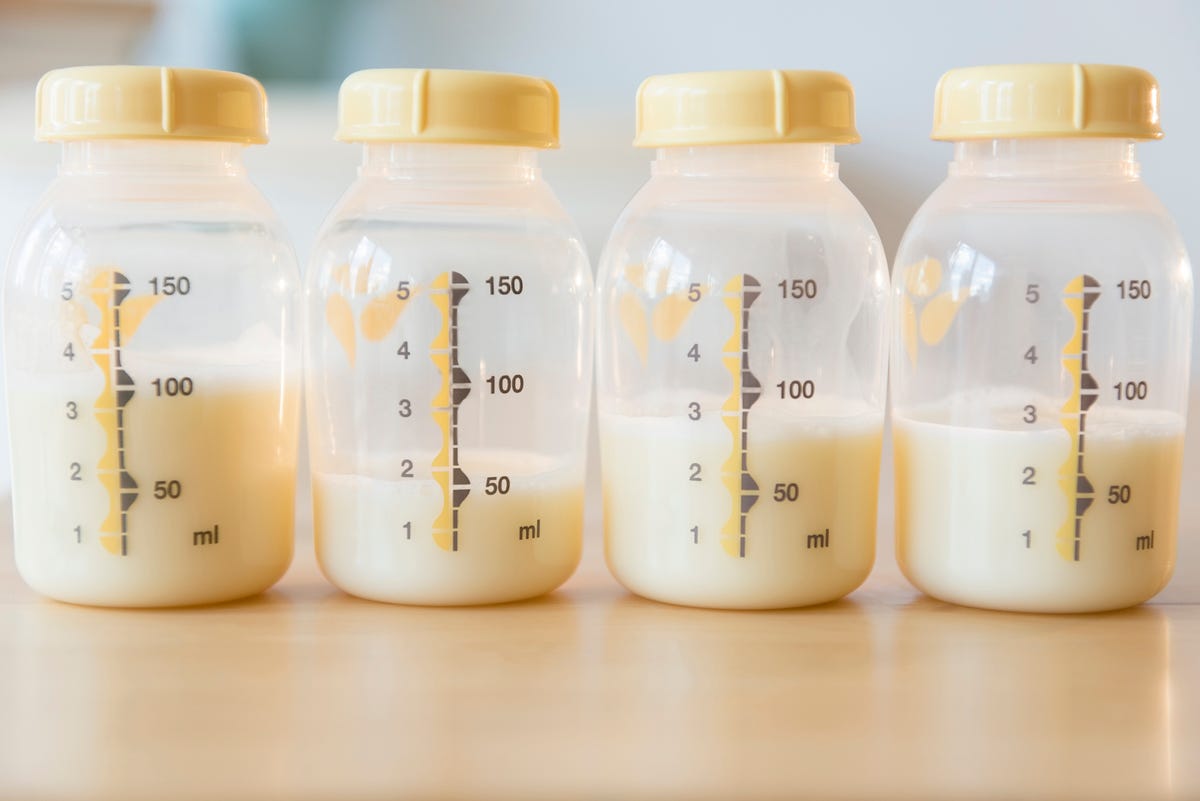
Taiyou Nomachi/Getty images
How many bottles do I need for a single day?
Every baby is different. How many bottles you need each day will depend on factors like your baby's age and whether you are breast-feeding, using formula or a combination of the two. There is no specific recommended number of bottles you need to buy to achieve peak feeding. But you should consider how often your baby eats and especially how often you want to clean the bottles.
You can expect to feed your newborn baby every two to three hours. They may need to eat more frequently if you are breastfeeding because breast milk is digested faster than formula.
We've rounded up the standard recommendations for how many baby bottles you need based on your baby's age and feeding habits.
Read more: Baby Registry Checklist: 10 Baby Products I Wish I'd Asked For
One to four baby bottles
If you are home and breastfeeding your baby, you won't need as many bottles. You'll likely only need to have one to four bottles ready to use per day. Of course, you'll want to have a few bottles on hand if you need to step out to run an errand. You can also consider having a few bottles around if you prefer to bottle feed your baby in public or if your partner wants to take part in feedings.
Bottles become less important as your baby gets older. You'll need fewer bottles if your baby is past the six-month mark and beginning to supplement with solid foods. In this case, experts recommend feeding them formula or breastmilk from a cup instead of a bottle.
Three to six baby bottles
It's common for babies to feed five to six times per day in the two-month to five-month age range. If you are doing a combination of breastfeeding and bottle feeding, your will likely need fewer than six bottles a day. Consider how often you need to clean the bottles. If you don't want to worry about cleaning the bottles every time your baby needs to eat, you can buy a few more.
Six or more baby bottles
Within the first month, newborns need six to eight feedings per day of around two to four ounces of milk. As your baby grows into their second month, how often you are feeding them may decrease because they are eating more at one time.
If you are also breastfeeding your baby, they will likely need fewer than six to eight bottles per day during that first month. However, if you're a working mom or will be away from your baby for periods of time, it's best to have more bottles on hand. You want to have enough to cover the entire time you're away.
Read more: Still Sterilizing Your Baby Bottles? You Might be Wasting Your Time
Jamie Grill/Getty
How to find your ideal baby bottle
Now you have an idea of how many bottles you need, so let's talk about which bottles are best for your situation. There are a few factors to consider when choosing bottles for your little one. It comes down to the types of baby bottles and the materials used to manufacture them.
Types of bottles
There are several bottle types to consider. Each comes with pros, cons and specializations. Some parents choose to keep a variety on hand to fit different needs.
Standard bottles
Standard baby bottles are basically what comes to mind when you picture a baby bottle. They are the most common bottles you see at stores and are typically what parents use for everyday needs. With a standard baby bottle, you don't get any bells and whistles. They are dependable and offer the most standard fits for teats and accessories. Standard baby bottles are generally the most affordable option.
Anti-colic bottles
Sometimes, babies swallow air when using standard bottles, leading to painful gas and indigestion. This can cause your baby to have prolonged fits of crying, also known as colic. Colic is most common during the first six weeks and will usually go away on its own. Anti-colic bottles are designed to help prevent your baby from swallowing air while they eat. This type of bottle is typically more expensive than standard bottles and is more difficult to clean. However, if you've noticed your baby tends to swallow air, it's worth it.
Self-sterilizing bottles
Self-sterilizing bottles are designed to be quickly and easily sterilized in the microwave. You'll fill a small portion of the bottle's base with water and place the bottle's parts on top. Then, you place it in the microwave for a few minutes to steam sterilize.
Disposable bottles
These single-use bottles come ready to use and are relatively inexpensive. But using them frequently can quickly become more expensive than feeding your baby with reusable bottles. They also aren't eco-friendly.
Catherine Delahaye/Getty
Baby bottle materials
There are a few different materials commonly used in the production of baby bottles. Plastic, glass, silicone, and stainless steel are most common within the US. Each material comes with its benefits, downsides and price points. While some materials may be better for some circumstances, the final selection may be a matter of preference.
Plastic bottles
Plastic bottles have traditionally been the most common, though there are some issues to consider. In the past, plastic baby bottles had the industrial chemical Bisphenol A (BPA) in them. In 2012, the US Food and Drug Administration banned the plasticizer BPA from baby bottles due to health concerns. However, some chemicals that are still allowed in plastic bottles may make you uncomfortable about using them. Despite potential health concerns, plastic does offer an inexpensive and durable option. If you decide to go with plastic bottles, avoid ones with BPA, BPS, Phthalates and PVC.
Glass bottles
Glass bottles don't have the risk of chemicals that plastic bottles do. They are also easy to sanitize and can withstand high temperatures. The downside of glass bottles is that they are more expensive and can break. They may also be too heavy for your baby, who may try to grab the bottle while eating.
Silicone bottles
Food-grade silicone bottles are a favorite among parents since they are shatter-proof like plastic but don't run the same risk of harmful chemicals. If you've decided that you want silicone bottles for your baby, ensure the product is made with food- or medical-grade silicone. Note that silicone bottles are generally more expensive than plastic and glass bottles.
Stainless steel bottles
Stainless steel bottles are often more expensive, but they come with upsides others don't have. For instance, stainless steel bottles withstand high temperatures, are lightweight and easy to hold and won't shatter. The main downside of stainless steel bottles is the cost and there is the risk of them containing lead. To ensure that your baby bottle is lead-free, purchase #304 or 18/8 food-grade stainless steel.
Read more: Should You Sterilize Your Baby Bottles? Here's When and How to Do So
Other considerations
There are other decisions that go into buying baby bottles. There are various accessories and components: nipples, venting systems, breast pump attachments and so on. You need to make sure they all can work together. Unfortunately, products aren't universally compatible, so do your research before you shop.
Different bottles also have various widths of the neck, which can impact how easy it is to clean and will determine which nipples will fit. Beyond that, it's best to ensure you choose bottle types and materials that are you are comfortable with.
The information contained in this article is for educational and informational purposes only and is not intended as health or medical advice. Always consult a physician or other qualified health provider regarding any questions you may have about a medical condition or health objectives.
Streaming Services to Cancel or Keep in September 2022
Streaming Services to Cancel or Keep in September 2022
September ushers in fall premiere season for traditional and cable networks, bringing new episodes of primetime TV shows and sports back to the screen. Whether you're a cord-cutter or not, it's likely your streaming plate will get a little fuller. Between The Rings of Power on Prime Video, House of the Dragon on HBO Max and Hulu's lineup of network premieres it's a busy time, making the "keep" section of this month's list heftier.
Starting Sept. 19, Peacock will have new episodes of NBC and Bravo shows exclusively on its platform the day after their network debuts. Series such as Law & Order will no longer stream on Hulu, but Hulu has new content arriving from Fox, ABC and other networks. With that in mind, both services may be keepers for you in September -- or not.
Each month I give advice on which streaming services to cancel and which ones to keep, based on their new releases and current lineup. You may be thinking about canceling a few streaming subscriptions to cut costs, and I'd like to offer my strategy: Churn like ice cream.
This means you subscribe for a period, cancel, choose a different service and later resubscribe, putting your favorites in a rotation. Feel free to pick one or two must-haves for the year and treat other streaming platforms like seasonal add-ons. The upside is that you can save money when Netflix, Disney Plus, HBO Max and others don't have the content you want to watch at a given time. Just remember to shut off auto-renewal for your monthly subscriptions. Rotating may not be an option if you're sharing your accounts with people outside your household, but if you can work out a system with your streaming clique, go for it.
Here are my recommendations for which streamers to keep or drop for September, primarily based on new TV shows and movies arriving on each platform. This time, there's a little bit of live sports thrown in the mix because it's football season. Of course your tastes may be different, but if nothing else, I urge you to at least consider the concept of rotating for savings. It's easier than you might think.
Streaming Service Rotation for September 2022
Keep
Cancel
Prime Video
X
Hulu
X
Netflix
X
Apple TV Plus
X
Disney Plus
X
Paramount Plus
X
HBO Max
X
Peacock
X
Starz
X
You should probably keep these subscriptions in September
Prime Video: Don't miss The Lord of the Rings: The Rings of Power on Sept. 1 and its two-episode premiere. Season 1 has eight episodes total that will air into October. Sports fans can catch the NFL's Thursday Night Football beginning Sept. 15.
Netflix: The biggest drops this month are Cobra Kai season 5 on Sept. 9, anime Cyberpunk: Edgerunners (Sept. 13) and Blonde, the fictionalized story based on Marilyn Monroe's life. Debuting on Sept. 28, Blonde is Netflix's first NC-17 original movie. Other releases include the Ivy + Bean movie trilogy (Sept. 2), a K-Drama version of Little Women (Sept. 3), The Anthrax Attacks: In The Shadow of 9/11 (Sept. 8), Queen Latifah's End of the Road movie (Sept. 9), Do Revenge starring Maya Hawke and Camila Mendes (Sept. 16) and Fate: The Winx Saga season 2 (Sept. 16).
Hulu: The Handmaid's Tale returns with season 5 on Sept. 14 and The Kardashians are back on Sept. 22. If you watch Hulu for its network shows that air the next day, look out for new seasons of Atlanta (Sept. 16), 9-1-1 (Sept. 20), The Cleaning Lady (Sept. 20) and The Resident (Sept. 21). On Sept. 22, Hulu drops premieres for Abbott Elementary season 2, The Conners season 5, The Goldbergs season 10 and The Masked Singer season 8. You can also stream new episodes of The Simpsons, Bob's Burgers, Shark Tank and Bachelor in Paradise later this month.
Is June worth your Hulu subscription when The Handmaid's Tale drops season 5?
Hulu
HBO Max: House of the Dragon and Harley Quinn are still going strong. Additionally, The Nevers season 1 part 2 (Sept. 16) and the Elvis movie (Sept. 2) arrive in September. Wondering where The Vampire Diaries landed after leaving Netflix? Find the Salvatores here starting on Sept. 4. And if you're a fan of Chip and Joanna Gaines' Magnolia content from Discovery, 25 titles touch down on HBO Max this month.
Disney Plus: I only recommend keeping this service this month if you're a Marvel or Star Wars fan, or a parent with young kids. Disney Plus moved its new Andor show from Aug. 31 to Sept. 21 with a three-episode premiere. The show has 12 episodes that air into November, so if you want to wait a few months and binge, go for it. She-Hulk is still spinning, but new Disney Plus Day releases include Pinocchio (with Tom Hanks), Thor: Love and Thunder and the new Cars on the Road series, which all drop on Sept. 8. Dancing With the Stars season 31 debuts on Sept. 19 and Hocus Pocus 2 starts streaming on Sept. 30.
Peacock: Sunday Night Football starts with a kickoff game on Sept. 8 then switches to Sundays beginning Sept. 11. With NBC shows rolling in this month with next-day streaming, you can upgrade to a Premium account to see full episodes and seasons on Peacock. New subscribers can sign up in September for only $2. You can also catch the Vampire Academy TV series (from Julie Plec, showrunner behind Vampire Diaries and The Originals), Bravo's Real Girlfriends of Paris (debuts Sept. 6 with weekly releases), Days of Our Lives (Sept. 20) and NBC's lineup. Of course, you can also hold off on a Peacock subscription and binge what you want in October or November.
Starz: Stream the debut of The Serpent Queen on Sept. 11, which features Samantha Morton as French monarch Catherine de Medici. Raising Kanan will continue to air through September. You can either keep Starz or binge everything at the end of October, but there's a deal for $5 per month for three months available right now.
Read more: Best Streaming Service of 2022: Netflix, HBO Max, Disney Plus and More
Cancel at least two services in September
Apple TV Plus: While the service produces high-quality content and a nice lineup for kids, there isn't much must-see content here for September. Releases include Hillary Clinton's Gutsy (Sept. 9) which features guests like the Little Rock Nine, Megan Thee Stallion and Jane Goodall, Central Park season 3 (Sept. 9) and The Greatest Beer Run Ever with Zac Efron Russell Crowe (Sept. 30).
Paramount Plus: Nothing hot on Paramount Plus this month. But you can stream new episodes of reality shows like Big Brother or Ink Master, or catch the season 6 premiere of The Good Wife.
Honestly, Disney Plus and Peacock could have dual membership in the keep and cancel columns this month, especially if you're not a football fan or don't mind waiting to binge-watch certain series. And there's nothing wrong with watching Hocus Pocus 2 in October. It's your choice.
Sorry, there's still no reason to cancel Netflix when releases like Cobra Kai are arriving this month.
Netflix
Save money by holding off a few weeks
If you're not someone who routinely gets FOMO, then a smart method is to wait until the bulk or all episodes of your favorite series land on a platform. That way, rather than pay for a service for several months to cover the 6- to 10-week run of a show, you can catch up on everything by subscribing for one month. And then repeat the cycle again.
As an example, there are 12 episodes of Andor coming to Disney Plus. The finale airs in November, so all episodes will be available to stream at that time. Though it premieres on Sept. 21 and continues through the fall, why pay for three months of Disney Plus when you can wait to watch it in full anytime in November? If this is the only series you want to watch during this period, it makes sense to be patient to save money.
Cassian Andor broods in upcoming Star Wars series Andor, which airs on Disney Plus into November.
Lucasfilm
How much do you pay each month for your streaming services? Netflix is $10 to $20, Disney Plus is anywhere from $3 to $8 depending on bundles, HBO Max costs $10-$15, Hulu starts at $7 and Starz runs $9. The others have a base rate of $5 per month. Should you decide to churn, set a calendar reminder to ping you when it's time to re-subscribe or cancel. We'll see you in October for another streaming breakdown.
Twitter blue what to know about the subscription and billing twitter blue what to know about the subscription and services twitter blue what to know about the subscription economy twitter blue what to know about the subscription box twitter blue what to know about the subscription racket twitter blue what to know about the subscription business twitter blue what to know about the subscription addiction twitter blue what to know about the subscription server twitter blue what to know about the subscription center twitter blue what to know about the bible
Twitter Blue: What to know about the subscription and features, including undo tweets
Twitter Blue: What to know about the subscription and features, including undo tweets
For those longing for more control over their tweets, your time has come. On Tuesday, Twitter rolled out Twitter Blue, a subscription service that (finally) allows you to undo a tweet, among other desired features.
First available in Australia and Canada back in June, the paid version is now open for users in the US and New Zealand.
The premium service also allows you to read news ad-free, edit a published tweet, organize your bookmarks into folders, pin conversations in your DMs, upload videos up to 10 minutes long and more.
If you're interested in learning more about all the exclusive features you can get only on Twitter Blue, here's everything you need to know about the new premium monthly subscription service. For more on Twitter, here's how to avoid Twitter scams. Here's how to stop Facebook from tracking you across the web and how to find and delete your Google data now.
What is Twitter Blue and what does it do?
Twitter Blue is a subscription service that offers exclusive features for a monthly fee. On Twitter, you'll frequently see people talk about which features Twitter should have -- and several of the most popular requests have made their way into the paid service.
The most prominent of these features is undoubtedly Undo Tweet -- which isn't exactly the edit tool that some have requested, but it does offer a way to quickly fix a published tweet. Here's what comes with a Twitter Blue subscription:
Undo Tweet: Not quite an edit tool, but you can preview a tweet after publishing it and revise it. You have up to 60 seconds to undo a tweet, reply or thread you've posted to Twitter.
Ad-free articles: Read stories from The Los Angeles Times, The Washington Post, BuzzFeed, Rolling Stone and more -- without advertisements. More than 45 sites are available with others coming. Also, a piece of your subscription fee goes directly to these sites. Note that "ad-free" applies just to these articles and not elsewhere in Twitter.
Reader for threads: Long threads are now easier to read thanks to the new Reader Mode. As you scroll through a thread, large tiles will showcase each tweet underneath, displaying only the tweet and any accompanying videos or photos. Distractions like the username, avatar, date and numbers are all gone when enabled. You can also customize text size.
Bookmark folders: Bookmark tweets? Now you can organize your messy bookmarks into folders so that they're easier to find. Whenever you bookmark a tweet, you'll be asked if you want to add it to a folder.
Custom navigation: If Twitter's navigation bar doesn't work quite like you want, you can customize it and add bookmarks, lists, profile and monetization icons (iOS only).
App Icons: You now choose a different Twitter app icon for your home screen: eight permanent icons and three seasonal ones (iOS only)
Themes: Choose between six theme colors: blue (original), yellow, red, purple, orange and green (iOS only).
Experimental features: Use unreleased experimental features, such as pinned DM conversations and 10-minute long video uploads (desktop only).
How much does Twitter Blue cost?
Here's how much a Twitter Blue subscription will cost per month:
US$3
AU$4.49
CA$3.49
NZ$4.49
However, these prices might change. On the Twitter Blue subscription page, Twitter calls this an"introductory price."
Is free Twitter going away?
No, the Twitter you know is still available and free to use. Twitter Blue is an opt-in service.
Is my account eligible for Twitter Blue?
Twitter Blue is currently available on iOS, Android and the web in four countries across the globe: US, Australia, Canada and New Zealand. Although the paid service may eventually spread to other countries, a company spokesperson told CNET, there are currently no plans for a bigger roll out.
How to sign up for Twitter Blue
You can subscribe to Twitter Blue on your mobile phone or from your computer.
On iOS or Android, do the following:
1. Open the Twitter app.
2. Tap your profile image in the top left corner to access the Profile menu.
3. Tap Twitter Blue.
4. Tap the Subscribe button at the bottom of the page.
5. Make a payment (including Apple Pay on iOS or Google Play on Android).
If you're on the web, signing up for Twitter Blue is slightly different:
1. Go to the Twitter website.
2. On the left, in the Profile menu, click More.
3. Click Twitter Blue.
4. Click the Subscribe button at the bottom of the page.
5. Make a payment (made via Stripe).
Now that I have Twitter Blue, how do I undo a tweet?
Once you have Twitter Blue, you can immediately begin to undo original tweets, replies, threads, quote tweets and poll tweets. After firing off a tweet, you'll automatically be redirected to your posted tweet, with the opportunity to Send Now -- or permanently post the tweet -- or Undo, which gives you 20 seconds (by default) to go back and make any edits, such as fix grammatical mistakes, tag someone or simply get rid of an embarrassing tweet.
You can customize how Undo Tweet works. In your Profile menu, go into Twitter Blue and tap Undo Tweet. Here you can toggle on and off how it works for different types of tweets and change the amount of time you have to undo a tweet (choose between 5 and 60 seconds).
How do I get pinned conversation, longer video uploads and other experimental features?
Since 2019, Twitter has tested out experimental features via Twitter Developer Labs, a program that allows the developer community to try out features that might possibly make their way to Twitter one day.
Thanks to Twitter Blue, you can now get your hands on many of these beta features, through a setting called Labs. Currently, there are only two features you can test:
Pinned conversations: Pin any conversation in your DMs to the top of the page.
Upload longer videos: Upload up to a 10-minute long video to Twitter (only available on desktop).
Eventually, more experimental features will come to Labs for Twitter Blue users. You can get real-time updates at @TwitterBlue.
How to cancel your Twitter Blue subscription
No longer interested in paying for Twitter Blue? Luckily, Twitter lets you pause or cancel your subscription.
1. Using the device that you purchased Twitter Blue on, make your way to the Twitter Blue option in the Profile menu.
2. Next, scroll down and tap Manage subscription.
As long as you're on the device you used to sign up for the subscription, you can cancel from here. If you do cancel, you'll be able to access your subscription until it ends.
Twitter isn't the only platform making big changes. YouTube is looking to remove dislike counts from their videos and Instagram announced it's testing a new feature to help prevent you from scrolling too much.
At amp t s galaxy s22 offer allows for 8000 at amp t s galaxy s22 offer allows meaning at amp t s galaxy s22 offer allows you to raise at amp t s galaxy s22 offer in compromise at amp t s galaxy watch at amp t yahoo home page concerts at amp rogers ar
AT&T's Galaxy S22 offer allows for $800 off even if you trade in an older, broken phone
AT&T's Galaxy S22 offer allows for $800 off even if you trade in an older, broken phone
If you have AT&T and are thinking of upgrading your old Galaxy to a new Galaxy S22 phone, you could get a solid deal if you're willing to stay with the carrier for 36 months. On Wednesday the carrier announced its latest offers to entice new and existing users to upgrade following Samsung's Unpacked event. It's offering $800 off a new S22 phone (S22 regular, S22 Plus or S22 Ultra) when you trade in any old Galaxy S, Galaxy Note or Galaxy Z phone.
The older phones can be in any condition, too. The carrier is offering the credit even if your old device won't turn on, has a busted battery or a broken screen.
"We have the opportunity there with any of these devices, there's certainly value to us as a company, whether we can reuse the device, refurbish it or even recycle," Jenifer Robertson, executive vice president and general manager at AT&T Mobility, tells CNET.
"So the ability to get those devices back in our hands certainly brings us value and supports our commitment to be more environmentally conscious."
While the offer is new to AT&T, it follows a similar deal from Verizon last year. At several points in the year, the company dangled promotions to lure customers to new devices and wireless plans by adding extra value in exchange for broken devices.
To get AT&T's deal you'll need to have an unlimited plan, though the company tells CNET that you won't be limited to the company's three most recent unlimited options (known as Starter, Extra and Elite). If you have a recent but older unlimited plan, you can still take advantage of the deal. All of the unlimited plans have 5G access, including for the carrier's C-band and upcoming 3.45GHz 5G networks, which AT&T calls "5G Plus."
As with the carrier's previous upgrade deals, you'll need to pay for your new phone on a 36-month installment plan. The $800 will be doled out as bill credits over the course of those 36 months. If you want to leave the carrier early, you'll need to give up the remaining credits and pay off the remaining balance owed on the phone.
The new Galaxy S22 line will be available in stores on Feb. 25. If you want to preorder with AT&T, you'll get a free doubling of storage. AT&T hasn't given out an end date for the trade-in deal but says the offer will be available for a "limited time."