James Corden upset the BTS Army and is trending on Twitter for all the wrong reasons
James Corden upset the BTS Army and is trending on Twitter for all the wrong reasons
If the internet has taught us anything in the last five years it is this: You don't mess with BTS and you definitely don't mess with the BTS army.
The latest person to learn this universal truth: James Corden.
For context, BTS, the South Korean super group with one of the most hardcore fanbases in history, took centre stage at the UN recently as a special envoy for South Korean President Moon Jae-in. They made a speech highlighting issues of climate change and vaccine hesitancy. They also performed. Why BTS? Well the numbers speak for themselves: Six million people watched the YouTube video of the speech and song in just five hours.
And that's where James Corden comes in.
James Corden has long been a friend of BTS, inviting them on his show constantly to the point where BTS fans call him "Papa Mochi" because of his relationship with Jimin (who is nicknamed Mochi).
But now there's trouble in paradise. The problem? A series of jokes made by Corden about BTS' recent trip to the UN.
On The Late Late Show, Corden very gently mocked the UN for inviting BTS to the UN headquarters in New York, but perhaps his biggest faux pax: Referring to the BTS fanbase as "15 year old girls." It was a brief series of very banal (and boring) jokes, but that was enough to raise the ire of BTS fans.
Next minute: James Corden is trending on Twitter for all the wrong reasons.
You literally cannot underestimate the power of the BTS. When the BTS army mobilizes around a topic, they tend to have a huge impact. K-Pop fans managed to sabotage a Trump rally in Tulsa, Oklahoma back in July 2020 and they are unforgiving of any perceived slights toward BTS or the BTS fanbase.
In this case, the anger is more directed toward how Corden is referring to the fanbase. Teasing a group for having a fanbase of teenage girls seems pretty long in the tooth. Harry Styles put it best in 2017: "Who's to say that young girls who like pop music -- short for popular, right? -- have worse musical taste than a 30-year-old hipster guy," he said, in an interview with Rolling Stone. "That's not up to you to say. Music is something that's always changing. There's no goal posts. Young girls like the Beatles. You gonna tell me they're not serious?"
James Corden has been trending for all the wrong reasons in the past month. Just weeks ago he set the internet on fire for dressing up as a mouse and thrusting in the general direction of cars in traffic.
Yep, that happened.
Representatives from the Late Late Show didn't immediately respond to a request for comment.
Facebook CEO Mark Zuckerberg wields so much power that even one of the social network's co-founders thinks it's both "unprecedented" and "un-American."
Chris Hughes, who co-founded Facebook with Zuckerberg while they were students at Harvard, called for the social network to be broken up in an op-ed published Thursday by The New York Times. "I'm angry that his focus on growth led him to sacrifice security and civility for clicks," Hughes wrote, referring to Facebook's boss and major shareholder. "I'm disappointed in myself and the early Facebook team for not thinking more about how the News Feed algorithm could change our culture, influence elections and empower nationalist leaders."
Facebook's rapid growth has been fueled by acquisitions, including Instagram and WhatsApp, a messaging service. Critics and experts say Facebook simply purchased its competition, rather than innovating to meet the challenges they posed.
"Their whole business model is to identify potential threats and then buy them or beat them in some way," said Stephen Diamond, an associate professor of law at Santa Clara University School of Law.
And Facebook has been called out for not doing enough to combat election meddling, misinformation and hate speech. Its enormous power, critics argue, needs to be kept in check. Facebook doesn't want to spin off Instagram and WhatsApp.
Here's what you need to know:
Who wants Facebook broken up? Why?
Calls to break up Facebook aren't new. But it is startling to hear one of the company's co-founders call for such an extreme measure. Hughes argues that Zuckerberg holds so much power that even the company's board of directors can't keep him accountable. Zuckerberg controls around 60 percent of Facebook's voting shares, which means the board technically can't fire him even if he messes up.
Hughes isn't alone. Advocacy groups, including the Electronic Privacy Information Center, Color of Change and Common Sense Media, have previously asked the Federal Trade Commission, the agency that enforces antitrust law, to make Instagram and WhatsApp separate companies. A split would also make it easier for other social media companies to compete with Facebook, the organizations argue.
In addition, a group called Freedom from Facebook has called on the FTC to force Facebook to spin off its Messenger service too.
Sen. Elizabeth Warren, a Democrat from Massachusetts who's also a presidential candidate, is among the lawmakers who want to break up Facebook, as well as other tech giants, including Google and Amazon.
How would Facebook be broken up?
One way to break up Facebook would be for the federal government to file a lawsuit against the company, arguing it stifles competition. That could prompt a negotiation between the parties that could lead to Facebook agreeing to make itself smaller.
Another alternative would be for Congress to pass a law covering tech monopolies. Warren has proposed such a law, which would require tech platforms that take in $25 billion or more in sales to "structurally separate" their products. Amazon, for example, would have to spin off its house brand Amazon Basics. Warren said that if she won the presidential election her administration would also appoint regulators to unwind the mergers of Instagram and WhatsApp from Facebook.
What does Facebook think about the idea?
Facebook has pushed back, arguing that breaking up the company wouldn't hold the social network more accountable for its actions. Instead, Facebook has called for more internet regulation around harmful content, election integrity, privacy and data portability.
"Accountability of tech companies can only be achieved through the painstaking introduction of new rules for the internet," Nick Clegg, Facebook's vice president of global affairs and communications, said in a statement Thursday. The social network also said that having Instagram and WhatsApp under Facebook helps them fight spam, election meddling and crime. Facebook says it has plenty of competition, pointing to YouTube, Snapchat, iMessage and WeChat, among others.
Clegg touched on all those points in a Saturday editorial in The New York Times.
Have tech companies been broken up in the past?
Yes, but it's unusual. In 1974, the US Department of Justice filed an antitrust lawsuit against AT&T but the matter wasn't settled until eight years later. The telephone company was required to spin off two-thirds of its assets into separate companies, according to a 1982 article from The Washington Post. The government has also tried to break up Microsoft and in 2000 a US federal judge ordered that the tech giant split into two companies. Microsoft appealed and the decision was reversed.
What would this mean for users of Facebook?
Facebook is trying to integrate its messaging services so users of Facebook, Instagram and WhatsApp can send messages to one another without switching apps. Splitting up the companies might prevent that from happening.
Those who want the government to break Facebook up argue the move would fuel more competition among social media companies, which could mean more options for consumers. About 2.7 billion people use Facebook, Instagram, WhatsApp or Messenger every month.
Diamond said that breaking up Facebook could also lead to the company stepping up its privacy efforts to match its social media competitors.
What are the chances this happens?
The FTC declined to comment on whether it's looking to break up Facebook. But if history is any indication, it would be a rare move.
"I doubt there is sufficient political momentum to break up Facebook," Diamond said. "I'm skeptical, even though I think there might be good reasons to do it."
Originally published May 10, 5:40 a.m. PT. Update, May 11: Adds mention of Facebook VP Nick Clegg's Saturday editorial in the Times.
The Motorola One Fusion Plus with pop-up selfie cam is on sale for $250 (Update: Sold out)
The Motorola One Fusion Plus with pop-up selfie cam is on sale for $250 (Update: Sold out)
What are your priorities when shopping for a midrange phone? I suspect they're the same as if you were shopping for a premium phone: Big screen, lots of storage, good cameras, excellent battery life and so on.
Now, what if you could get that midrange phone at a budget price? For a limited time, you can: The unlocked Motorola One Fusion Plus is on sale for $250, a full $150 off the regular price.
This is a GSM phone, meaning it's compatible with AT&T, T-Mobile and many of their MVNOs: Cricket, Consumer Cellular, Mint Mobile and so on. Just pop in your existing SIM card or set up a new line of service and you should be good to go.
Like most Motorola phones we've seen in recent years, the One Fusion Plus offers considerable bang for the buck. Notable specs include a 6.5-inch FHD Plus display, 128GB of expandable storage, a 5,000-mAh battery (good for up to two full days, according to Motorola), a fingerprint reader, four rear cameras and something pretty unique: a pop-up front-facing camera.
That selfie sensor means you get a full edge-to-edge screen -- no notch or teardrop interrupting the image.
OK, but are those cameras any good? That's a question I can't answer, because CNET hasn't reviewed the One Fusion Plus, and I haven't tried it myself. I can tell you that the phone doesn't support wireless charging, which is a feature I'd be hard-pressed to live without. At least it offers USB-C, though.
Still, a big, unlocked, pure-Android phone with these specs for this price? I definitely recommend taking a look. (And if you already own this phone, share your thoughts on it in the comments!)
Read more: The best phones under $500
CNET's Cheapskate scours the web for great deals on tech products and much more. For the latest deals and updates, follow him on Facebook and Twitter. You can also sign up for deal texts delivered right to your phone. Find more great buys on the CNET Deals page and check out our CNET Coupons page for the latest Walmart discount codes, eBay coupons, Samsung promo codes and even more from hundreds of other online stores. Questions about the Cheapskate blog? Answers live on our FAQ page.
Intel's Meteor Lake Chip for 2023 PCs Is Up and Running Today
Intel's Meteor Lake Chip for 2023 PCs Is Up and Running Today
Meteor Lake, a radically redesigned Intel processor due to ship in PCs in 2023, now can run Windows, Linux and Chrome OS. It's a notable achievement for a complicated new approach that combines many "chiplets" into one more capable processor.
"We have officially powered on our first disaggregated product: Meteor Lake," tweeted Michelle Johnston Holthaus, head of Intel's PC processor business, on Friday. Intel Chief Executive Pat Gelsinger announced that the chip runs the three operating systems on a conference call Thursday after the chipmaker reported first-quarter financial results.
The step is significant given that it embodies two ambitions key to Intel's effort to reclaim the chip leadership it lost to Taiwan Semiconductor Manufacturing Co. and Samsung. First, Meteor Lake uses multiple chiplets stacked together with a technology called Foveros. That kind of packaging prowess is increasingly important to remain competitive, as shown by two shipping computer processors that already are shipping, Apple's M1 Ultra and AMD's Ryzen 5800X3D.
Second, much of Meteor Lake is built with the Intel 4 manufacturing process, an important advance that could match miniaturization advantages that TSMC and Samsung already offer. That's crucial for Intel's own chips and its Intel Foundry Services effort to build others' processors the way TSMC and Samsung do.
Intel also is working on a side-by-side packaging technique called EMIB, used in its Sapphire Rapids chip for servers arriving later this year, and on improvements to Foveros called Foveros Omni and Foveros Direct.
Sleek Lenovo Legion Y740S gaming laptop weighs just over 4 pounds -- but at a cost
Sleek Lenovo Legion Y740S gaming laptop weighs just over 4 pounds -- but at a cost
This story is part of CES, where CNET covers the latest news on the most incredible tech coming soon.
Lenovo's Legion gaming laptops offer good mainstream performance with designs that don't necessarily scream "gamer." So when I saw the announcement for the 15-inch Legion Y740S, a gaming laptop that weighs only 4.2 pounds (1.9 kg), is just 0.6-inch thick (14.9mm) starting at $1,100, and is expected to be on display at CES 2020 this week, I quickly searched for what discrete graphics chip would be in it to power my gaming on the go.
The answer is none. It has no discrete graphics.
The laptop will have up to a 10th-gen Intel Core i9 H-series processor. That chip's integrated graphics are expected to be good enough for entry-level gaming and other graphics tasks that Intel's integrated graphics weren't up for in the past. But for those who expect more from a gaming laptop than integrated graphics, which is everyone really, Lenovo has an answer.
In an interesting move, the company made an external Thunderbolt 3 GPU box to pair with the Y740S, the Legion BoostStation. Not every gaming manufacturer makes its own eGPU, but for Lenovo, the BoostStation enabled the ultraslim profile of the Y740S -- by putting the graphics on the outside. The eGPU itself bears a strong resemblance to a rotated version of Razer's Core X, with its slide-out tray, venting design, aluminum build and arrangement of the back Ethernet and USB ports.
The BoostStation is a bit less accommodating, though; it looks like it only fits a dual-width card instead of the triple-width slot on the Razer. However, you can use Lenovo's for external storage as well, with slots for a hard disk/SATA SSD or a pair of PCIe SSD modules, as long as the 500-watt power supply can accommodate your options.
Lenovo will offer pre-equipped versions of the BoostStation with Nvidia GeForce RTX 2060, 2070 or 2080 Super cards, a GTX 1660 Ti or an AMD Radeon RX 5700 XT, though you can always choose your own graphics card. It starts at $250, which is a pretty good price for the empty box. It's expected to ship in May alongside the laptop. That's assuming Intel is able to deliver its processors on schedule, something it struggled to do much of last year.
One of the biggest issues with gaming laptops is that the GPU typically can't be upgraded, so at least this gives you options. But without discrete graphics built in, is the Legion Y740S even a gaming laptop? Lenovo gave it a new keyboard design with tactile feedback that it says is better for gameplay. But it also used a display panel with a 60Hz refresh rate, whereas much of its competition has moved to 120Hz panels (or faster) for smoother visuals. In the end, it's a thin-and-light 15-inch laptop with an edgier design and a few gaming features thrown in, but you'll need to spend more on the eGPU if you want to actually game with it.
HP Pavilion Aero 13 review: A small laptop you'll want to take everywhere
HP Pavilion Aero 13 review: A small laptop you'll want to take everywhere
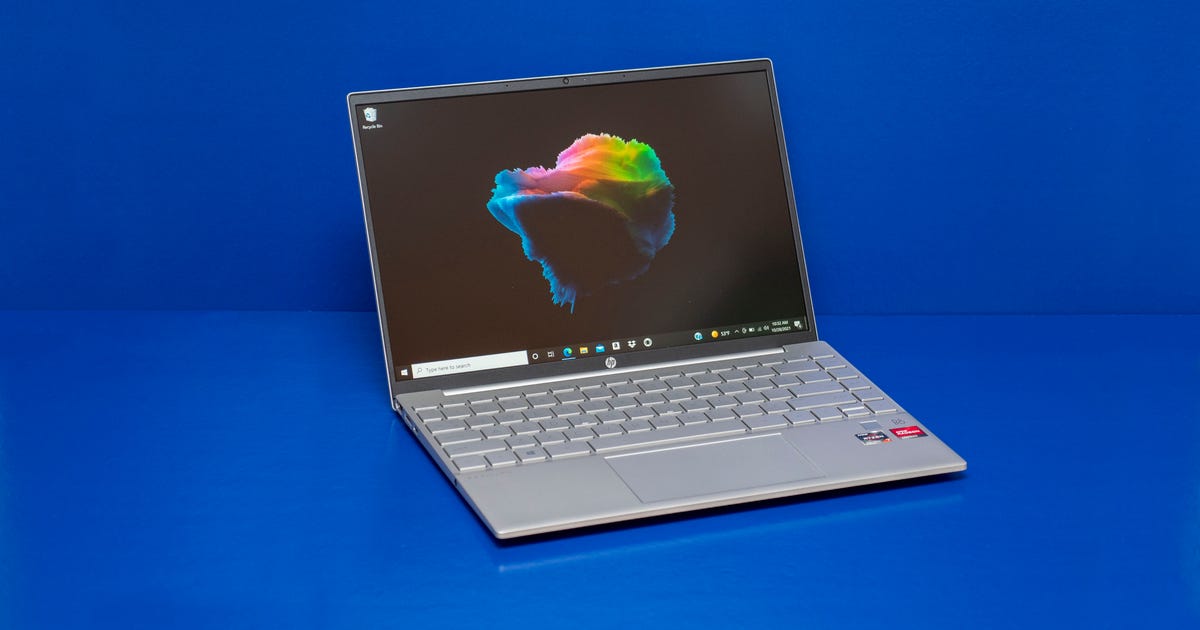
The HP Pavilion Aero 13 is not your average Pavilion laptop, a product line that is decidedly average. For HP, Pavilion is its everyday line with a focus on value, while its Envy and Spectre lines are the midrange and premium models, respectively. But wow, HP packed a lot of value into the Aero 13: Eye-pleasing magnesium-aluminum chassis, strong processing performance, long battery life, a bright, colorful display and a weight of just 2 pounds (0.94 kilograms). Amazingly, with all that it offers though, it has a starting price of $750.
Like
Weighs under 2.2 pounds
Long battery life
Excellent performance for everyday tasks
Don't Like
Backlit keyboard not standard
No touchscreen option
Memory is soldered on
The configuration I tested is $1,000 but even if you max out the configuration the price stops at $1,125 and you're getting a really great set of specs for that money including upgrades to the keyboard, display, storage, Wi-Fi card and a choice of four colors. Basically, while the price might not scream "budget-friendly laptop" you're actually getting quite a lot of laptop for the money.
The Pavilion Aero 13 is listed as coming soon on HP's UK siteand the price is expected to start at £850. It's not available from HP yet in Australia either, but Harvey Norman stocks a configuration for AU$1,598.
HP Pavilion Aero 13
Price as reviewed
$1,000
Display size/resolution
13.3-inch 1,920 x 1,080 display
CPU
AMD Ryzen 7 5800U
Memory
16GB 3200MHz (onboard)
Graphics
512MB AMD Radeon Graphics
Ports
USB-C (10Gbps), USB-A (x2, 5Gbps), HDMI 2.0 out; AC in, combo headphone jack
Storage
512GB PCIe SSD
Networking
Realtek 802.11ax (Wi-Fi 6), Bluetooth 5.2
Operating system
Windows 10 Home (21H1)
The Aero 13 is available in sliver (pictured), rose gold, warm gold and white.
Josh Goldman/CNET
When it comes to 13-inch lightweight laptops, Apple's MacBook Air is the unofficial benchmark -- at least in terms of the design and features you'll typically find at or around $1,000. The Pavilion Aero 13 doesn't quite match the fit and finish of Apple's least expensive laptop, but it comes close and offers some things you just don't get on the Air. It also weighs nearly a pound less.
For instance, the MacBook Air has a 2560x1600-pixel, 13.3-inch display with 400-nit brightness and P3 color gamut coverage. The Aero 13 can be configured with either a 1920x1200 or 2560x1600-pixel display (neither is a touchscreen, though). I tested the former and it covers 100% sRGB color gamut and 81% of Adobe RGB and P3 color gamuts. While it's rated for 400 nits, the brightness actually measured 495 nits in my testing. It's a generally excellent display, certainly better than I'd expect to find on past Pavilion models, and if you want the higher-resolution panel, it's only $30 extra.
The keyboard is comfortable and spacious but the silver keys aren't always the easiest to read.
Josh Goldman/CNET
Speaking of upgrades, my configuration didn't come with a backlit keyboard; it's a $10 upgrade if you get an Aero 13 in silver, but is included with the other three color options HP offers. However, the colors are $10 or $15 extra so it's pretty much a wash. You can also pick between an AMD Ryzen 5 5600U or Ryzen 7 5800U processor with 8GB or 16GB of memory (it's onboard and can't be upgraded later, so get the 16GB if you can afford it) and a choice of a 256GB, 512GB or 1TB SSD for storage. You'll also be able to upgrade to Windows 11 for free.
The performance from the Ryzen 7 5800U is impressive, outperforming a pricier Intel Core i7-1185G7 in the Dell XPS 13 -- a premium rival to the Aero 13. You are getting a lot of processing power here for sure and combined with 16GB of memory, you won't experience any slowdowns on typical office and schoolwork, streaming entertainment or basic content creation. Battery life is great, too, lasting for 10 hours, 8 minutes on our streaming video test.
You'll find more than USB-C ports on the Pavilion Aero 13.
Josh Goldman/CNET
Most importantly, the HP Pavilion is just a pleasure to use. It feels good in your hand. It's insanely light and yet you can still open it with just your thumb. You get more than a couple of USB-C ports and even though the power adapter uses a barrel connector, you can charge it through the USB-C port, too.
The keyboard feels about as good as any skinny laptop at this price and the precision touchpad is smooth and responsive without any jumpiness. There's even a fingerprint reader in the palm rest for passwordless sign-ins. There are some things missing that you'll find on HP's Envy and Spectre models, such as a shutter to block the webcam and a shortcut key to instantly kill the mics and there's no microSD or SD card reader.
But to HP's credit, it doesn't feel like you're missing much when you're using Pavilion Aero 13. With the long battery life, featherweight body and zippy performance, this small laptop is one you'll probably want to take with you everywhere.
Geekbench 5 (multicore)
Microsoft Surface Laptop 4
HP Pavilion Aero 13 (13-be0097nr)
Dell XPS 13 OLED (9310)
Note:
Longer bars indicate better performance
Cinebench R23 CPU (multicore)
HP Pavilion Aero 13 (13-be0097nr)
Dell XPS 13 OLED (9310)
Note:
Longer bars indicate better performance
PCMark 10 Pro Edition
HP Pavilion Aero 13 (13-be0097nr)
Dell XPS 13 OLED (9310)
Microsoft Surface Laptop 4
Note:
Longer bars indicate better performance
Streaming video playback battery drain test (minutes)
Microsoft Surface Laptop 4
HP Pavilion Aero 13 (13-be0097nr)
Dell XPS 13 OLED (9310)
Note:
Longer bars indicate better performance
System Configurations
HP Pavilion Aero 13 (13-be0097nr)
Microsoft Windows 10 Home (64-bit); 1.9GHz AMD Ryzen 7 5800U; 16GB DDR4 SDRAM 3,200MHz;512MB AMD Radeon; 512GB SSD
Framework Laptop
Microsoft Windows 10 Pro (64-bit); 3GHz Intel Core i7-1185G7; 32GB DDR4 SDRAM 3,200MHz; 128MB Intel Iris Xe; 512GB SSD
Microsoft Surface Laptop 4
Microsoft Windows 10 Home (64-bit); 2GHz AMD Ryzen 7 4980U; 16GB DDR4 SDRAM 4.27GHz; 512MB AMD Radeon Vega 8; 512GB SSD
Razer Book 13
Microsoft Windows 10 Home (64-bit); 2.8GHz Intel Core i7-1155G7; 16GB DDR4 SDRAM 4.27GHz; 128MB Intel Iris Xe; 256GB SSD
Dell XPS 13 OLED (9310)
Microsoft Windows 10 Pro (64-bit); 3GHz Intel Core i7-1185G7; 16GB DDR4 SDRAM 4.27GHz; 128MB Intel Iris Xe; 512GB SSD
Pixel Buds A-Series review: Excellent headphone value for Android users
Pixel Buds A-Series review: Excellent headphone value for Android users
Google's Pixel Buds A-Series are kind of unusual, in that they're new but not exactly an upgrade. They look and sound very similar to last year's Pixel Buds 2, which debuted at $179 but are now selling for less. However, instead of adding new features -- like active noise canceling -- they've actually lost a few. Why? They only cost $99: The "A" stands for affordability. That new lower price is the real story here and what makes these a bonafide true-wireless value, particularly for Android users. They're available for preorder now and ship June 17.
Like
Lower price
Virtually the same likable design and sound as Pixel Buds 2 but weigh slightly less
Hands-free Google Assistant
Very good sound for the price
Excellent call quality
Compact charging case
IPX4 sweat-resistant (splashproof)
Don't Like
No swipe controls for volume up/down
No real feature upgrades vs. earlier model
Average battery life
As I said, lookwise, not much has changed. They feature the same likable design as the Pixel Buds 2, with the integrated sport fin and relatively discrete look. They don't stick out of your ears as much as many buds do and not only did they fit my ears securely but I found them comfortable to wear.
What's different?
There are some small differences, however. The Pixel Buds 2 were already relatively lightweight, but these are even a tad lighter -- Google says the Pixel Buds A are "about 20% lighter across the earbuds and the case" compared to the Pixel Buds 2. Along with Clearly White, they come in a new Dark Olive color and incorporate slightly different materials and aren't two-tone. The inside of the buds have a glossy, as opposed to matte, finish and its color matches the color of the outside of the buds. Additionally, the inside of the case also has a glossy finish and its color matches the color of the buds.
On the surface, the Pixel Buds A look very similar to the Pixel Buds 2.
David Carnoy/CNET
The other thing you'll notice is that the nozzle that you attach the ear tip to is now made of plastic instead of metal, which presumably is more durable. Also, the Pixel Buds A have two charging pins as opposed to three and they're missing a sensor. I was worried that meant they had no ear-detection feature (that's the feature where your music pauses when you pull the earbuds out and resumes when you put the buds back in), but it turns out that Google's engineers were able to optimize in-ear detection in the Buds A with one IR sensor, according to a spokesperson. So no issue there.
The case is the same -- it's nice and compact -- but unlike the Pixel Buds 2, the A-Series doesn't have wireless charging, just USB-C charging. These are also missing the swipe for volume control feature -- you can't run your finger across the bud to adjust volume, you now have to use the volume controls on the device you're streaming from or access Google Assistant by simply saying "Hey. Google," then tell it to raise or lower volume. For Android users Google Assistant is always-on, listening for your voice commands like Siri does with the AirPods, so you don't have to tap a button to access it (unless you turn off the feature).
But there are subtle differences, with the Pixel Buds 2 (left) having a metal nozzle, an extra sensor and three charging pins instead of two.
David Carnoy/CNET
Lastly, the A-Series doesn't have the Attention Alerts feature that detects certain ambient sounds, like a baby crying, dog barking or an emergency vehicle siren, and alerts you while you're wearing the buds. I have a feeling that not too many people bothered with that experimental feature, but a lot of people liked the swipe to control volume feature -- it's one of the Pixel Buds' signature features. Personally I can live without it for the price reduction.
Similar performance
Like the Pixel Buds 2, the Pixel Buds A are equipped with Bluetooth 5.0, but they're powered by a new chipset. When the Pixel Buds 2 first came out, there were widespread complaints that the wireless connectivity wasn't rock solid -- people were getting some dropouts -- and while subsequent firmware upgrades improved performance, Google appears to have addressed any connectivity issues with the A-Series. I had almost no dropouts during my testing time, although like every other true-wireless earbud these aren't completely infallible.
As far as I can tell, they sound the same as the Pixel Buds 2 -- or very close to them anyway. To get optimal sound, you do need a tight seal, but you should be able to get one with one of the three included eartips. These are comfortable earbuds and they do stay in your ears well and can be used for sporting activities, including running. They have an IPX4 water-resistance rating, which means they're splashproof, the same as the AirPods Pro.
Like the Pixel Buds 2, the buds don't stick out of your ears as much as some other buds do.
David Carnoy/CNET
They sound quite good overall, with ample bass that's not loose or bloated and have decent clarity with a bit of sparkle in the treble. They don't have the more refined, richer, more open sound of higher end earbuds like the Sennheiser Momentum True Wireless 2 or Sony's WF-1000X series, but their sound measures up well against other earbuds' sound at his price. There's a bass boost mode along with an adaptive sound mode that raises and lowers volume according to the amount of ambient noise around you, but the EQ options in the app are limited.
They support streaming using the AAC codec, which both Apple and Android devices use for audio streaming, but not AptX streaming.
They should work well for a variety of music genres, but I did notice they were a bit challenged when I hit them with some complicated rock tracks where a lot of instruments were playing. Again, they lacked the more refined and articulate traits of higher-end buds, but most people should be quite happy with their sound.
I did think these were really good for making calls. To test call quality, I hit the streets of New York and made calls while traffic was passing. The buds did a very good job reducing a lot of background noise during calls and callers said they could hear my voice clearly. For calling, they measured up well against the AirPods Pro, so they seem top-notch in that department.
Battery life remains slightly underwhelming for non-noise-canceling earbuds. They're rated at five hours at moderate volume levels and you can get an extra 19 hours from the charging case.
Note that there's no multipoint Bluetooth pairing that gives you the option to pair the buds with two devices simultaneously -- such as computer and a smartphone -- so you can seamlessly switch between the two when a call comes in. That's a somewhat rare but useful headphone feature. However, you can pair these with multiple devices, just not two at the same time.
The Buds have are splashproof with an IPX4 water-resistance rating just like the AirPods Pro.
David Carnoy/CNET
Pixel Buds A: Final thoughts
As I said, this is a little bit of an unusual product because it's next-gen but not really an upgrade for owners of the previous model. But I think it's a smart move by Google. As it tries to expand its audience for its true-wireless earbuds, this sub-$100 price is where it needs to play.
You've got Samsung's Galaxy Buds Plus selling for around $100 these days and, even though they've been out a while, they remain a good value at that price with very good sound (they have a little more bass than the Pixel Buds) and excellent battery life. The Anker Liberty Air 2 Pro and Amazon Echo Buds are priced around $130. Both those models feature active noise canceling and sporadically go on sale for $100, so they're also direct competitors that deliver comparable sound (I like the Anker Liberty 2 Pro's sound slightly better). None of those models have hands-free Google Assistant, however.
So while I don't know if the Pixel Buds A are necessarily any better than those competitors, when you factor in their strong design and solid performance, they're a very good value at $99 and a top pick for Android users. True, they work with Apple devices, but they lack certain features like hands-free Google Assistant or an iOS companion to upgrade the firmware. So Apple users should take a pass unless they also have an Android device.